

What Bracelet Size Should You Order for a Man's Wrist?
Measure your wrist at the wrist bone with a soft tape or piece of string, then add about 0.5 inches (1.3 cm) for a comfortable chain bracelet fit. That single step solves most sizing headaches before they start. Cuffs and rigid bangles use different math, which we’ll break down below, but for the standard link or chain bracelet, wrist measurement plus a half inch gets you close every time.
Most men land somewhere between 7.5 and 9 inches for a finished bracelet length, and 8 inches is the most common size sold across men’s jewelry retailers.
The quick version:
- Wrap a soft tape or string snug around the wrist bone
- Note the measurement, then add 0.5 in (1.3 cm) for chains
- Cuffs need less allowance; bangles need a fist-clearing measurement
- Most men order between 7.5 and 9 inches, with 8 inches as the default
Key Takeaways
Accurate bracelet sizing comes down to measuring at the wrist bone, adding the correct style-specific allowance, and checking fit against the one-finger rule before you buy.
| Point | Details |
|---|---|
| Measure at the wrist bone | Wrap a soft tape there, not higher up the forearm, and take three readings. |
| Add the right allowance | Chains need 1.5–2 cm extra, cuffs need 0.5–1 cm, bangles need fist clearance. |
| Know the common range | Most men order between 7.5 and 9 inches, with 8 inches the most typical length. |
| Round up when unsure | A slightly loose fit beats a bracelet that won’t clear your wrist bone. |
| Check specs before buying | Baker Gold Chains lists finished length and karat weight on every product page to match against your measurement. |
Table of Contents
- How to Measure Your Wrist for the Right Bracelet Size
- Men’s Bracelet Size Chart: Inches, Centimeters, and Labels
- Chain, Cuff, or Bangle: Sizing Rules Change by Style
- Mistakes That Lead to the Wrong Bracelet Size
- How Baker Gold Chains Applies These Sizing Rules
- Why Most Sizing Advice Undersells the Style Question
- Find Your Fit at Baker Gold Chains
- Sources
How to Measure Your Wrist for the Right Bracelet Size
Getting an accurate number takes about two minutes, but where you measure matters more than what you measure with.
1. Find the right spot. Wrap the tape or string directly over the wrist bone, the small knob on the outside of your wrist where a watch or bracelet naturally sits. Measuring an inch higher up the forearm gives you a bigger number and a bracelet that slides around loosely.
2. Measure three times. Take the reading, loosen the tape, and measure again. Do it a third time. Use the middle value, since multiple measurements reduce the chance of a stretched or misread number throwing off your final size.
3. Choose your tool. A soft cloth tape measure gives the most accurate reading. No tape on hand? Use a piece of string or a strip of paper, mark where it overlaps with a pen, then lay it flat against a ruler. Some retailers also offer printable wrist sizers, which work fine as long as your printer scale is set to 100 percent. A PDF sizer scaled down even slightly will hand you the wrong number.
4. Check the clasp question. This is where a lot of men get tripped up. Some bracelet listings state the length including the clasp, others state only the chain length before the clasp adds on. Baker Gold Chains lists total finished length on every product page, but if you’re comparing across different sellers, check the product description for a note on clasp inclusion. When in doubt, assume it isn’t included and lean toward the longer size.
Pro Tip: Measure your wrist at the end of the day rather than first thing in the morning. Hands and wrists tend to swell slightly with activity, so an evening measurement gives you a more realistic everyday fit.
Common measuring tools ranked by convenience:
- Soft cloth tape measure (most accurate, reusable)
- String or paper strip plus a ruler (works in a pinch)
- Printable PDF wrist sizer (convenient, but verify print scale first)
Men’s Bracelet Size Chart: Inches, Centimeters, and Labels
Once you have your wrist number, matching it to a bracelet length depends on the fit you want. Jewelers typically offer three tiers: tight, comfort, and loose. A tight fit sits close to the skin, comfort allows a finger’s worth of movement, and loose lets the bracelet slide and rotate freely.
These figures come from standard wrist-to-bracelet mapping tables used across the jewelry trade, and the comfort column is what most men should order.
One distinction trips people up constantly: “bracelet length” on a product page refers to the finished piece, clasp to clasp, laid flat. It is not your wrist circumference. If a listing says 8.5 inches and your wrist measures 7.5 inches, that’s a comfort fit with room to spare, not an error.
Chain, Cuff, or Bangle: Sizing Rules Change by Style
The style of bracelet you’re buying changes the math, and treating every bracelet like a chain is where a lot of sizing mistakes start.
Chain and link bracelets need the most room. Add 1.5 to 2 cm (roughly 0.6 to 0.8 inches) to your wrist measurement for a daily comfort fit that still moves naturally with your wrist rather than pulling tight when you flex your hand.
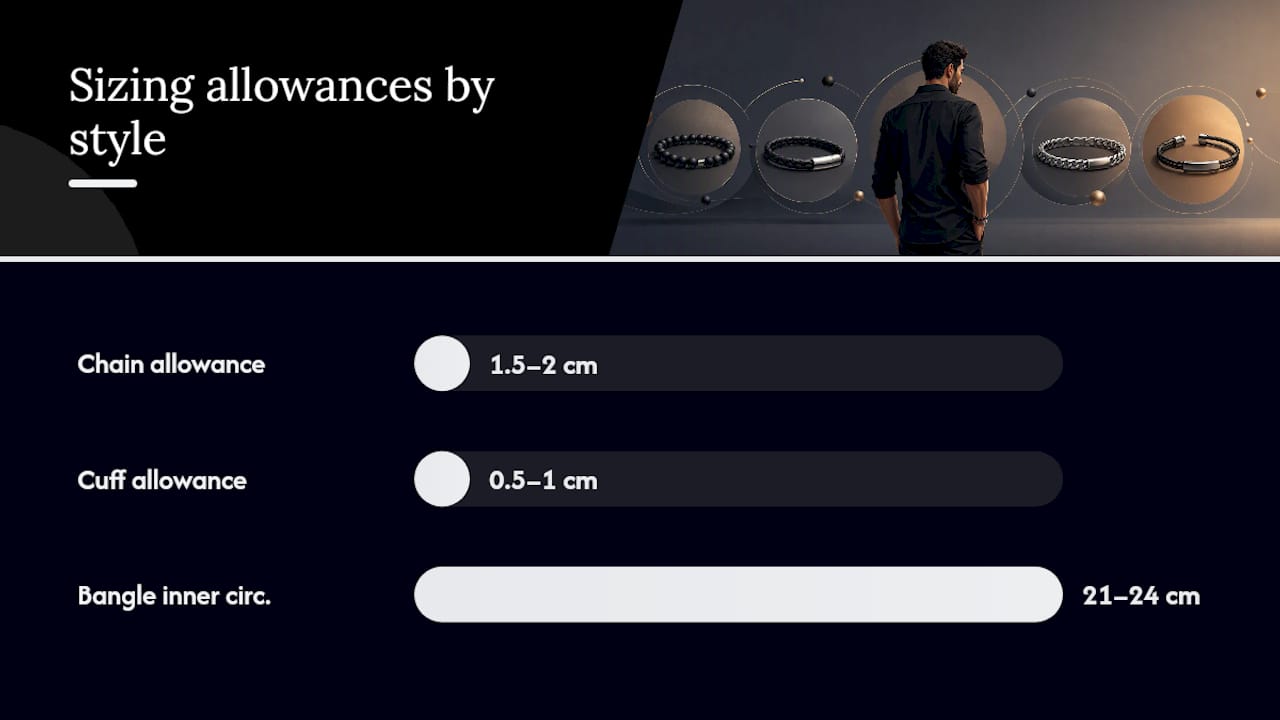
Cuff bracelets grip the wrist rather than hang loose, so they need far less allowance, typically just 0.5 to 1 cm beyond your measurement. A cuff’s inner curve is designed to hold its shape against the skin, and some cuffs flex open slightly for a small adjustable range, so check the product notes before assuming a fixed size.
Rigid bangles follow an entirely different rule. Because a bangle has no clasp, it has to slide over your entire hand to get on, which means it needs to clear your closed fist, not just your wrist. Measure your hand at its widest point with your thumb tucked against your palm. Most men need a bangle with an inner circumference between 21 and 24 cm to get it on comfortably without forcing it over the knuckles.
A few fit checks work across every style:
- One-finger rule: you should be able to slide one finger between the bracelet and your wrist at rest
- Clasp rotation: the clasp shouldn’t constantly spin to the top of your wrist; if it does, the bracelet may be sized too loose
- Wrist bone clearance: the bracelet should slide on and off over your wrist bone without forcing, but not fall off on its own
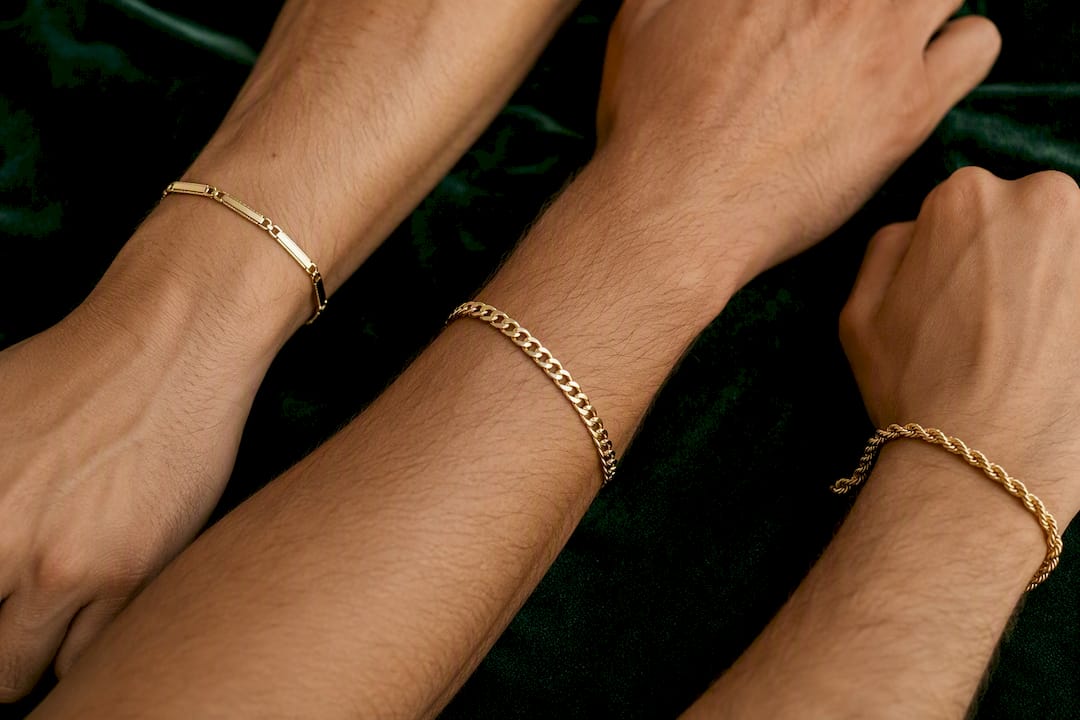
Width matters too. A wide curb chain or statement-link bracelet carries visual weight that a slim rope chain doesn’t, so a bold, heavier design can sit slightly shorter than a thin chain without ever looking tight.
Mistakes That Lead to the Wrong Bracelet Size
Nearly every bracelet return traces back to one of a handful of avoidable errors, and ordering the raw wrist number without any allowance is the most common one by far. A bracelet sized exactly to your wrist measurement won’t close, let alone move naturally.
Other frequent slip-ups:
- String stretch. A piece of string can stretch slightly under tension, inflating your measurement. A tape measure avoids this problem entirely.
- Wrong placement. Measuring an inch above or below the wrist bone changes the number enough to throw off your size.
- Temperature timing. Wrists can swell slightly in heat or after exercise, so a cold-morning measurement and a post-workout measurement can differ by close to half a centimeter.
- Ignoring the clasp. Some listed lengths don’t account for the clasp hardware, quietly shrinking your actual fit.
- Trusting a default size. A generic “20 cm” listing isn’t universal. It’s a starting point, not a guarantee.
If your measurement falls between two standard sizes, round up rather than down. A slightly loose bracelet is comfortable; a slightly tight one is not. If you already own a bracelet that runs too big or small, look for adjustable links, a removable-link design, or a jeweler who offers professional resizing.
Pro Tip: Keep your measurement written down after you take it. Wrist size doesn’t change often, but knowing your number saves you from re-measuring every time you shop.
How Baker Gold Chains Applies These Sizing Rules
Baker Gold Chains specializes in authentic, solid gold bracelets and chains crafted from 10K, 14K, and 18K gold, sourced from reputable U.S. suppliers. Every product listing states the finished length and the material specifications up front, so you can apply the allowance rules above directly to what you’re browsing.
- Product pages list total finished length, wire gauge, and karat weight so you know exactly what you’re measuring against
- A 14K yellow gold curb chain ID bracelet at 8.5 inches illustrates how a wider link style reads differently on the wrist than a slim design at the same length
- The brand’s chain length guide walks through the same measuring principles covered here, adapted for necklace and bracelet buyers alike
A bracelet that fits well doesn’t announce itself. It sits, moves, and clasps without you thinking about it, which is exactly the standard every listed length on Baker Gold Chains is built to meet.
Why Most Sizing Advice Undersells the Style Question
The conventional wisdom on bracelet sizing treats it as a single number problem: measure your wrist, add a fixed amount, done. That advice isn’t wrong, but it’s incomplete in a way that causes real returns. The allowance you add should depend entirely on what you’re buying. A half inch that works perfectly for a chain will make a cuff gap awkwardly at the wrist, and it does nothing to help you size a bangle, which ignores wrist measurement almost entirely in favor of fist clearance.
What gets underestimated most is width. Two bracelets at the identical length can wear completely differently depending on how heavy and wide the links are. A slim rope chain at 8.5 inches feels looser than a bold curb chain at the same length, because visual weight changes perceived tightness even when the tape measure says otherwise.
If you take one thing from this guide, take this: measure once, measure at the wrist bone, and then let the bracelet style dictate the allowance, not a one-size-fits-all rule you read somewhere else.
— Blayne
Find Your Fit at Baker Gold Chains
Baker Gold Chains gives you the exact finished length and karat weight on every bracelet listing, so the measuring steps above translate directly into a confident order instead of a guess. That transparency matters more with solid gold pieces, where a return means shipping real gold back and forth rather than a cheap costume piece you’d just toss.
If you’ve already measured your wrist and landed on a comfort fit around 8 inches, a mariner link bracelet in 14K gold shows how a mid-weight link wears at that length, backed by a lifetime craftsmanship guarantee and free insured shipping on qualifying orders. Browse the current bracelet selection, check the finished length listed on any piece against your own measurement, and order the size that matches your comfort fit rather than the default.
Sources
This guide draws on established measuring methods and trade sizing standards, chosen because they reflect how retailers and jewelers actually calculate fit rather than generic size charts.
- Bracelet sizing guide - Plumb Club
- Standard Men’s Bracelet Size and Guidelines - MeasuringKnowHow
- Men’s bracelet sizing guide 2026 - STRUGA DESIGN
- How to measure bracelet size at home - Fitiny
- How to measure wrist size - wikiHow
Recommended
- Designer Bold Width Bracelet in 14K Yellow Gold (24.60 mm) – Baker Gold Chains
- 14k Yellow Gold 8 1/2 inch Mens Wide Curb Chain ID Bracelet (10.00 mm) – Baker Gold Chains
- 14k White Gold Solid Curb Bracelet (4.70 mm) – Baker Gold Chains
- 14k Two-Tone Gold Mens Bracelet with S Style Bar Links (7.85 mm) – Baker Gold Chains

