

Are Box Chains Strong Enough for Everyday Wear?
A properly made, solid box chain is one of the most durable necklace styles you can buy for everyday wear and medium-weight pendants. Three things decide whether that holds true for your specific chain:
- Solid vs hollow construction, metal karat (10K, 14K, 18K), and gauge in millimeters — get these right and a box chain outlasts most other styles.
- Repairability matters too — a well-made box chain is easy to maintain but harder to fix once a link is crushed.
A box chain isn’t the right pick for very heavy pendants, rough physical activity, or situations with a high risk of snagging.
Key Takeaways
Box chain durability depends primarily on solid versus hollow construction, metal karat, and gauge in millimeters, in that order of importance.
| Point | Details |
|---|---|
| Solid beats hollow | Solid box chains resist crushing and are repairable; hollow chains dent easily and often can’t be fixed. |
| Match gauge to pendant weight | Use 1.5 to 2.2mm for medium pendants and 2.5mm or more for heavy statement pieces. |
| Repairs leave stiff spots | Soldering a crushed link fixes the break but usually creates a segment that no longer drapes naturally. |
| Box chains trade flexibility for strength | They resist tangling and stretching better than cable chains but flex less than rope or wheat styles. |
| Check specs before buying | Bakergoldchains lists solid construction, karat, and gauge on every box chain product page, backed by a lifetime craftsmanship guarantee. |
Table of Contents
- What Is a Box Chain, and How Is It Made?
- Why Do Box Chains Resist Snapping and Stretching?
- How Do Box Chains Compare to Other Popular Styles?
- What Determines How Long a Box Chain Actually Lasts?
- What Gauge Should You Choose for Your Pendant?
- How Do You Care for and Repair a Box Chain?
- How Do You Choose a Durable Box Chain?
- How Does Baker Gold Chains Support Long-Term Durability?
- Find a Box Chain Built to Last
- Frequently Asked Questions
- Sources
What Is a Box Chain, and How Is It Made?
A box chain is built from square or cube-shaped links, folded and interlocked so each one sits flush against the next. That flush fit is what gives the chain its smooth, boxy profile and its resistance to kinking.
Manufacturers start with rolled wire, flatten it, then fold it into a square link and interlock it with the next before soldering the seam. The result is a chain that lies flat, doesn’t twist during wear, and resists tangling far better than open-link designs like cable chains, according to reference material on chain types.
You’ll typically find box chains sold in:
- 10K, 14K, and 18K gold (the most common purity options for daily wear)
- Sterling silver, often with rhodium plating for a brighter finish
- Solid or hollow construction — the single biggest factor separating a chain that lasts decades from one that dents on day one
Why Do Box Chains Resist Snapping and Stretching?
Box chain strength comes down to geometry. Each square link locks into the next at a 90 degree angle, creating a cubic lattice that spreads tensile load across multiple links instead of concentrating stress at one weak point. That’s a structural advantage cable chains, with their looser oval links, don’t have in the same way.
This consistent link shape also reduces the micro-stretching and kinking that plague open, unevenly shaped links over years of wear. Manufacturing guidance on box versus cable chains notes that box chains distribute tensile load differently than cable-style chains and can support heavier pendants when the folding and soldering meet proper tolerances.
That tolerance detail matters more than most buyers realize. Loose folding or an uneven solder seam creates gaps between links that quietly reduce the chain’s effective strength, even when the metal itself is high quality. Watch for:
- Links that look slightly misaligned or gapped under light
- Rough or visible solder seams instead of a smooth join
- Inconsistent link size along the chain’s length
There’s a trade-off worth knowing before you buy: box chains are strong but relatively stiff compared with softer, more flexible styles like rope or wheat chains. You’re gaining tensile resistance and giving up a bit of drape.
How Do Box Chains Compare to Other Popular Styles?
Chain style changes the durability equation more than most shoppers expect. Here’s how box chains stack up against the styles you’ll see most often:
- Box vs rope: Rope chains flex more and tangle less on layering, but box chains hold their shape better under pendant weight.
- Box vs curb: Curb chains have flatter, twisted links that wear well but show scratches faster; box chains resist surface wear a bit longer.
- Box vs Franco: Franco chains use a similar interlocking logic and rival box chains for strength, though Franco tends to run pricier at the same gauge.
- Box vs wheat: Wheat chains are more flexible and better for delicate layering, but they’re generally weaker under sustained pendant load.
- Box vs cable: Cable chains are the most tangle-prone and least suited to heavier pendants of the group.
If you’re carrying a medium pendant on a daily basis, box chains outperform most of these options. For a very heavy statement piece, though, a Cuban or Franco link at a comparable gauge may serve you better.
What Determines How Long a Box Chain Actually Lasts?
Durability isn’t one property. It’s the sum of four variables you can actually check before buying.
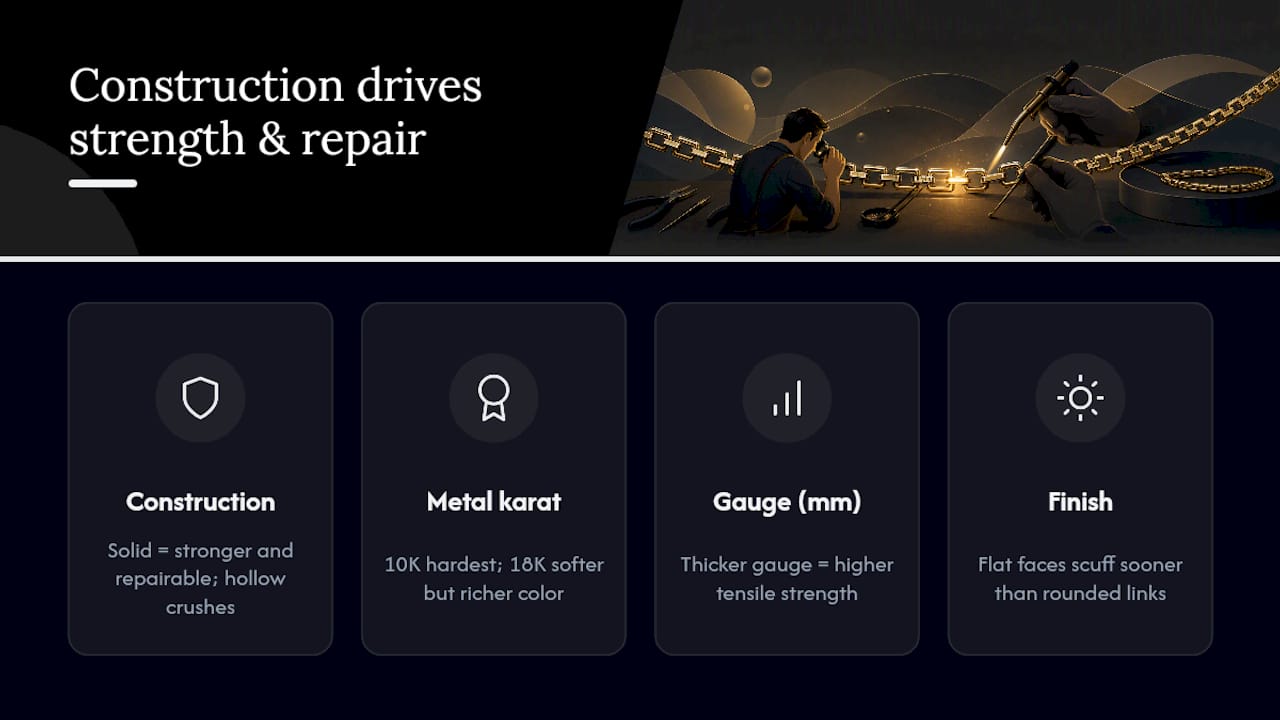
Solid vs hollow construction decides almost everything else. Solid box chains carry real metal all the way through the link, which makes them stronger and, importantly, repairable. Hollow chains are lighter and cheaper but crush under far less pressure, and testing that rates box chains overall as “Good to Very Good” for strength specifically flags solid construction as the deciding factor.
Metal type and karat set the hardness-to-malleability ratio. 10K gold is the hardest of the common options and resists dents well; 18K is softer and more prone to marking but offers superior color and value. 14K sits in the middle and is the most common everyday choice for a reason.
Gauge, measured in millimeters, is the most direct driver of tensile strength. Thicker gauge chains support heavier pendants and resist stretching under tension.
Finish and plating affect how the chain ages. The flat faces on box links show scuffing sooner than rounded profiles like rope, since there’s more flat surface exposed to friction.
Pro Tip: If you wear your chain daily and clip a pendant onto it, size up one gauge from what a jeweler recommends for “occasional wear.” That extra margin absorbs the stress of constant on and off.
What Gauge Should You Choose for Your Pendant?
Matching gauge to use case prevents the two most common regrets: a chain that snaps under a pendant it can’t support, or one so heavy it feels like overkill for a light layering piece.
- Everyday, no pendant or a light charm (under 1 gram): 1.0 to 1.5mm is plenty and keeps the chain comfortable for daily wear.
- Medium pendants (1 to 5 grams, a small cross or initial charm): Step up to 1.5 to 2.2mm for reliable support without added bulk.
- Heavy pendants (over 5 grams, statement medallions or dense gemstone settings): Look for 2.5mm or thicker, ideally in solid 14K or 18K for the added durability.
- Layering multiple thin chains: Stay under 1.5mm per chain so the stack doesn’t feel heavy or stiff.
For anything approaching a genuinely heavy heirloom piece, consider an anchor or Cuban link instead. Those styles are built specifically to carry weight that would overwork a box chain at any reasonable gauge.
How Do You Care for and Repair a Box Chain?
Routine care is straightforward, and most of it is just avoiding avoidable damage.
- Store it flat or hanging, never crumpled in a drawer where links can crush against each other.
- Remove it before sports, sleep, and manual work where snagging or sharp tension is likely.
- Clean solid gold with warm water and mild soap; be gentler with rhodium-plated pieces, since aggressive cleaning wears the plating faster.
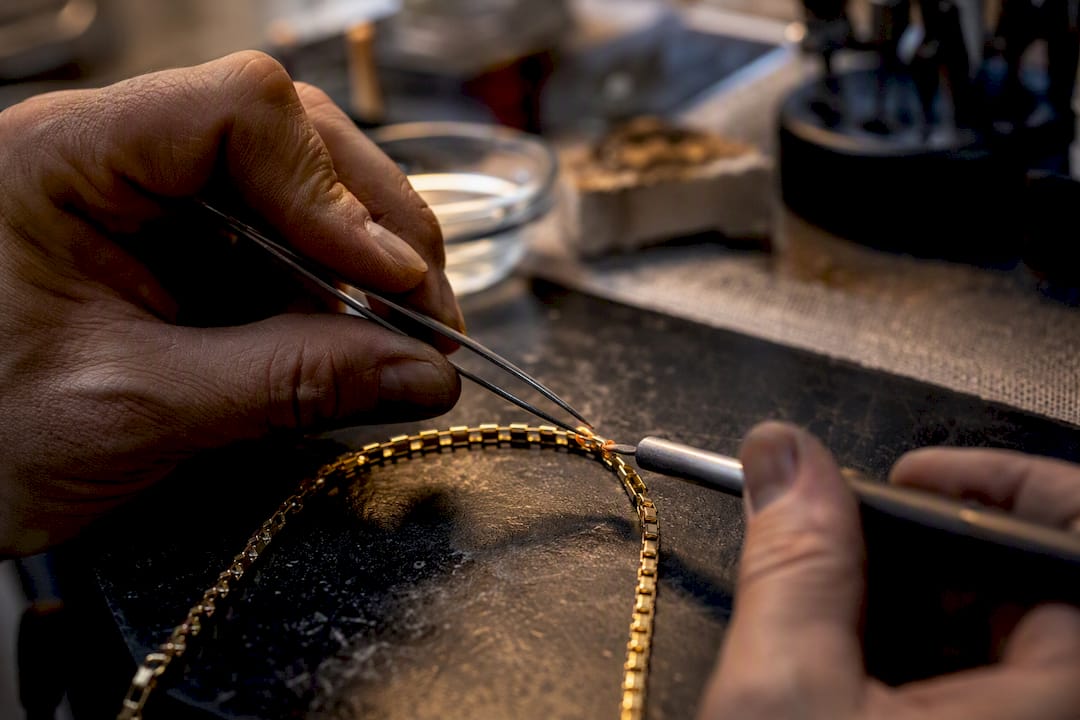
Repair is where expectations need to be realistic. A jeweler can resolder a broken link, but repair specialists report that fixing a crushed box link often leaves a slightly stiff spot where the chain no longer drapes quite the same. That’s a physical limitation of soldering, not a sign of a bad repair job.
Replace the chain if you see repeated wear at the same point, multiple flattened links, or a clasp that’s stretched loose. One clean repair is normal. Three is a sign the chain’s outlived its gauge.
How Do You Choose a Durable Box Chain?
Run through this checklist before you buy, whether you’re shopping online or in a store:
- Solid vs hollow stamp: Confirm the listing explicitly states solid construction.
- Karat mark: Look for 10K, 14K, or 18K stamped on the clasp or tag.
- Gauge in mm: A specific number, not a vague “medium” or “thick” description.
- Solder and link finishing: Smooth, even joins with no visible gaps.
- Warranty or craftsmanship guarantee: A sign the seller stands behind the piece long term.
- Return policy: Especially important for online purchases you can’t inspect first.
Red flags include missing metal stamps, “solid gold” claims at prices that don’t match gold’s actual market value, and thin gauge chains marketed for heavy pendants. Ask the retailer directly: is this solid or hollow, what’s the exact gauge, and what does the warranty cover?
How Does Baker Gold Chains Support Long-Term Durability?
Bakergoldchains builds its box chain selection around the exact factors that determine longevity. Every listing specifies solid construction, karat, and gauge upfront, so you’re not guessing at what you’re buying.
- Solid 10K, 14K, and 18K gold box chains with no hollow-construction guesswork
- Transparent product specs, including gauge in millimeters, listed on every product page
- A lifetime craftsmanship guarantee backing the metal and construction
- Free insured shipping on qualifying orders
A piece like the 18K Yellow Gold Classic Box Chain at 0.85mm shows exactly this kind of spec transparency in practice. When you’re comparing sellers, the metal purity stamp, the solid construction label, and a real warranty are the three signals worth checking first.
A Jeweler’s Take on What Actually Breaks
In practice, the box chains that come back for repair almost always failed the same way: a crushed link from catching on a zipper or seatbelt, not a clean snap from normal wear. Buy the right gauge for your pendant the first time, because a soldered repair on a crushed link never quite bends the same way again.
Find a Box Chain Built to Last
You’ve seen what actually determines durability: solid construction, the right karat, and correct gauge for your pendant. Bakergoldchains built its entire box chain lineup around exactly those three specs, so you’re never guessing at what’s holding up your pendant.
Every box chain listing states its gauge in millimeters and karat plainly, and it’s backed by a lifetime craftsmanship guarantee plus a straightforward return policy if it’s not the right fit. Whether you need a chain for a medium gold pendant or a lightweight daily piece, browse Bakergoldchains’ solid box chain collection and check the specs against the checklist above before you commit.
Frequently Asked Questions
Are box chains strong enough for daily wear? Yes. A solid box chain in the right gauge holds up well to daily wear, resisting the tangling and kinking that affect looser link styles.
How strong are box chains compared to rope chains? Box chains hold their shape better under pendant weight, while rope chains flex more and resist tangling slightly better during layering.
What gauge box chain do I need for a medium pendant? A gauge between 1.5mm and 2.2mm typically supports pendants in the 1 to 5 gram range without excessive stress on the links.
Can a broken box chain link be repaired? Yes, but soldering a crushed link often leaves a stiff spot that changes how the chain drapes at that point.
Does hollow construction affect box chain durability? Significantly. Hollow box chains are lighter and less expensive but crush much more easily than solid construction and are harder to repair.

