

Gold Chain Link Density Explained: Weight, Strength & Style
What is gold chain link density and why does it matter?
Gold chain link density refers to how compactly the individual links are packed within the chain’s total volume. The tighter the links sit against each other, the denser the chain. That single factor shapes almost everything you care about when buying a gold necklace: how heavy it feels, how strong it is, how it drapes on your neck, and how much gold you’re actually getting for your money.
Here’s what link density directly controls:
- Weight: Denser chains contain more gold per inch, so they weigh more. A loosely linked chain of the same length and karat will feel noticeably lighter.
- Strength: Tightly packed, interlocking links distribute stress across more contact points, making the chain harder to break under tension.
- Flexibility: Higher density often means less movement between links, which reduces how freely the chain bends and drapes.
- Style: Dense chains look bolder and more substantial. Lighter, open-link chains read as delicate and refined.
- Value: More gold per unit of length means a higher price, but also a stronger case for long-term value as a wearable asset.
Understanding link density helps you cut through marketing language and evaluate a chain on its actual physical merits. A chain that looks thick can still be hollow and low-density inside. Knowing the difference protects your purchase.
Table of Contents
- How link density affects chain weight and strength
- How link density shapes flexibility, comfort, and style
- How do common gold chain styles compare by link density?
- What experts say about solid vs. hollow chains and how to verify density
- Link density, price, and the trade-offs you should know
- Key Takeaways
- Bakergoldchains carries solid gold chains built to last
How link density affects chain weight and strength
Denser chains weigh more because they contain more solid gold per link. A 5mm solid 14K Cuban link chain typically weighs between 30 and 35 grams, while a hollow version of the same width weighs only 10 to 12 grams. That’s not a minor difference in feel. It’s the difference between a chain that reads as a serious piece of jewelry and one that feels like costume wear.

Weight is only part of the story. Tensile strength, which is how much pulling force a chain can withstand before breaking, scales with how the links interlock. Curb and Cuban link chains with tightly interlocking designs resist bending and kinking far better than open-link styles like herringbone or snake chains. The dense contact between links means force gets spread across the whole chain rather than concentrating at one weak point.
Karat also plays a role, but it’s a separate dimension from link density. Higher-karat gold is denser by nature: 24K gold measures approximately 19.3 g/cm³, while 14K yellow gold falls between 12.9 and 14.6 g/cm³ depending on the alloy mix. A 14K chain with very dense link packing can still outweigh a loosely linked 18K chain of the same length.
Pro Tip: When shopping for a chain you plan to wear daily, prioritize solid construction over visual width. A narrower solid chain will outlast a wider hollow one and can be repaired by a jeweler if a link ever breaks. Hollow chains cannot be soldered once dented or crushed.
How link density shapes flexibility, comfort, and style
Higher link density tends to reduce flexibility. When links are packed tightly, there’s less room for each one to pivot or rotate, so the chain moves as a more unified structure rather than a fluid strand. That rigidity is a feature for some styles and a drawback for others.
Common chain types and their flexibility profiles:
- Cuban link: Very dense, minimal pivot between links. Lays flat and rigid against the chest. Comfortable for most wearers because it doesn’t twist or tangle.
- Curb link: Similar to Cuban in density, with flattened links that interlock closely. Slightly more flexible than Cuban depending on width.
- Rope chain: Twisted link construction creates a moderately dense chain with good flexibility. Moves fluidly but can kink under pressure.
- Box chain: Square links connected at right angles. High density, very low tangle risk, and a clean flat drape.
- Figaro: Alternating short and long links create variable density along the chain. More flexible than curb at the same width.
- Herringbone: Flat, tightly woven links with almost no pivot. Extremely rigid and prone to kinking if bent sharply.
Style follows directly from these properties. Dense, rigid chains like Cuban and curb links project a bold, structured look. They hold their shape against the chest and work well as statement pieces worn solo. Lighter, more flexible chains like rope and Singapore styles catch light differently as they move, giving a more dynamic, sparkling appearance. For layering, chain necklace styles with moderate density tend to work best because they drape at different depths without tangling.
Comfort is also tied to density. A very dense, heavy chain can feel fatiguing over a long day. A hollow chain feels light but may feel insubstantial. The sweet spot for most everyday wearers is a solid chain with moderate link density that offers real weight without strain.
How do common gold chain styles compare by link density?
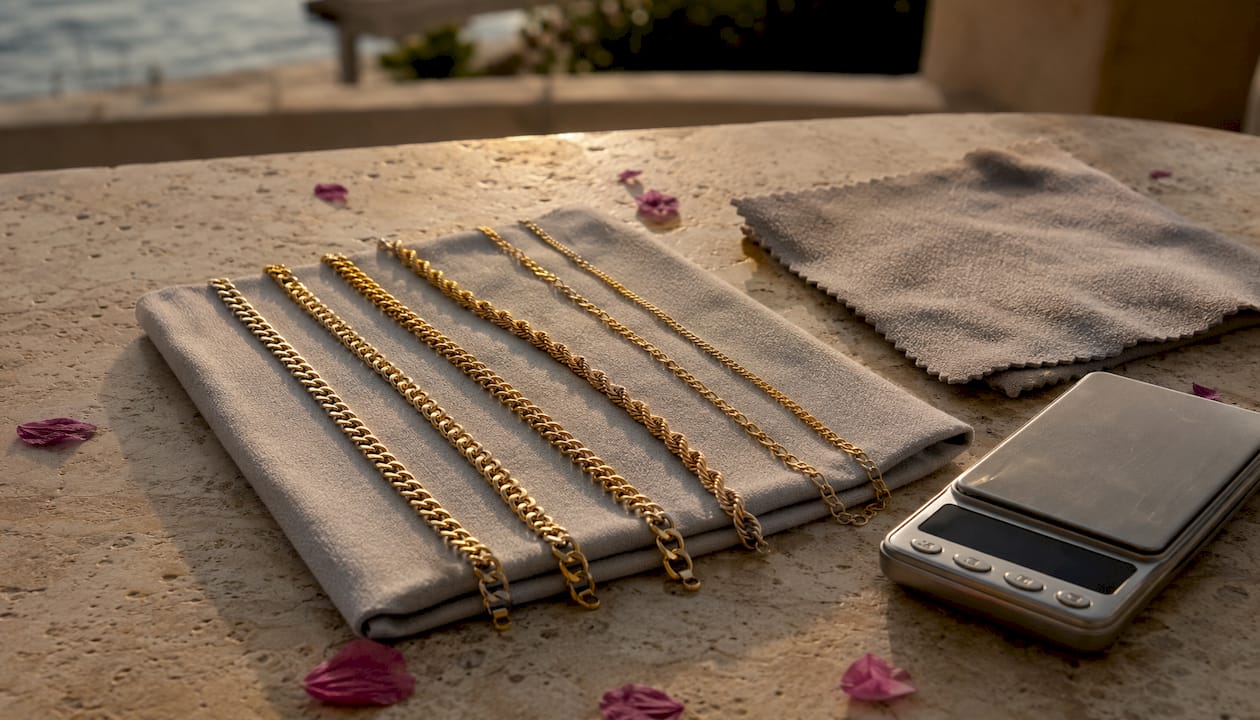
The table below covers the most popular gold chain link types and where each falls on the density spectrum.
| Chain Style | Typical Width | Link Density | Durability | Best Use |
|---|---|---|---|---|
| Cuban link | 4–12mm | Very high | Excellent | Solo statement, heavy pendants |
| Curb link | 2–10mm | High | Very good | Men’s and unisex, everyday wear |
| Box chain | — | High | Excellent | Daily wear, all pendant sizes |
| Rope chain | 2–5mm | Moderate | Good | Statement, layering base |
| Figaro | 2–5mm | Moderate | Very good | Solo wear, men’s styles |
| Franco | 2–5mm | Very high | Excellent | Active wear, heavy pendants |
| Byzantine | 4–6mm | Very high | Excellent | Statement solo, gifts |
| Herringbone | 2–6mm | High (surface) | Poor | Occasional wear only |
| Snake chain | 1–4mm | Moderate | Fair | Minimalist, formal occasions |
Cuban and Franco links sit at the top of the density scale. Their interlocking construction leaves almost no empty space between links, which is why they’re the preferred choice for carrying heavy pendants. A rigid, dense structure holds a pendant centered and upright rather than letting it slide or flip. Box chains achieve similar pendant stability through their square-link geometry despite a narrower profile.
Herringbone is a special case worth flagging. It looks dense because the flat links lie flush against each other, but that same flatness makes it extremely vulnerable to kinking. One sharp bend can permanently crease the chain. High visual density does not always mean high structural density.
For layering, pairing a dense Cuban or curb chain as the base with a lighter rope or Singapore chain above it creates visual contrast without tangling. The denser chain anchors the stack while the lighter one adds movement and sparkle.
What experts say about solid vs. hollow chains and how to verify density
The most important distinction in gold chain construction is not style or karat. It’s whether the chain is solid or hollow. Solid chains have nearly 100% gold volume throughout each link. Hollow chains contain air pockets inside the links, which reduces their effective density and makes them fragile under real-world conditions.
Industry experts recommend solid gold chains for durability and repairability. A solid link that breaks can be soldered back together by a jeweler. A hollow link that dents or crushes cannot be repaired because the heat required to solder collapses the thin walls. That’s a permanent loss.
Here’s how to verify gold density at home using a specific gravity test:
- Weigh the chain dry. Use a kitchen scale accurate to 0.01 grams. Record this number as your dry weight.
- Suspend the chain in water. Fill a glass with water. Tie the chain with a fine thread and hang it fully submerged without touching the sides or bottom. Record the submerged weight.
- Apply the formula. Specific gravity equals dry weight divided by the difference between dry weight and submerged weight: SG = Wdry ÷ (Wdry − Wwet).
- Compare to known values. Pure 24K gold reads 19.30–19.32 g/cm³. A 14K yellow gold chain should fall between 12.9 and 14.6 g/cm³. A result far below the expected range for the stated karat indicates diluted alloy content or a hollow construction.
- Pair with a hallmark check. Look for a karat stamp such as 585 (14K) or 750 (18K) on the clasp or a link near the clasp.
One important limitation: tungsten has a density of approximately 19.25 g/cm³, just 0.4% below pure gold. A gold-plated tungsten core will pass a density test alone. Combining the specific gravity test with a visual hallmark inspection and, for high-value pieces, an X-ray fluorescence (XRF) reading gives you reliable confirmation. For everyday jewelry purchases, the density test paired with a hallmark check covers the vast majority of authenticity concerns.
You can also verify gold purity using additional at-home methods including the magnet test and ceramic scratch test, which together with density testing give a thorough picture of what you’re buying.
Link density, price, and the trade-offs you should know
Denser chains cost more, and the reason is straightforward: more gold per inch means more raw material. A solid 14K Cuban link chain at 5mm will carry a noticeably higher price tag than a hollow chain of the same width, even from the same retailer. That price gap reflects a real difference in gold content, not just branding.
The trade-off is weight versus cost. If you want the look of a wide, bold chain but prefer a lighter feel, a hollow or semi-solid chain delivers that visually without the weight or price of a fully solid version. The risk is durability. Hollow chains dent under pressure, cannot be repaired, and lose their shape faster with daily wear.
There’s also a value dimension worth considering. Solid gold chains hold their melt value because the gold content is real and consistent throughout. A hollow chain, despite its higher visual impact, contains less actual gold and therefore less intrinsic value. If you’re buying a chain as both jewelry and a long-term asset, solid gold chains offer a much stronger case.
For buyers on a tighter budget, a narrower solid chain at a lower karat, such as a 2mm 10K curb link, delivers genuine durability and real gold content at a lower price than a wide hollow chain. The narrower width keeps the gold weight down while the solid construction keeps the chain repairable and long-lasting. That’s a smarter trade-off than paying for visual bulk that can’t survive daily wear.
Pro Tip: Ask your jeweler or retailer for the gram weight of any chain before buying. A chain’s gram weight is the most direct measure of its gold content and value. Two chains that look identical can differ by 20 or more grams depending on whether they’re solid or hollow.
Key Takeaways
Link density is the single most important structural factor in evaluating a gold chain, because it determines weight, strength, repairability, and long-term value simultaneously.
| Point | Details |
|---|---|
| Density drives weight | A solid 14K Cuban link at 5mm weighs 30–35 grams; a hollow version of the same width weighs only 10–12 grams. |
| Solid beats hollow every time | Solid chains can be soldered and repaired; hollow chains collapse under heat and cannot be fixed once dented. |
| Karat sets the baseline density | Pure 24K gold measures 19.3 g/cm³; 14K yellow gold falls between 12.9 and 14.6 g/cm³ depending on alloy. |
| Style and density are linked | Cuban and Franco links are the densest and most durable; herringbone looks dense but kinks permanently under pressure. |
| Bakergoldchains | Bakergoldchains offers solid 10K, 14K, and 18K gold chains with a lifetime craftsmanship guarantee, sourced from reputable U.S. suppliers. |
Bakergoldchains carries solid gold chains built to last
Knowing how link density works is only useful if you can actually find chains that deliver on it. Bakergoldchains specializes in solid 10K, 14K, and 18K gold chains, the kind where the gram weight reflects real gold content throughout every link, not air pockets and thin walls.

Every chain in the Bakergoldchains catalog is sourced from reputable U.S. suppliers and backed by a lifetime craftsmanship guarantee. That guarantee means something specific: if a link fails under normal wear, it gets fixed. That’s only possible with solid construction. The 14K yellow gold pendant chain with textured links at 3.3mm is a strong starting point if you want a solid chain with real density and pendant compatibility. Free insured shipping applies to orders over $150, and flexible financing is available if you want to invest in a heavier, denser chain without paying all at once. Browse the full collection at Bakergoldchains and check the gram weight on any chain you’re considering. That number tells you exactly what you’re getting.
Recommended
- Solid vs Hollow Gold Chains Explained | Which Should You Buy? – Baker Gold Chains
- Gold Chain Styles Explained | Cuban vs Rope vs Franco Chains – Baker Gold Chains
- Gold chain necklace types: durable styles for collectors – Baker Gold Chains
- How chain style impacts durability, quality, and design – Baker Gold Chains

