

How to Verify Gold Purity: Methods That Actually Work
Gold purity verification is the process of confirming how much pure gold a piece contains, expressed in karats or millesimal fineness, before you buy or invest. You can verify gold purity confidently using hallmark inspection, acid test kits, and X-ray fluorescence (XRF) analysis. Each method serves a different purpose, from quick at-home screening to lab-grade confirmation. This guide walks you through every technique so you know exactly which one to use and when. Whether you are buying a 14K chain or evaluating inherited jewelry, the right approach protects your money and your trust.
What is gold purity and how is it measured?
Gold purity is defined as the proportion of pure gold in a metal alloy, measured by the karat system or millesimal fineness. Pure gold is 24 karats. Most jewelry uses alloys because pure gold is too soft for daily wear.
Millesimal fineness denotes parts per thousand of pure gold, making it more precise than the karat scale. Professional refiners prefer it for appraisals and high-value transactions. A piece stamped “750” contains 750 parts per thousand of gold, which equals 18K. A “585” stamp means 58.5% gold, or 14K.
Here are the most common purity markings you will find on jewelry and bullion:
- 999 or 24K: 99.9% pure gold, used in bullion bars and coins
- 916 or 22K: 91.6% gold, common in Indian and Middle Eastern jewelry
- 750 or 18K: 75% gold, popular in fine European jewelry
- 585 or 14K: 58.5% gold, the most common standard in American jewelry
- 417 or 10K: 41.7% gold, the legal minimum for gold jewelry in the United States
Hallmarking is the official process of stamping these marks on jewelry after independent verification. In India, the Bureau of Indian Standards (BIS) mandates hallmarking on all gold jewelry sold since mid-2021, giving buyers legal protection. In the United States, the Federal Trade Commission (FTC) sets labeling standards that sellers must follow.
How to verify gold purity with visual and hallmark checks
The first step in any gold purity verification is a visual inspection. You look for a karat stamp, usually found on the clasp of a necklace, the inner band of a ring, or the back of a pendant. Common stamps include “14K,” “585,” “750,” or “18K.” A magnifying glass helps you read faint or small engravings clearly.
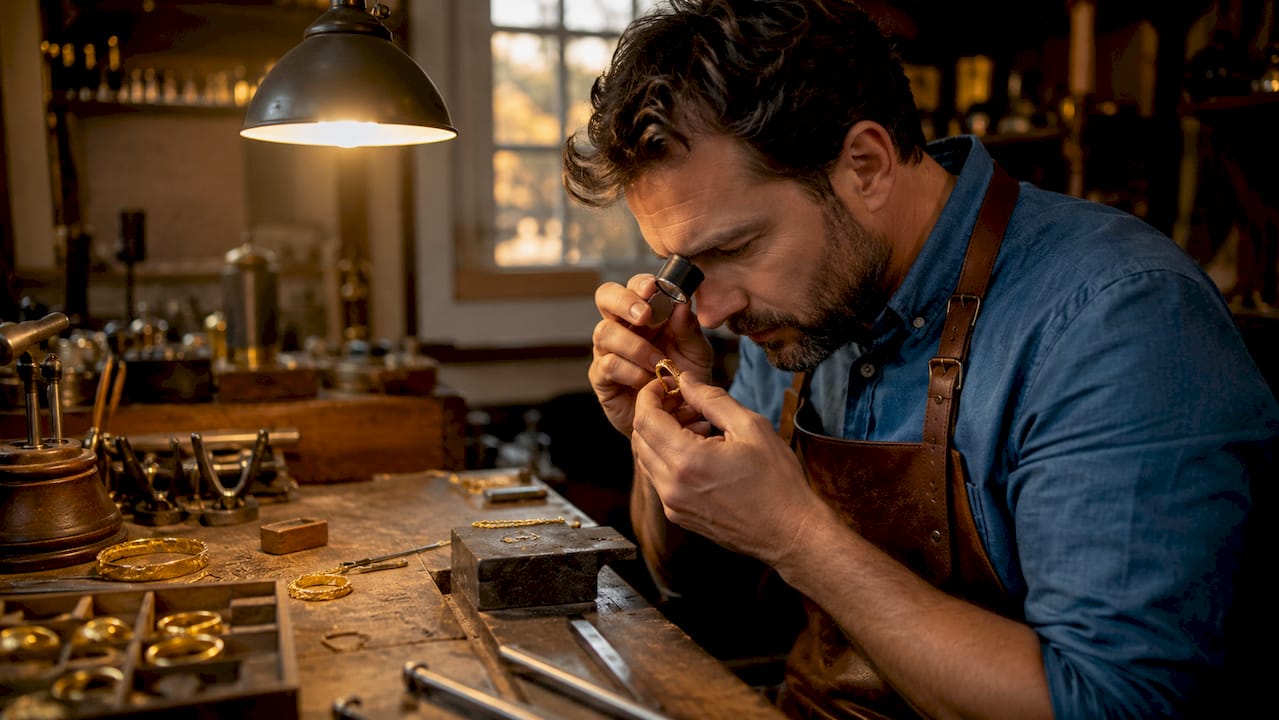
Hallmark stamps tell you the claimed purity, but they do not guarantee it on their own. Modern counterfeiters can laser-etch hallmarks like “18K” or “750” onto low-quality alloy or gold-plated items. This means a stamp alone is not proof of authenticity.
To counter forgery, cross-check the stamp against an official database. The BIS Care mobile app allows free, instant hallmark verification using the Hallmark Unique Identification (HUID) code printed on BIS-certified jewelry. The app returns the jeweler name, purity grade, and hallmarking date so you can confirm the piece matches official records.
Watch for these red flags during visual inspection:
- Discoloration or green marks on the skin after wearing, which suggest base metal beneath a thin gold layer
- Stamps that look uneven, blurry, or inconsistently placed
- Missing hallmarks on pieces claimed to be solid gold
- Plating marks such as “GF” (gold-filled) or “GP” (gold-plated) near the karat stamp
Pro Tip: Use a jeweler’s loupe at 10x magnification to read hallmarks clearly. Counterfeit stamps often show rough edges or shallow depth compared to genuine factory stamps.
The magnet test is a fast, free screening tool. Gold is not magnetic. If a piece pulls strongly toward a magnet, it contains significant amounts of iron or nickel. However, a piece that does not attract a magnet is not automatically real gold. Many non-gold metals, like copper and aluminum, are also non-magnetic.
Home testing methods: what works and what to watch out for
Home testing gives you a second layer of confirmation beyond visual checks. No single home test is definitive, but combining two or three methods narrows down the likelihood of a fake significantly.
Acid testing
- Rub the piece firmly against a black touchstone to leave a gold streak.
- Apply a drop of acid matched to the karat you are testing (10K, 14K, or 18K acid).
- Observe the reaction. Real gold at the correct karat resists the acid. A fake or lower-karat piece dissolves or changes color.
Acid testing kits cost $30–$80 and are more accurate than magnet or float tests. The tradeoff is a minor surface scratch on the piece and the need to handle corrosive chemicals safely. Always wear gloves and work in a ventilated area.
Density testing
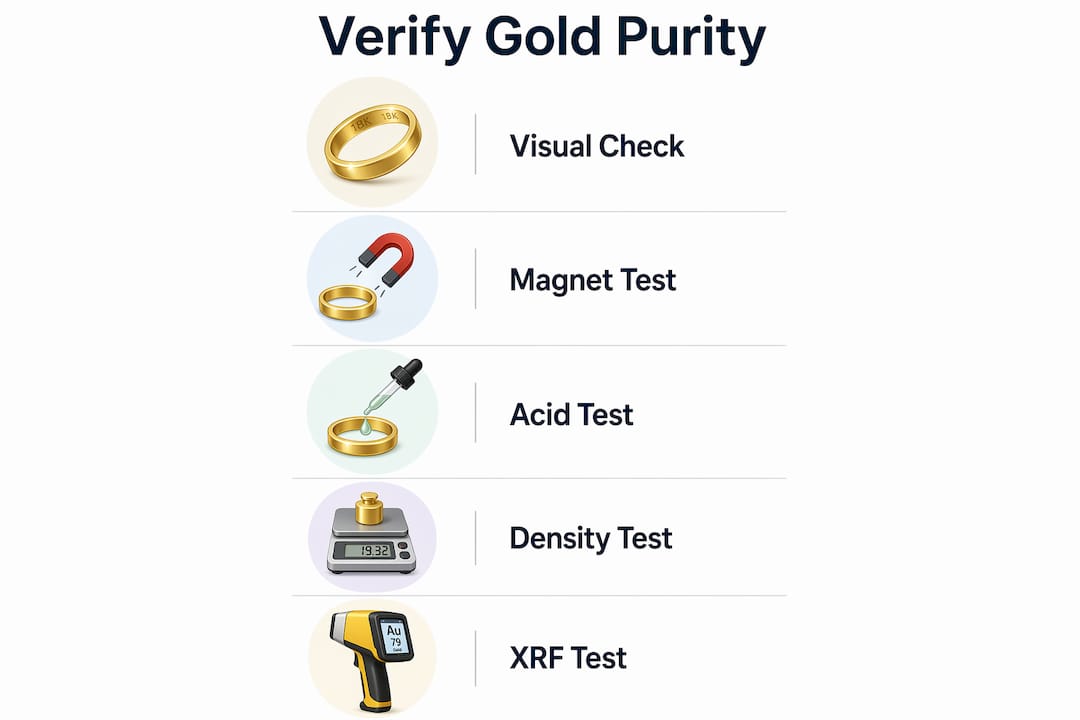
Gold has a density of 19.3 grams per cubic centimeter, far denser than most metals used in fakes. You weigh the piece in air, then weigh it submerged in water, and calculate density from the difference. The math is straightforward, but hollow designs or alloy mixtures skew the result. A hollow gold chain will show a lower density than solid gold even if it is genuine.
Electronic gold testers
Electronic testers use electrical conductivity to estimate karat. They are fast and non-destructive. Accuracy varies by brand and price point. Budget models under $50 give rough readings. Professional-grade units used by jewelers are more reliable but cost several hundred dollars. Electronic testers work best as a screening tool, not a final verdict.
Pro Tip: Never rely on just one home test. Run the magnet test first to rule out obvious fakes, then follow with an acid test or density check for a stronger result. Layering methods gives you far more confidence than any single test alone.
Here is a quick comparison of home test reliability:
- Magnet test: Fast and free, but only screens for ferrous metals. Many fakes pass it.
- Float test: Gold sinks in water. Useful only for detecting very light fakes. Dense non-gold metals also sink, so this test has limited value.
- Acid test: More accurate than magnet or float. Causes minor surface damage. Best for confirming karat range.
- Density test: Good in theory, unreliable for hollow or composite pieces.
- Electronic tester: Convenient, but accuracy depends heavily on the device quality.
Professional gold purity testing: XRF and fire assay compared
Professional testing removes the guesswork entirely. Two methods dominate: X-ray fluorescence (XRF) and fire assay. Each has a specific role depending on what you need confirmed and how much you are willing to spend.
XRF testing: the non-destructive standard
XRF testing is the most reliable non-destructive method for verifying gold purity. The process takes 15–30 seconds and costs $20–$50 per test at most jewelry stores and assay offices. The machine fires X-rays at the surface of the piece and reads the elemental composition back, identifying exact percentages of gold, silver, copper, and other metals.
XRF is fast, accurate, and leaves the piece completely undamaged. It is the preferred method for verifying jewelry before purchase, resale, or insurance appraisal. Most reputable jewelers and pawn shops own XRF machines or have access to one.
The one limitation is depth. XRF reads surface composition, so a thick gold-plated item can fool the machine if the plating is deep enough. For hollow coins, bars, or items you genuinely suspect of being plated over a base core, fire assay is the more definitive choice.
Fire assay: the definitive but destructive test
| Feature | XRF Testing | Fire Assay |
|---|---|---|
| Accuracy | Very high for surface composition | Near 100% for total gold content |
| Destructive? | No | Yes, requires a small sample |
| Cost | $20–$50 per test | $50–$150 or more |
| Turnaround | 15–30 seconds | Hours to days |
| Best for | Jewelry, coins, bars | Bullion, high-value investment pieces |
| Availability | Most jewelers and assay offices | Specialized assay labs |
Fire assay destructively tests a small sample of the metal to obtain gold content with near 100% accuracy. A tiny portion of the piece is dissolved and chemically analyzed. The result is the most precise purity reading available. Fire assay is reserved for high-value bullion, disputed appraisals, or situations where absolute certainty is required.
For most jewelry buyers, XRF is the right call. For investors buying gold bars or coins in quantity, fire assay provides the certainty that protects large sums of money.
Where to find professional testing: Ask at local jewelry stores, pawn shops, or certified assay offices. The American Society of Jewelry Appraisers (ASJA) maintains a directory of credentialed appraisers who offer XRF and other testing services.
Common mistakes when checking gold purity and how to avoid them
The biggest mistake buyers make is trusting a hallmark stamp without any additional verification. Legal tolerances allow items stamped with a specific purity to vary by up to half a karat without violating labeling regulations. That means a “14K” stamp does not guarantee exactly 58.5% gold content.
Here are the most common pitfalls and how to sidestep them:
- Trusting stamps alone: Always cross-verify with a database check or physical test. Stamps are a starting point, not a conclusion.
- Overrelying on the magnet test: Many non-gold metals are also non-magnetic. A piece that does not attract a magnet still needs further testing.
- Ignoring hollow or plated construction: Density tests and XRF surface readings can both mislead you on hollow or plated items. Ask the seller directly whether a piece is solid or hollow.
- Skipping professional testing on high-value purchases: Reliable gold purity verification requires layering multiple test methods, from hallmarks and home tests to professional XRF or assay testing for high-value pieces. A $30 acid kit is fine for a $200 chain. A $5,000 investment piece deserves XRF confirmation.
- Buying from sellers who refuse testing: Any reputable seller welcomes independent verification. Resistance to testing is a red flag.
Pro Tip: Before buying gold online, ask the seller for an XRF test certificate or a third-party appraisal report. Legitimate retailers provide this documentation without hesitation. You can also learn more about spotting fake gold chains to sharpen your eye before you shop.
Key takeaways
Reliable gold purity verification requires combining hallmark inspection, home testing, and professional XRF or fire assay analysis to confirm authenticity with confidence.
| Point | Details |
|---|---|
| Start with hallmarks | Locate the karat stamp and cross-check it against an official database like the BIS Care app. |
| Layer home tests | Use the magnet test first, then follow with acid or density testing for stronger screening. |
| Use XRF for certainty | XRF testing costs $20–$50 and gives non-destructive elemental analysis in under 30 seconds. |
| Reserve fire assay for bullion | Fire assay is near 100% accurate but destructive; use it only for high-value investment pieces. |
| Never trust stamps alone | Legal tolerances allow purity to vary by up to half a karat, so independent testing always matters. |
Why I think most buyers skip the most important step
I have seen a lot of gold change hands, and the pattern is consistent. Buyers check the stamp, feel the weight, and call it done. That works fine when you are buying from a jeweler you have trusted for twenty years. It falls apart fast when you are shopping online or at an estate sale.
The step most people skip is the XRF test. It costs less than a dinner out, takes thirty seconds, and gives you a precise elemental breakdown of exactly what you are holding. Yet buyers routinely spend hundreds or thousands of dollars on gold jewelry without ever asking for one. The reasoning I hear most often is that the stamp looks right and the price seems fair. Neither of those things confirms purity.
What I have found actually works is treating hallmark inspection as the opening question, not the final answer. The stamp tells you what the seller claims. The XRF test tells you what the metal actually contains. Those two things should match. When they do not, you have learned something worth knowing before the money leaves your account.
For inherited pieces or estate jewelry, I always recommend professional testing before resale or insurance appraisal. Stamps on older pieces can be worn, restamped, or simply wrong due to old labeling standards. A $30 acid kit gives you a reasonable screen. A professional XRF result gives you something you can stand behind. If you want to go deeper on buying solid gold jewelry with confidence, the research is worth your time before you commit.
— Blayne
Shop verified gold jewelry at Bakergoldchains
Every piece at Bakergoldchains is sourced from reputable U.S. suppliers and verified for purity before it ships to you. You do not have to wonder whether the karat stamp matches the metal inside. The work is already done.
Browse the collection and find pieces you can buy with full confidence. The 14K yellow gold pendant chain is a strong starting point for anyone who wants solid, everyday gold at a proven purity level. For a classic fine jewelry option, the graduated bead necklace in 14K yellow gold combines timeless design with guaranteed authenticity. Free insured shipping applies on orders over $150, and a lifetime craftsmanship guarantee backs every purchase.
FAQ
What is the fastest way to check gold purity at home?
The magnet test is the fastest home check. Hold a strong magnet near the piece. Real gold shows no magnetic attraction. Follow up with an acid test kit for a more reliable result.
How accurate is XRF testing for gold jewelry?
XRF testing provides exact elemental composition in 15–30 seconds without damaging the piece. It is the most accurate non-destructive method available and costs $20–$50 per test at most jewelers.
Can a hallmark stamp be faked?
Yes. Counterfeiters can laser-etch stamps like “18K” or “750” onto low-quality alloys. Always cross-verify a hallmark against an official database or request a physical test before purchasing.
What does millesimal fineness mean on a gold piece?
Millesimal fineness shows parts per thousand of pure gold. A stamp of “585” means 585 parts per thousand, equal to 14K gold. Professionals prefer this system because it is more precise than the karat scale.
When should I use fire assay instead of XRF?
Use fire assay when you need near-perfect accuracy on bullion, bars, or coins where surface-level XRF readings may not reflect the full metal composition. It is destructive but delivers results close to 100% accuracy.

