

How U.S. Suppliers Shape Jewelry Quality and Authenticity
U.S. suppliers are the backbone of jewelry quality, authenticity, and ethical sourcing in the American market. They enforce strict manufacturing standards, verify metal purity through regulated hallmarking, and maintain transparent supply chains that overseas producers rarely match. When you buy from a brand that sources domestically, you get more than a piece of jewelry. You get documented quality at every stage of production.
Here is what U.S. suppliers bring to the table:
- Regulatory compliance with FTC jewelry guides covering quality marks and precious metal content
- Multi-stage inspections across casting, stone setting, polishing, and plating
- Ethical certifications like RJC and Sedex 4-Pillar for verified labor and environmental standards
- Faster collaboration through shared time zones and direct site access
- Transparent supply chains that let you verify where your gold actually comes from
Bakergoldchains sources its solid gold pieces from reputable U.S. suppliers, backing every purchase with a lifetime craftsmanship guarantee and full material transparency.
How U.S. suppliers define jewelry quality standards
The FTC’s 16 CFR Part 23 sets the legal floor for jewelry quality marks in the United States. Every karat stamp, “sterling” label, or “platinum” designation must accurately reflect the metal’s composition. Misrepresenting those marks violates Section 5 of the FTC Act, and U.S. suppliers at every level of the trade are bound by these rules.
Beyond legal compliance, reputable domestic manufacturers run quality checks at multiple production stages. Casting, stone setting, polishing, and plating each get their own inspection protocols, with dedicated QA personnel separate from the craftspeople doing the work. That separation matters because it removes the conflict of interest that plagues self-checked production lines.
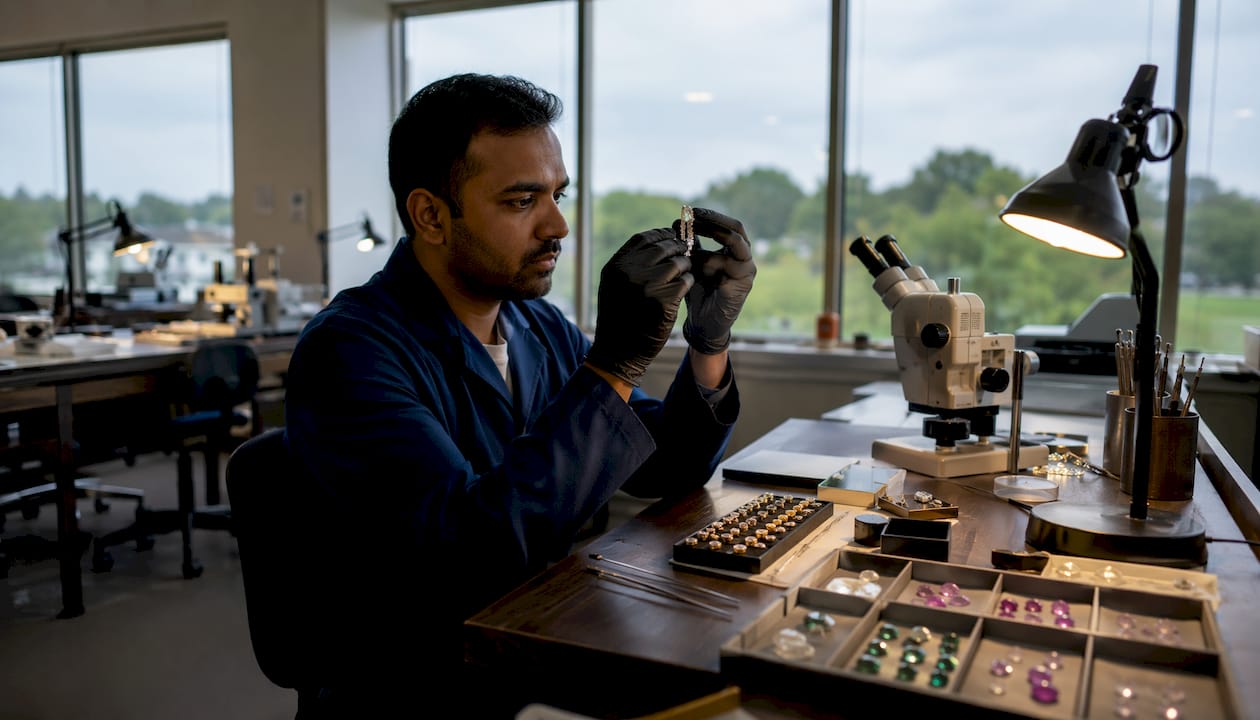
Pro Tip: When evaluating a jewelry brand, ask whether their supplier uses XRF testing. X-ray fluorescence analyzers verify metal composition and plating thickness without damaging the piece, giving you objective proof of what you are actually buying.
One real challenge U.S. suppliers face: the FTC’s “all or virtually all” standard makes a strict “Made in USA” label nearly impossible for most jewelry, since raw gold, gemstones, and brass rarely originate domestically. The honest answer is that domestic value lies in design, engineering, and quality control, not raw material geography.
- ISO 9001 certification documents continuous quality improvement across production batches
- XRF analyzers catch plating inconsistencies before pieces ship
- CAD design and 3D printing improve dimensional accuracy and reduce handmade variation
- Laser engraving adds precise hallmarks that stay legible over time
Why sourcing from U.S. suppliers benefits you as a buyer
-
Supply chain transparency. U.S. suppliers offer verifiable sourcing that lets brands document every production step. You can ask questions and get real answers.
-
Ethical labor standards. Certifications like RJC membership and Sedex 4-Pillar require independent audits covering labor practices, health and safety, and environmental impact.
-
Consumer demand alignment. 78% of American consumers verify ethical diamond sourcing before buying, increasing demand for verifiable ethical supply chains. U.S. suppliers make that verification possible.
-
Faster turnarounds. Domestic production means no ocean freight delays, no customs holds, and direct communication when a design needs adjustment.
-
Inventory reliability. U.S. manufacturers maintain more predictable stock availability, which matters for e-commerce brands and buyers expecting consistent restocks.
-
Brand trust and premium positioning. Verified ethical sourcing supports higher price points and long-term customer loyalty, particularly in fine and investment-grade jewelry categories.
How do U.S. suppliers compare with overseas manufacturers?
| Factor | U.S. suppliers | Overseas suppliers |
|---|---|---|
| Quality control access | Direct site visits, real-time feedback | Limited oversight, longer feedback loops |
| Lead times | Shorter, more predictable | Longer, subject to shipping delays |
| Ethical certification | RJC, Sedex 4-Pillar common | Varies widely by region and factory |
| FTC compliance | Built into domestic operations | Requires additional verification |
| Cost per unit | Generally higher | Generally lower |
| Supply chain risk | Lower geopolitical exposure | Higher exposure to tariffs and disruptions |
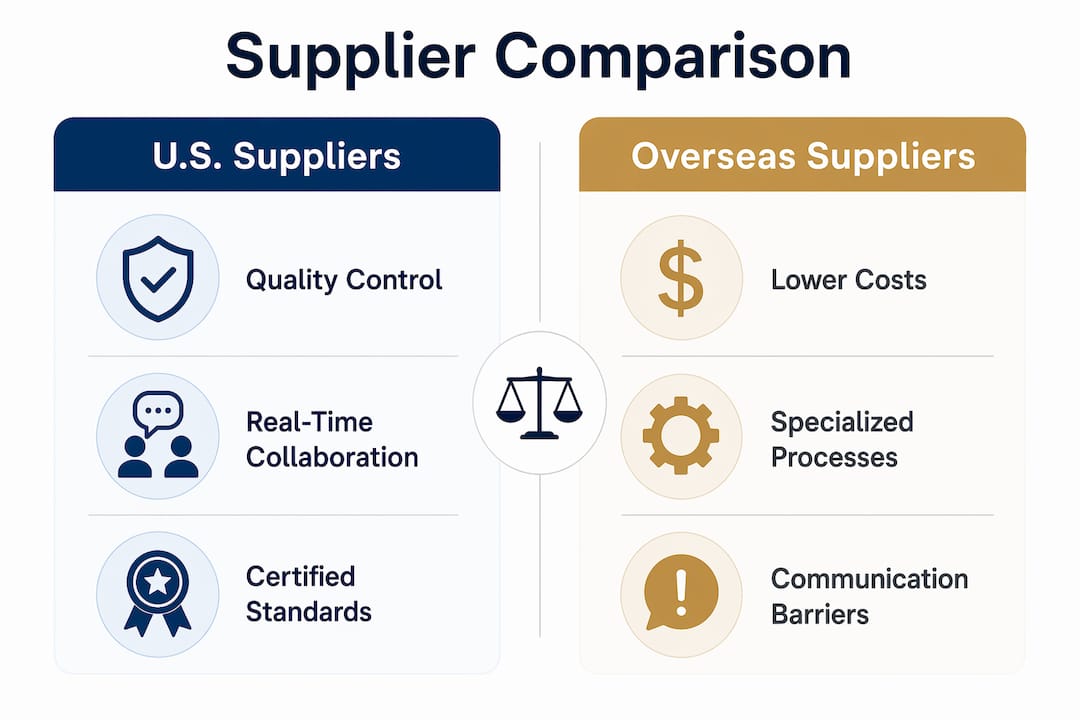
Overseas production can offer lower per-unit costs, and some specialized processes like large-scale diamond cutting remain concentrated abroad. The U.S. imported over $89 billion in gems and jewelry in 2024, reflecting how global the supply chain still is. Many brands now use hybrid models, prototyping domestically for quality control while scaling certain staple styles offshore. For fine and investment-grade pieces, though, domestic production delivers a level of oversight that is genuinely difficult to replicate at a distance.
Domestic production gives brands real-time collaboration and stricter standards that overseas manufacturing’s communication delays make hard to match.
What certifications and technologies back U.S. supplier quality?
Credible U.S. suppliers do not rely on reputation alone. They back their quality claims with documented systems and third-party verification.
- ISO 9001 certification proves a supplier has structured quality management with continuous improvement built in
- RJC membership requires third-party supply chain audits covering responsible sourcing and ethical labor
- XRF testing equipment verifies metal composition and plating thickness without damaging finished pieces
- Sedex 4-Pillar audits cover labor rights, health and safety, environment, and business ethics independently
- CAD and 3D printing reduce human error in design replication and improve consistency across production runs
- Multi-level QA roles separate inspection from production, catching defects before they reach you
These systems work together. A supplier with ISO 9001 and XRF testing can prove batch-to-batch consistency with documented data, not just a verbal assurance. That kind of paper trail is what separates a trustworthy supplier from one that simply claims quality.
Bakergoldchains partners with U.S. suppliers who meet these standards, so every piece you receive carries the craftsmanship and authenticity you expect. Explore the Graduated Bead Necklace in 14K Yellow Gold as one example of what verified domestic sourcing looks like in a finished piece.
Key Takeaways
U.S. suppliers strengthen jewelry quality through regulatory compliance, multi-stage inspection, and verified ethical sourcing that overseas producers rarely replicate at the same level.
| Point | Details |
|---|---|
| FTC quality marks | 16 CFR Part 23 requires all karat and metal labels to match actual composition. |
| Multi-stage inspections | U.S. suppliers check quality at casting, stone setting, polishing, and plating stages. |
| Ethical certifications | RJC and Sedex 4-Pillar audits verify labor and environmental standards independently. |
| Consumer demand | 78% of American consumers verify ethical diamond sourcing before buying. |
| Domestic advantages | Shorter lead times and direct site access give buyers and brands real quality control. |

