

How to identify and buy premium gold jewelry
Not all gold jewelry is created equal, and the price tag alone will not tell you why. Two necklaces can share the same karat stamp yet differ dramatically in durability, resale value, and long-term wearability. One might be solid through and through, with clean solder joints and a crisp hallmark. The other could be hollow, lightly finished, and destined to dent after a few months of regular wear. Understanding what separates true premium gold jewelry from ordinary pieces gives you the confidence to spend wisely, whether you are buying for yourself, choosing a meaningful gift, or building a collection worth holding onto.
Table of Contents
- What defines premium gold jewelry?
- How gold purity and construction impact value
- Hallmarks, craftsmanship, and spotting fakes
- Buying strategies for premium gold jewelry
- Why most shoppers get premium gold jewelry wrong (and how to get it right)
- Find your next premium gold piece
- Frequently asked questions
Key Takeaways
| Point | Details |
|---|---|
| Not all gold is premium | Only solid 14k or 18k jewelry with expert craftsmanship, hallmark, and solid construction qualifies as premium. |
| Purity isn’t everything | The best premium pieces balance gold content with durability and superior build. |
| Verify before you buy | Look for authentic hallmarks, reputable sellers, and quality documentation to ensure real value. |
| Trust construction over karat | A solidly made 14k piece often outperforms a poorly built higher-karat one for daily wear. |
What defines premium gold jewelry?
With the myth that all gold jewelry is equal out of the way, let’s break down what actually sets premium pieces apart from standard offerings.
Premium gold jewelry refers to high-quality, solid gold pieces typically in 14k (585, meaning 58.5% pure gold) or 18k (750, meaning 75% pure gold) alloys, distinguished by verified hallmarks, substantial solid weight distribution, and superior craftsmanship including clean soldering, smooth finishes, and durable construction. That definition matters because it sets a measurable standard. You are not just paying for a shiny surface. You are paying for material integrity and skilled execution.
Here is a side-by-side comparison that makes the difference concrete:
| Feature | Standard gold jewelry | Premium gold jewelry |
|---|---|---|
| Karat | 10k or lower | 14k or 18k solid |
| Construction | Hollow or plated | Fully solid |
| Finish | Machine-polished, rough edges | Hand-finished, smooth, even |
| Hallmarks | Missing or faded | Clear, verified, stamped |
| Clasp quality | Lightweight, prone to failure | Substantial, secure, tested |
| Weight distribution | Uneven, light | Consistent, dense |
When you hold a premium piece, you notice the weight immediately. It feels substantial in your hand. The finish catches light evenly, with no rough spots or visible seams. The clasp clicks shut with purpose. These are not accidental qualities. They result from deliberate choices in material selection and production.
Quick identifiers of a premium piece:
- Purity stamp: Look for 585 (14k), 750 (18k), or 417 (10k) stamped inside clasps or on inner surfaces.
- Weight: A solid gold chain should feel noticeably heavier than a hollow or plated alternative of the same size.
- Finish quality: Run your fingernail along the surface. Premium pieces have no ridges, sharp edges, or pitting.
- Clasp and joint integrity: Clasps should open and close smoothly without wobbling. Solder joints should be invisible.
- Symmetry: Links, prongs, and design elements should align evenly across the entire piece.
Only a small fraction of jewelry marketed as “gold” actually meets these premium standards. Plated and gold-filled pieces can look identical to solid gold at first glance, which is exactly why knowing these identifiers matters. You can also explore gold chain quality standards to see how these details translate into real pieces.
How gold purity and construction impact value
Once you know what to look for, understanding how gold’s purity and construction affect its performance will keep you from expensive mistakes.
Gold purity is measured in karats, with 24k representing pure gold. But pure gold is not the best choice for most jewelry. Here is how the common karat levels break down:
| Karat | Gold percentage | Common uses | Pros | Cons |
|---|---|---|---|---|
| 10k | 41.7% | Budget jewelry, fashion pieces | Most durable, affordable | Not considered premium, lower resale value |
| 14k | 58.5% | Everyday fine jewelry, chains | Balanced durability and purity | Slightly less pure than 18k |
| 18k | 75% | Engagement rings, luxury pieces | High purity, rich color | Softer than 14k, higher cost |
| 24k | 99.9% | Bullion, investment bars | Maximum purity | Too soft for rings, impractical for daily wear |
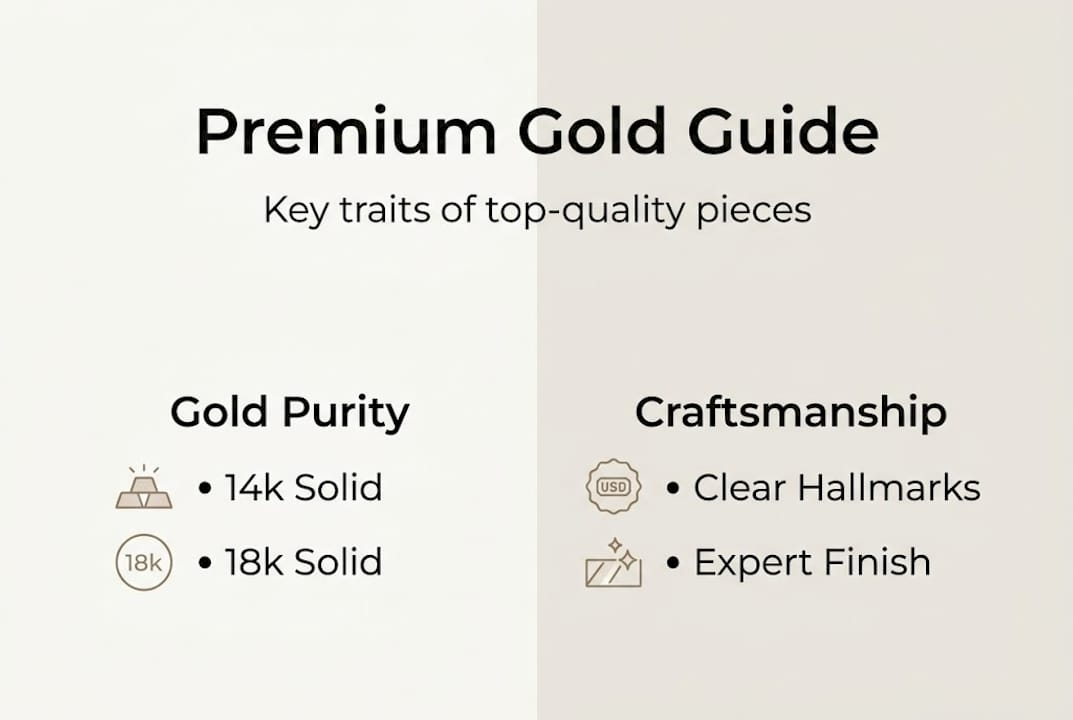
As the table shows, 24k gold scores highest on purity but lowest on wearability. At just 25 HV (Vickers hardness), it scratches and bends easily. It is best suited for investment bars or ceremonial pieces worn occasionally. Meanwhile, 10k gold sits at the legal minimum for gold labeling in the United States at 41.7% purity, which is why it does not qualify as premium despite being genuine gold.
The sweet spot for premium everyday jewelry is 14k or 18k. Both alloys blend gold with metals like silver, copper, or zinc to improve hardness without sacrificing the color and warmth that make gold desirable.
Construction type is just as important as karat. Here is how to inspect a piece and avoid common pitfalls:
- Ask about construction directly. A reputable seller will tell you immediately whether a piece is solid, hollow, or semi-solid. If they hesitate or deflect, that is a red flag.
- Weigh the piece. Gold is dense. A solid 14k chain of a given length and width has a predictable gram weight. If a piece feels unusually light, it is likely hollow.
- Check the price relative to gold spot value. If a piece is priced far below the current market value of the gold it would contain if solid, it almost certainly is not solid.
- Inspect the clasp area. Hollow chains often reveal their construction at the clasp, where the tube-like interior becomes visible.
- Look for dents or deformation. Hollow pieces dent under pressure. If a chain shows dents along its length, it is not solid.
“A high karat mark means very little without solid construction behind it. An 18k hollow chain is worth less in material terms than a 14k solid chain of the same weight.”
Pro Tip: When comparing two chains of the same length and style, ask for the gram weight of each. The heavier piece is almost always the better investment. You can learn more about understanding solid versus hollow jewelry to make sure you are comparing pieces on equal terms.
Hallmarks, craftsmanship, and spotting fakes
Beyond karats and construction, premium status relies on expert details you can spot in the flesh or with close examination.
Hallmarks are small stamps that tell you exactly what you are buying. In the United States, reputable jewelers stamp karat marks (585, 750, 417) along with a maker’s mark inside clasps, on ring shanks, or on the inner surface of bracelets. The stamp should be sharp and legible, not faded or partially worn away. A missing or blurry hallmark is one of the most reliable signs of a low-quality or misrepresented piece.

Premium pieces show even symmetry, secure clasps, no visible tool marks, and stress-resistant designs. Hollow or semi-solid construction reduces both value and durability compared to fully solid pieces. When you examine a chain or pendant under good lighting, you should see consistent link shapes, no rough spots at solder points, and a finish that looks the same from every angle.
Red flags to watch for:
- Faded or missing karat stamp: A legitimate solid gold piece always has a clear purity mark.
- Unusually low price: If the deal seems too good to be true, the piece is almost certainly plated or hollow.
- Suspicious return policy: Reputable sellers stand behind their products. A no-return policy on a gold piece is a warning sign.
- Weight that feels wrong: Pick up similar pieces and compare. Solid gold has a distinct heft.
- Discoloration at wear points: Gold plating wears through at friction points like clasps and edges, revealing base metal underneath.
- Overly perfect surface with no maker’s mark: Mass-produced fakes often have machine-polished surfaces but no identifying stamps.
Common traps include gold-filled and gold-plated pieces being sold as solid gold. Gold-filled jewelry has a layer of gold bonded to a base metal core, while gold-plated pieces have an even thinner coating. Neither holds value like solid gold, and both will eventually show wear.
Pro Tip: When in doubt, ask for third-party documentation or have the piece tested. XRF (X-ray fluorescence) testing is a non-destructive method that jewelers use to verify gold content accurately. Acid testing is another option, though it requires a small surface scratch. For pieces like quality settings in earrings, the setting itself should grip stones firmly with no wobble, and the prongs should be smooth and even.
Buying strategies for premium gold jewelry
Knowing how to spot “premium” is only half the battle. Here is how to apply this expertise when buying for yourself or others.
Seek AGS or GIA-aligned jewelers who can provide gram weight documentation, clear return policies, and authenticity certificates. Avoid any seller who cannot or will not provide these. If a piece is labeled solid but the seller refuses to share its gram weight, walk away.
Here is a practical buying checklist:
- Request gram weight documentation. A reputable seller documents the exact weight of each piece. This lets you verify value against current gold spot prices.
- Confirm the karat and construction in writing. Get it on the receipt or order confirmation: “solid 14k gold” or “solid 18k gold,” not just “gold.”
- Check the return and authenticity policy. Premium sellers offer meaningful return windows and stand behind their hallmarks.
- Compare prices to spot value. Use the current gold price per gram to estimate the minimum material value of a solid piece. A fair premium for craftsmanship is expected, but extreme markups or suspiciously low prices both deserve scrutiny.
- Ask about sourcing. Reputable retailers source from established U.S. suppliers and can tell you where their pieces originate.
“True premium transcends karat. Focus on solid construction, verifiable hallmarks from reputable makers, and engineering for stress points. Poor execution negates high purity every time.” This insight from GIA’s gold research reinforces what experienced buyers already know: the execution of a piece matters as much as its gold content.
For buyers focused on investment, prioritize solid construction, clear hallmarks, and pieces in 14k or 18k. These hold their material value and are easy to resell or appraise. For gifting, consider pieces with timeless design and strong craftsmanship. A gifting premium gold necklace or a well-crafted gold bracelet communicates care and lasting value in a way that fashion jewelry simply cannot.
For fashion buyers, the same rules apply. A solid gold piece that you wear every day will look better longer, resist tarnish, and remain a wardrobe staple for years. Hollow or plated alternatives may cost less upfront but often need replacement within a year or two.
Why most shoppers get premium gold jewelry wrong (and how to get it right)
The checklist above will steer you right, but let’s look at the deeper patterns that lead buyers astray, because the mistakes are surprisingly consistent.
Most buyers over-focus on karat and ignore construction entirely. They see “18k” and assume the piece is premium. But an 18k hollow chain can be worth a fraction of a 14k solid chain of the same length. The karat stamp tells you the gold percentage in the alloy. It says nothing about how much of the piece is actually gold versus empty space or base metal filler.
We have seen this play out repeatedly. A customer buys a visually impressive chain at a low price, drawn in by the 18k stamp. Within months, the chain dents, the clasp fails, and the piece loses its finish at wear points. The karat was real. The construction was not premium. That combination is more common than most shoppers realize.
Chains sold as “solid” often are not. The term is used loosely in the market. Some sellers use “solid gold color” to mean the piece looks gold throughout, not that it is made of solid gold. Others use “solid” to describe the chain style rather than the construction. Always ask specifically: “Is this piece made of solid gold throughout, with no hollow sections or base metal core?”
Brand pedigree and visible finish count nearly as much as gold percentage. A piece from a jeweler with a transparent sourcing policy, clear hallmarks, and a craftsmanship guarantee is worth more than an anonymous piece with a higher karat stamp. The finish quality you can see with your eyes reflects the quality you cannot see inside the metal.
The hardest lesson is this: ignore hallmarks at your peril, and never trust a deal that seems too good. Gold has a known market value. If a piece is priced well below what its solid gold weight would cost at spot price, something is missing, either the gold content, the construction quality, or both. For expert gold jewelry advice on what to look for and how to compare pieces, take the time to research before you buy. The few minutes you spend verifying a piece will protect you from years of regret.
Find your next premium gold piece
Now that you know how to spot true premium quality, here is where to find it.
At Baker Gold Chains, every piece in our collection is built on the principles you have read about here: solid construction, verified hallmarks, and finishes that hold up to real wear. We source exclusively from reputable U.S. suppliers, and every piece carries a lifetime craftsmanship guarantee.
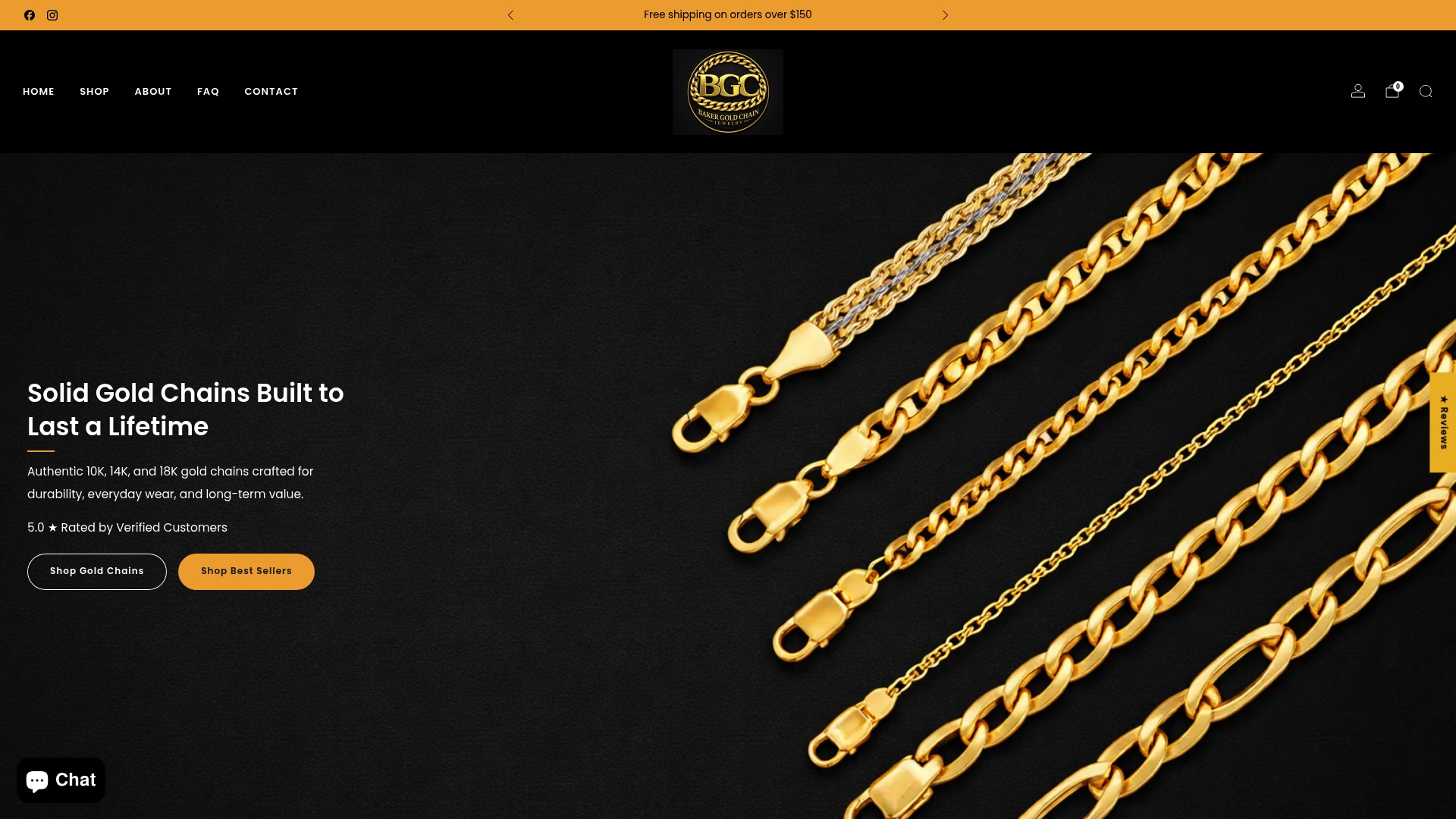
Whether you are looking for a solid 14k gold necklace for everyday wear, a pair of premium gold earrings as a meaningful gift, or a statement piece like our 14k byzantine chain that combines intricate craftsmanship with solid gold durability, you will find pieces that meet the premium standard at every level. Free insured shipping on orders over $150 and flexible financing options make it straightforward to invest in quality you can feel.
Frequently asked questions
Is 14k or 18k gold better for premium jewelry?
Both can be premium if solid and well-crafted. 18k is purer at 75% gold content, while 14k is more durable for everyday wear due to its harder alloy composition.
How can I spot fake or misrepresented solid gold jewelry?
Check for clear hallmarks, proper weight, and buy from reputable sources. Seek AGS or GIA-aligned jewelers and request gram weight documentation or XRF test results if you have any doubts.
Is 24k gold jewelry always premium?
24k gold is the purest form, but it is too soft for regular wear at just 25 HV hardness. Solid 14k or 18k pieces are generally the better choice for jewelry worn regularly.
Does premium always mean more expensive?
Premium gold jewelry does cost more upfront, but the extra value comes from durability, craftsmanship, and resale potential. Solid gold pieces hold their material value in a way that hollow or plated alternatives simply cannot match.

