

How to buy solid gold jewelry online safely and smartly
Buying gold online is convenient, but the risks are real. Counterfeit pieces, inflated prices, and vague product descriptions make it easy to spend good money on something that isn’t what you expected. Whether you’re shopping for a personal treat, a meaningful gift, or a piece that holds long-term value, knowing how to verify authenticity and evaluate sellers before you click “buy” is essential. This guide walks you through every step of the process, from understanding the difference between bullion and jewelry to placing your order with confidence and getting exactly what you paid for.
Table of Contents
- What to know before you buy: Types of solid gold and their value
- Step 1: How to choose a reputable online retailer
- Step 2: Evaluating costs, premiums, and authenticity
- Step 3: Placing your order and avoiding common mistakes
- The uncomfortable truth about buying gold jewelry online
- Explore high-quality gold jewelry for your next purchase
- Frequently asked questions
Key Takeaways
| Point | Details |
|---|---|
| Investment vs. gift | Choose bullion for investment value, jewelry for gifting and personal use. |
| Retailer trust | Prioritize reputable sellers with transparent pricing, support, and independent reviews. |
| Cost breakdown | Know the spot gold price, premiums, making charges, and additional fees before buying. |
| Authenticity checks | Always verify gold with certificates, hallmarking, and retailer guarantees. |
| Avoid mistakes | Double-check details, confirm shipping, and use third-party guidance for safer purchases. |
What to know before you buy: Types of solid gold and their value
Now that you understand the guide’s scope, let’s start by clarifying the two main types of solid gold you might buy online.
When people talk about “buying gold,” they often mean two very different things: bullion or jewelry. Each serves a different purpose, and mixing them up can lead to frustration and wasted money. Knowing which one suits your goals before you start browsing is the most important first step.
Bullion refers to gold bars and coins valued primarily by weight and purity. The price closely tracks the spot price of gold (the live market price per troy ounce), with a relatively small premium added by the dealer. Bullion is straightforward to value, easy to sell, and widely recognized. If your goal is purely to own gold as a financial asset, bullion typically gives you the most gold for your dollar.
Jewelry, on the other hand, is priced differently. As bullion experts note, jewelry includes making charges, craftsmanship premiums, and design costs that are layered on top of the raw gold value. These additions mean you pay more per gram of actual gold than you would for bullion. When you sell jewelry later, those extra charges rarely come back to you in full. However, jewelry offers something bullion never can: wearability, aesthetic value, emotional meaning, and the joy of giving or receiving a beautiful piece.
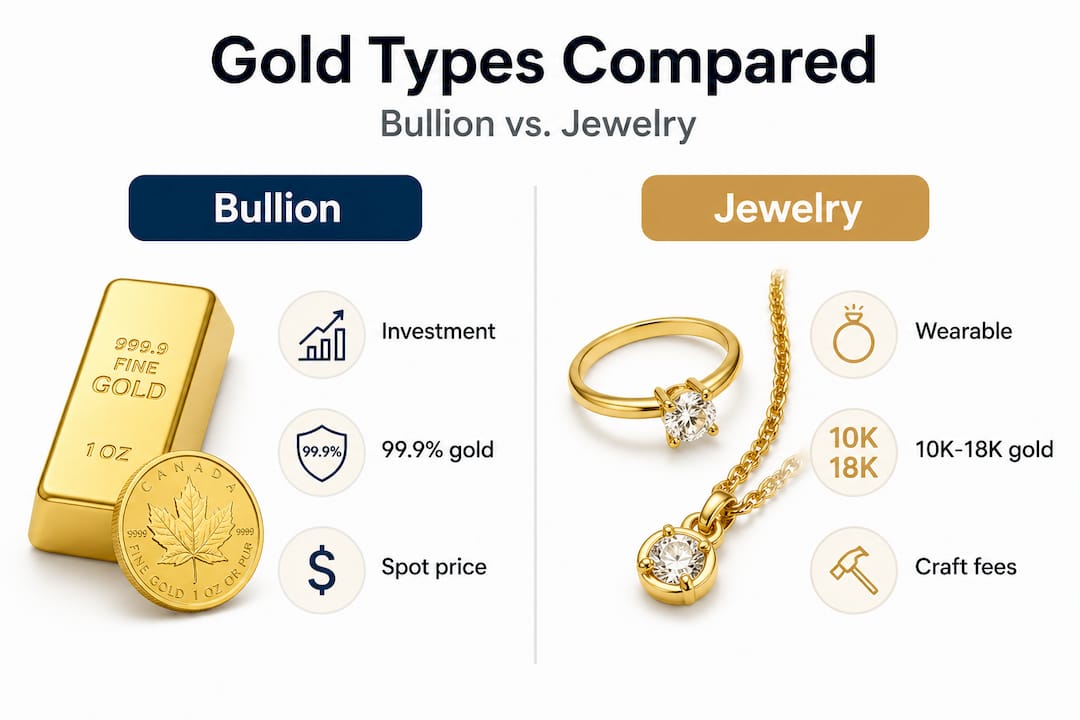
Here’s a quick comparison to help you decide:
| Feature | Bullion | Gold jewelry |
|---|---|---|
| Best for | Investment, wealth preservation | Gifts, personal wear, special occasions |
| Price basis | Spot price + small premium | Spot price + making charges + design |
| Resale ease | High | Moderate to low |
| Purity options | 99.9% (24K) | 10K, 14K, 18K |
| Emotional value | Low | High |
| Liquidity | High | Lower |
If you want a gift that lasts for decades, or a piece you’ll wear every day, choosing quality jewelry in 10K, 14K, or 18K gold makes the most sense. If you’re purely focused on tracking gold’s market value, bullion is the cleaner option.
Choosing your karat: Lower karats like 10K contain less gold but are more durable for everyday wear. Higher karats like 18K contain more gold and have a richer yellow color but are softer. For chains, bracelets, and rings that see regular use, 10K and 14K are the most practical choices.
Pro Tip: If you’re buying as a gift, solid gold jewelry in 14K is the sweet spot. It’s durable, beautiful, and carries enough gold content to feel genuinely valuable without the high price tag of 18K.
Step 1: How to choose a reputable online retailer
Once you’ve decided between bullion and jewelry, your next task is to ensure the seller is reputable and transparent.
This is where most buyers cut corners, and it’s also where most problems begin. The internet is full of sellers using terms like “gold-filled,” “gold-tone,” or “gold-plated” in ways that can mislead buyers who aren’t looking closely. Choosing the right retailer is just as important as choosing the right piece.
Third-party comparisons from sources like CNBC Select evaluate online gold retailers across key criteria: pricing transparency, fees, shipping costs, customer support responsiveness, and the quality of educational resources they provide. Using this kind of independent guidance narrows down your options quickly and flags which retailers are playing it straight with their customers.
Here’s what a trustworthy gold jewelry retailer looks like:
- Clear product descriptions: Karat stamp information, weight, dimensions, and metal composition are all listed upfront.
- Verifiable authenticity: Products come with certifications, hallmarks, or retailer guarantees that can be checked.
- Transparent pricing: No hidden fees. You can see what you’re paying for before checkout.
- Accessible customer support: Phone, email, or live chat that actually responds.
- Fair return and exchange policy: Written out clearly, not buried in fine print.
- Positive independent reviews: Look at Google Reviews, Trustpilot, or the Better Business Bureau (BBB), not just testimonials on the brand’s own website.
You’ll also want to explore a retailer’s articles and buying guides to gauge their knowledge level. A seller who invests in educating their customers is usually one who stands behind their products.
What to watch out for: Red flags include prices that seem too good to be true (they usually are), vague descriptions like “gold-colored” or “gold-style,” missing contact information, and return policies that require you to absorb shipping costs both ways. Check out how to identify premium jewelry before you commit to a purchase.
It also helps to look at retailer alternatives to see how different sellers compare on product quality, customer experience, and value for money. Comparing at least two or three sources before buying is a smart habit.
| Retailer quality indicator | Green flag | Red flag |
|---|---|---|
| Product descriptions | Karat, weight, dimensions listed | Vague or missing details |
| Pricing | Clear breakdown | Hidden fees at checkout |
| Customer reviews | Consistent, verified, third-party | Only on-site testimonials |
| Return policy | Written clearly | No returns or vague terms |
| Support | Multiple channels, fast response | Contact form only, no reply |
Step 2: Evaluating costs, premiums, and authenticity
After identifying a reputable seller, it’s crucial to decipher gold pricing and ensure you’re getting genuine products.

Understanding what you’re actually paying for is one of the most overlooked parts of buying gold online. Many buyers look at the price and assume it reflects quality. It often reflects something else entirely.
Understanding the spot price: The spot price of gold is the live global market rate for one troy ounce of pure gold. Every piece of gold you buy, whether it’s a bar or a bracelet, is priced in relation to this number. The spot price changes daily, so it’s worth checking it on the day you’re shopping.
Premiums and making charges: On top of the spot price, you’ll pay premiums. For bullion, this is relatively low, covering storage, minting, and dealer margins. For jewelry, making charges and craftsmanship are added on top of the raw gold value, which can significantly increase the per-gram cost. This is normal and expected, but you should know what you’re paying for.
Here’s a step-by-step approach to evaluating cost fairly:
- Look up the current spot price of gold per gram on a site like Kitco or Gold Price.
- Determine the karat of the piece you’re considering (10K = 41.7% gold, 14K = 58.3% gold, 18K = 75% gold).
- Calculate the raw gold value by multiplying the spot price per gram by the gold percentage, then by the item’s weight in grams.
- Compare to the retail price. The difference is the premium. For jewelry, a reasonable premium covers craftsmanship, design, and brand reliability. An excessive premium with no clear justification is a warning sign.
- Check for certifications and hallmarks. In the U.S., reputable pieces carry a karat stamp (like “14K” or “585”) and often a maker’s mark. These are physical proof of gold content.
“Authenticity isn’t just about the stamp on the piece. It’s about the full chain of transparency from the manufacturer to the retailer to you. Certifications matter, but so does the seller’s willingness to answer questions and back up their claims.”
For a full breakdown of what makes a piece genuinely high quality, read up on authenticity tips before you finalize any purchase. Knowing the difference between a karat stamp and an assay certificate, for example, gives you a real edge as a buyer.
Pro Tip: Ask the retailer directly if they can provide documentation of the gold’s origin or a certificate of authenticity. Sellers who are confident in their product will answer this without hesitation. Those who can’t or won’t are telling you something important.
Step 3: Placing your order and avoiding common mistakes
Ready to buy? Follow these steps to place your order confidently and avoid the most common mistakes that catch buyers off guard.
The research phase is done. Now it’s time to purchase. This is where careful buyers still make avoidable errors, especially when buying for gifts or special occasions where timing and presentation matter.
Step-by-step order checklist:
- Final product review: Read the full product description one more time. Confirm the karat, weight, length (for chains), and any customization options like clasp type or pendant compatibility.
- Check the return window: Know exactly how long you have to return or exchange if the piece doesn’t meet expectations on arrival.
- Select a secure payment method: Credit cards offer purchase protection that debit cards and wire transfers don’t. Avoid sellers who only accept non-reversible payment forms.
- Confirm shipping details: Is shipping insured? Does it require a signature on delivery? For orders over $150, reputable retailers like Baker Gold Chains provide free insured shipping automatically.
- Save your order confirmation: Screenshot or print your order details, including item description, price, and estimated delivery date.
- Track your shipment: Use the tracking number provided and check it regularly. If there are delays, contact customer support before the delivery window closes.
Common mistakes to avoid:
- Rushing the purchase. Take time to read reviews, check the return policy, and confirm specifications. Impulse buys in gold are rarely satisfying.
- Skipping the detail check. A chain listed as “18 inches” and one listed as “18 cm” are very different things. Always read dimensions carefully.
- Ignoring the difference between solid and plated. This is one of the most common and costly mistakes. If you’re unsure, reviewing the difference between solid and plated gold before ordering is always worth your time.
- Not confirming delivery tracking for gifts. If you’re buying for a birthday or anniversary, build in extra time. Shipping delays happen, and a gift that arrives late can take the shine off the experience.
“The moment after you place an order is when most buyers relax. It’s actually when you should be most alert, tracking your shipment and keeping records in case any issue comes up on delivery.”
As CNBC Select’s retailer comparisons emphasize, shipping transparency and support responsiveness are two of the biggest differentiators between gold retailers. A seller who hides shipping costs or goes quiet after payment is a seller you don’t want to deal with when something goes wrong.
The uncomfortable truth about buying gold jewelry online
Most articles about buying gold online focus on the practical steps: check the karat, read the reviews, use a credit card. Those steps matter. But there’s a deeper issue most buyers never fully reckon with.
Making charges are almost never explained clearly. When you buy a gold chain at a price that seems reasonable, a significant portion of that price can be design and labor cost, not gold cost. That’s not dishonest. It’s how jewelry is priced everywhere. But it means that when someone tells you a piece is “investment-grade jewelry,” you need to ask what they actually mean. Most jewelry does not track gold’s market value. It holds sentimental and aesthetic value, which is worth a great deal, just not the same thing as a bullion coin.
Certifications are not all equal. Some retailers use the word “certified” loosely. A genuine certification means an independent third party has assessed and verified the gold’s content. A retailer’s own “authenticity card” does not carry the same weight. Always look for independent verification, a karat stamp, and a return policy that lets you test the piece if needed.
Transparency is the real measure of a retailer’s quality. Brand reputation and glossy photography are easy to produce. What’s harder to fake is a willingness to answer specific questions about sourcing, gold content, and return terms. A retailer who makes this information easy to find, like detailed product specs, supplier sourcing disclosures, and clear guarantees, is telling you they have nothing to hide.
That’s why we always point customers to our premium gold guide before they buy. Not to close a sale, but because an informed buyer is the only kind of buyer who stays satisfied. Confusion leads to regret. Clarity leads to confidence.
Explore high-quality gold jewelry for your next purchase
You’ve done the research. You know what to look for, what to avoid, and how to buy with confidence. Now it’s time to find something worth wearing.
At Baker Gold Chains, everything we sell is authentic solid gold, sourced from reputable U.S. suppliers and backed by a lifetime craftsmanship guarantee. If you’re looking for a timeless everyday piece, the 10K Singapore chain is a refined, lightweight option that works for any occasion. For something with more visual impact, the diamond cut rope chain delivers bold style with genuine durability. Browse the full collection of premium gold jewelry with free insured shipping on orders over $150 and flexible financing options available.
Frequently asked questions
How can I confirm if my online gold jewelry purchase is authentic?
Check for a karat stamp on the piece, independent certification from the retailer, and a verifiable authenticity guarantee. Reputable sellers will also accept returns if the piece doesn’t meet the stated specifications, which is a strong sign of confidence in their product quality.
What are the main costs when buying solid gold jewelry online?
You’re paying for the spot price of gold at the current karat weight, plus the retailer’s premium, plus making charges and craftsmanship for the design and labor involved. Shipping fees may also apply, though many reputable retailers offer free insured shipping above a certain order value.
Should I buy gold jewelry or bullion for investment purposes?
Bullion is the stronger choice for pure investment because it tracks gold’s spot price more closely and has higher resale liquidity. As noted in comparisons of the two, jewelry includes making charges that rarely return in full at resale, making it better suited to gifting and personal use than financial investment.
Are there trustworthy comparison sites for online gold retailers?
Yes, CNBC Select’s curated comparisons evaluate retailers based on pricing transparency, shipping policies, customer support, and educational resources. Using third-party comparisons before committing to a retailer is one of the most effective ways to avoid overpaying or dealing with unreliable sellers.
Recommended
- Solid gold jewelry: what it really means and why it matters – Baker Gold Chains
- How to identify and buy premium gold jewelry – Baker Gold Chains
- Blog – Baker Gold Chains
- Gold chain vs gold plated: How to choose quality jewelry – Baker Gold Chains
- Why choose fine jewelry online: value, ethics, and design – Bel Viaggio Designs, LLC

