

What Is Authentic Gold? Purity, Hallmarks, and Smart Buying
Not all gold jewelry is created equal, and that gap matters more than most shoppers realize. A piece can look identical to solid gold yet contain only a thin gold coating over base metal. If you have ever wondered whether a chain, ring, or bracelet is truly worth what you paid, you are asking exactly the right question. Understanding what makes gold authentic requires looking beyond the shine and knowing how to read the language of hallmarks, karat stamps, and certifications that professionals use every day to verify quality and protect buyers.
Table of Contents
- How authentic gold is defined: Purity and certification
- Decoding gold hallmarks: Reading the signs
- Jewelry vs investment gold: What to buy and why it matters
- Dealing with edge cases and common gold authenticity pitfalls
- Perspective: Why most buyers overestimate gold’s investment value
- Find authentic gold jewelry and trusted investment options
- Frequently asked questions
Key Takeaways
| Point | Details |
|---|---|
| Gold authenticity basics | True gold is defined by high purity, certified hallmarks, and independent assay marks. |
| Hallmarks matter | Official hallmarks and sponsor marks are essential for verifying genuine gold jewelry. |
| Jewelry vs investment gold | 14K-18K suits durable jewelry, while 999+ fineness is best for investment gold bars. |
| Watch for pitfalls | Counterfeits and worn marks make testing and careful verification necessary, especially for antiques. |
| Smart purchasing | Choose gold based on your goals—quality craftsmanship for enjoyment, purity for investment. |
How authentic gold is defined: Purity and certification
Authentic gold is not simply about how it looks or how heavy it feels. It is about measurable purity backed by independent verification. Gold purity levels are defined using two systems: karats and millesimal fineness. Karats measure gold content in parts per 24, so 24K gold is nearly pure, while 18K gold contains 18 parts gold and 6 parts other metals. Millesimal fineness expresses this as parts per 1,000, so 18K gold equals a fineness of 750, and 24K gold sits at 999 or higher.
Here is a quick reference table to put the numbers in context:
| Karat | Fineness | Gold content | Common use |
|---|---|---|---|
| 24K | 999 | 99.9% | Investment bars, coins |
| 22K | 916 | 91.6% | Some jewelry markets |
| 18K | 750 | 75.0% | Fine jewelry |
| 14K | 585 | 58.5% | Everyday jewelry |
| 10K | 417 | 41.7% | Entry-level gold jewelry |
For jewelry buyers, this table explains why two pieces priced differently can both be called “gold.” The purity determines value, durability, and appropriateness for different uses. If you want to understand the characteristics of fine jewelry gold in depth, our 18K gold guide covers everything from color variations to alloy composition.
Official certification adds another layer of confidence. A hallmark is not just a stamp; it represents third-party testing by a recognized assay office (a laboratory authorized to test metal purity). In countries with strict regulations, no gold item above a certain weight can be sold without a hallmark from an approved authority. This matters because it means someone other than the seller has verified the gold content. When you shop for solid gold jewelry, understanding that certification process helps you know you are getting exactly what is advertised.
Key facts to keep in mind when evaluating authentic gold:
- 24K gold is too soft for most jewelry and bends or scratches easily under normal wear
- 18K and 14K are the most common choices for wearable fine jewelry because alloy metals improve strength
- Investment gold requires 999+ fineness to qualify for major trading programs
- Jewelry purity below 10K cannot legally be marketed as gold in the United States
Decoding gold hallmarks: Reading the signs
Knowing gold purity is just the start. Recognizing and reading hallmarks is where buyers gain real confidence. A hallmark is a small marking stamped onto a piece of gold that carries specific information about its origin and purity. In the United Kingdom and across the European Union, hallmarks include three core components: the sponsor’s mark (identifying the maker or importer), the fineness mark (showing gold content), and the assay office symbol (confirming independent testing). Common UK assay office symbols include a leopard’s head for London and an anchor for Birmingham.
In the United States, hallmarking requirements are less rigid than in the UK or EU, but reputable manufacturers still stamp karat values on their pieces. The Federal Trade Commission requires that any karat marking must be accurate, and it must be accompanied by a maker’s registered trademark. This means a “14K” stamp alone is not enough; you should also look for a manufacturer’s mark next to it.
| Feature | UK/EU hallmarks | US markings |
|---|---|---|
| Required by law | Yes (items over 1g gold) | Karat mark + trademark required |
| Assay office symbol | Yes (e.g., anchor, leopard) | No official assay symbol |
| Fineness mark | Yes (e.g., 750 for 18K) | Karat only (e.g., 14K) |
| Sponsor’s mark | Yes | Manufacturer’s trademark |
For buyers, this comparison explains why imported pieces sometimes carry more markings than domestic ones. It also tells you what to look for depending on where a piece was manufactured. Learning how to buy premium gold jewelry starts with being able to read these markings correctly. And if you want to know how solid gold compares to gold-plated options in terms of markings and value, a clear gold chain vs gold plated comparison makes those differences immediately visible.
Buyers should also prioritize hallmarked jewelry for craftsmanship and durability, and seek LBMA-approved bullion (London Bullion Market Association) for investment purposes, since these standards provide the most transparent proof of gold content.
Pro Tip: Never assess a piece by fineness number alone. A complete, authentic hallmark should include all three elements: maker’s mark, fineness mark, and assay symbol. If only one of those is present, treat the piece with caution and consider professional verification.
Jewelry vs investment gold: What to buy and why it matters
Once you know how to spot authentic gold and read hallmarks, your next decision is figuring out what type of gold actually serves your goals. This is where many buyers make avoidable mistakes, because jewelry gold and investment gold are built for different purposes and perform very differently over time.
For jewelry, 14K to 18K gold strikes the ideal balance between beauty and durability. Pure 24K gold is far too soft for everyday wear. It scratches with minimal contact and deforms under normal pressure. Alloying gold with metals like copper, silver, or palladium creates a much more resilient material without significantly affecting its appearance. A 14K gold chain, for instance, is harder and more scratch-resistant than an 18K piece, making it better suited for people with active lifestyles.

For investment, the calculus reverses. 999+ fineness gold is preferred because it trades near the spot price, the global market price for gold at any given moment. Bars and coins that meet this standard can be easily valued, bought, and sold through major dealers worldwide. Jewelry carries manufacturing markups, design premiums, and retail margins that make it a less efficient financial asset.
Here is a practical breakdown:
| Factor | Jewelry gold (14K-18K) | Investment gold (999+) |
|---|---|---|
| Primary purpose | Wear, gifting, aesthetics | Store of value, liquidity |
| Resale value | 40 to 70% of retail price | Near spot price |
| Durability | High, alloyed for strength | Varies; handled carefully |
| Certifications needed | Hallmark, maker’s mark | LBMA certification |
| Best for | Daily wear, personal style | Portfolio diversification |
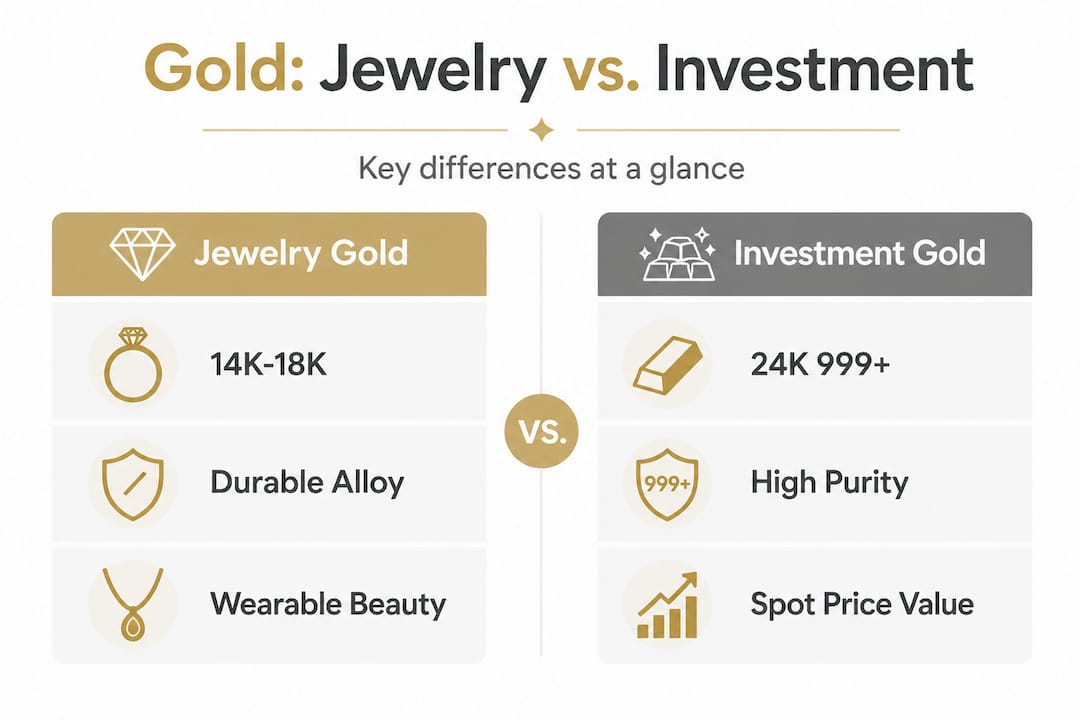
Jewelry resale typically recovers only 40 to 70 percent of the original retail price because of markup, design cost, and labor. Bullion sits much closer to spot price, making it more predictable for investors. As one straightforward way to frame it: jewelry is consumption with a gold value bonus, not a reliable investment vehicle in the same way that bullion is.
A smart buying process, regardless of your goal, follows these steps:
- Determine your purpose. Are you buying for personal style, a gift, or financial return? Your answer shapes every decision that follows.
- Check the purity. Match the karat or fineness mark to your purpose. 14K or 18K for jewelry, 999+ for investment.
- Verify the hallmark. Confirm all three hallmark components are present and readable. Use a loupe (a small magnifying glass used by jewelers) if needed.
- Assess resale potential. For jewelry, research what similar pieces sell for secondhand. For bullion, compare to live spot prices.
If you want to see how these principles play out in real purchasing decisions, our gold jewelry buying tips section walks through specific scenarios with practical guidance.
Dealing with edge cases and common gold authenticity pitfalls
Even with careful research and the right knowledge, authenticity pitfalls still catch experienced buyers off guard. Counterfeit gold and deceptive products have grown more sophisticated, and a basic visual inspection is no longer enough.
Fake hallmarks are one of the most common traps. These stamps can appear crisp and convincing, but the details are wrong. A fake piece might show a fineness number without an assay symbol, or display a symbol that does not correspond to any recognized assay office. The stamp looks official, but it has no backing. This is why verifying the seller’s reputation matters as much as reading the mark itself.
Gold-filled and gold-plated items deserve special attention. A gold-filled item carries a stamp like “GF” (gold-filled) or “GP” (gold-plated), indicating only a thin layer of gold bonded or applied to a base metal core. These are not solid gold. They wear down over time, exposing the base metal underneath. For a detailed breakdown of how to tell these products apart from genuine solid gold, our article on the difference between gold chains and gold plated pieces explains the visual and structural differences in plain terms.
Tungsten-filled bars represent a more serious fraud risk, particularly in the investment space. Tungsten has a density close to gold, so it can pass a basic weight and feel test. Some surface-level XRF (X-ray fluorescence) testing can also be fooled if only the outer layer is scanned. These bars look and feel authentic but contain a tungsten core. Buyers of investment gold should always request testing from a certified assay office, not just a surface scan.
Antique pieces present a different challenge. Wear and age can erode hallmarks to the point where they are no longer readable. In these cases, visual inspection alone cannot confirm authenticity. XRF analysis or a full assay review by a qualified specialist is the appropriate step before purchasing. Reading about solid gold jewelry meaning can also help you understand what distinguishes genuinely solid gold from imitations at a structural level.
Key red flags to watch for when buying gold:
- A hallmark with only a karat number and no maker’s mark
- A price significantly below market value for the stated purity
- No documentation or provenance offered for high-value pieces
- A seller who resists independent verification or professional appraisal
Pro Tip: The magnet test (checking whether a piece is attracted to a magnet, which gold is not) is useful but not definitive. Tungsten and other non-magnetic metals will also pass this test. Use the magnet test as one data point, not as confirmation of authenticity. Combine it with hallmark inspection, density checks, and seller verification for a more complete picture.
Perspective: Why most buyers overestimate gold’s investment value
Here is something the jewelry industry rarely says out loud: most people who buy gold jewelry believing it is a financial investment are making a decision that will not pay off the way they expect. That is not a criticism of buying jewelry. It is just an honest look at how the economics actually work.
The markups built into retail jewelry cover design, labor, brand overhead, and retail margins. When you buy jewelry as an investment and later try to sell it, you recover only a fraction of what you paid, typically 40 to 70 percent at best. The gold content has value, but the craftsmanship premium disappears the moment the sale is complete.
The better framing is this: buy jewelry for what it genuinely offers, which is beauty, personal meaning, and the enduring quality of a real material that does not tarnish or corrode the way base metals do. Solid gold jewelry holds its physical integrity for decades. It is a purchase that rewards you with enjoyment, not just an asset sitting in a vault. Understanding what solid gold jewelry actually means structurally makes this clearer. A piece made from solid 14K or 18K gold throughout will outlast gold-plated alternatives by years, sometimes by generations.
If you want exposure to gold as a financial asset, bullion is the right tool. It trades near spot price, carries standardized certification, and can be liquidated efficiently. Jewelry serves a different purpose, and the best buyers are the ones who know which one they actually want before they spend a dollar.
Find authentic gold jewelry and trusted investment options
If you are ready to apply what you have learned, the most important step is shopping with a source that provides verified purity and clear documentation for every piece. Baker Gold Chains sources all jewelry from reputable U.S. suppliers, with solid gold construction in 10K, 14K, and 18K options backed by a lifetime craftsmanship guarantee.
Start with something timeless and verified, like our 10K yellow gold Singapore chain, crafted from authentic solid gold with clear karat markings. For something more delicate, our 14K yellow gold puffed oval earrings combine hallmarked authenticity with everyday elegance. If you are buying as a gift, the 14K gold small puffed heart necklace offers a certified, solid gold piece that carries real value and lasting appeal. Free insured shipping on orders over $150 and flexible financing make it easy to invest in quality you can actually see and feel.
Frequently asked questions
What does ‘karat’ mean in gold?
Karat measures gold purity, with 24K representing pure gold and lower numbers indicating mixtures with other metals that improve durability. The lower the karat number, the higher the proportion of non-gold metals in the alloy.
How can I tell if gold jewelry is real?
Look for a complete hallmark that includes a sponsor’s mark, fineness number, and assay office symbol; all three together provide strong evidence of authenticity. A reputable seller with documented sourcing adds another layer of confidence.
Is 14K or 18K better for everyday jewelry?
Both are excellent choices, but 14K to 18K gold balances durability with gold content for wearable jewelry, with 14K being slightly tougher for pieces exposed to daily friction and impact. 18K is a better choice when a richer gold color and higher purity are priorities.
Why are gold bars preferred for investment?
999+ fineness gold bars trade near the global spot price and carry standardized certification, making them easy to value and liquidate through major dealers. Jewelry carries design and labor markups that reduce its value relative to raw gold content.
Can I trust all gold stamps and marks?
Not entirely. Some fake hallmarks exist with convincing stamps that lack proper assay backing, and worn or missing marks on antique pieces require professional XRF testing to verify. Always combine hallmark inspection with reputable sourcing and, when in doubt, independent appraisal.

