

Trusted Gold Jewelry Suppliers in the US: 2026 Guide
Trusted gold jewelry suppliers in the US are defined as vendors that offer certified authentic gold products with transparent sourcing, verifiable karat content, and reliable delivery. The US jewelry market is projected to reach $97.62 billion by 2030, growing from $78.40 billion in 2024. That growth reflects a clear shift: buyers now demand ethical sourcing, honest labeling, and supplier accountability alongside beautiful design. Whether you are buying for yourself or as a gift, knowing how to identify reliable gold suppliers protects your investment and your peace of mind.
1. What makes a trusted gold jewelry supplier in the US?
A trusted supplier combines three things: certified gold content, ethical sourcing practices, and consistent service. Industry standards like LBMA (London Bullion Market Association) certification, RJC (Responsible Jewellery Council) membership, and ISO 9001:2015 quality management certification are the benchmarks buyers should look for. Suppliers that meet these standards have passed third-party audits covering material purity, labor practices, and environmental impact. Without at least one of these credentials, a supplier’s authenticity claims are unverifiable.
Transparency in gold content disclosure is equally critical. Solid gold versus gold-filled are not interchangeable terms. Solid gold (10K, 14K, or 18K) contains gold throughout the piece. Gold-filled jewelry has a bonded gold layer over a base metal, which affects long-term durability and resale value significantly. Reputable suppliers state this distinction clearly on every product listing.

2. Bakergoldchains: authentic solid gold for US buyers
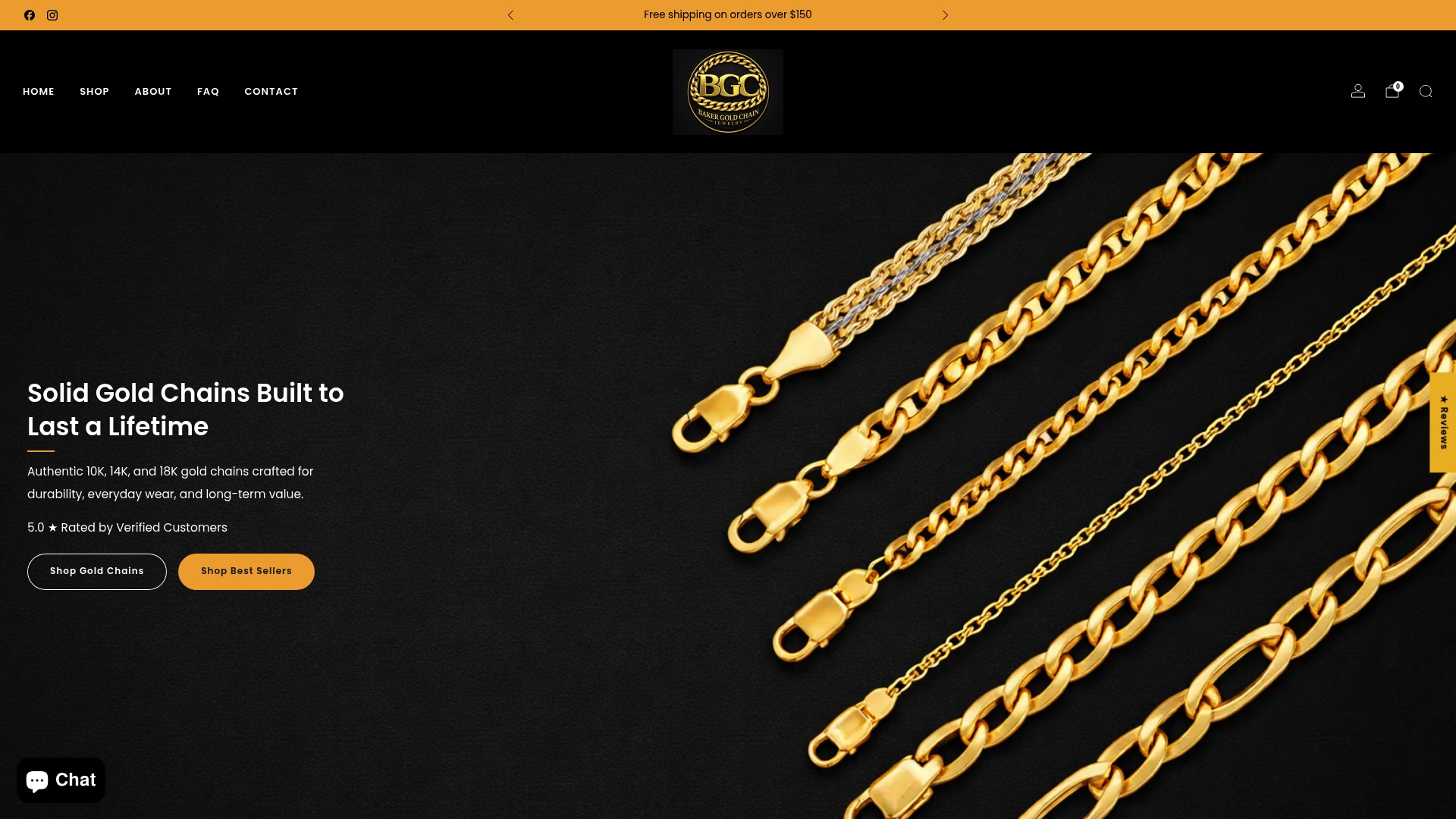
Bakergoldchains is a US-based e-commerce retailer specializing in solid gold chains and fine jewelry in 10K, 14K, and 18K gold. The catalog covers rope chains, Franco chains, Cuban links, Byzantine styles, pendants, earrings, rings, and bracelets. Every piece is sourced from reputable US suppliers, and the brand backs its products with a lifetime craftsmanship guarantee. Free insured shipping applies to orders over $150, and flexible financing options are available at checkout.
What separates Bakergoldchains from generic online retailers is its commitment to material transparency. Each listing specifies karat, weight, and gold type so buyers know exactly what they are purchasing. That level of disclosure is the standard buyers should expect from any gold supply company in the US.
3. Suppliers with LBMA and RJC certification
LBMA-certified refineries and RJC-accredited manufacturers represent the highest tier of verified gold suppliers. Reputable suppliers partner with LBMA-certified refineries to guarantee that the gold in each piece traces back to a responsible, audited source. The RJC Code of Practices covers human rights, labor standards, environmental impact, and business ethics across the entire supply chain.
Buyers working with RJC-accredited suppliers gain access to documentation that proves ethical sourcing at every stage. This matters especially for gifting contexts, where the story behind a piece adds to its meaning. When a supplier cannot produce RJC or LBMA documentation on request, that is a clear signal to look elsewhere.
4. US gold jewelry manufacturers with ISO 9001:2015 certification
ISO 9001:2015 is the international standard for quality management systems. Multi-stage inspections and ISO 9001:2015 certification are industry benchmarks that confirm a manufacturer controls its production process from raw material to finished piece. Suppliers with this certification document every step, which means fewer defects, consistent karat accuracy, and reliable delivery timelines.
Domestic US manufacturers also offer a practical advantage over overseas sourcing. US-based manufacturers deliver faster communication, better regulatory compliance, and more predictable production timelines. For buyers who need a piece by a specific date, that reliability is worth prioritizing.
5. Suppliers using advanced manufacturing technology
Leading US gold jewelry manufacturers use computer-aided design (CAD), precision casting, and automated temperature control to produce consistent, high-quality pieces. CAD and X-ray fluorescence testing allow manufacturers to verify purity at the design and production stages, not just at the end. X-ray fluorescence (XRF) testing is a non-destructive method that measures gold content by karat without damaging the piece.
This technology matters for buyers because it removes guesswork from the authenticity equation. A supplier using XRF testing can provide a documented purity report for any piece in its catalog. That report is your proof of value, especially if you plan to resell or insure the jewelry later.
6. Ethical and sustainable gold sourcing practices
Sustainability practices using recycled gold and renewable energy are now core standards among leading US gold jewelry manufacturers. SGS-certified recycled gold and solar power installations are two concrete examples of how responsible suppliers reduce environmental impact without compromising product quality. SGS is one of the world’s leading inspection and certification companies, and its recycled gold certification carries real weight.
Consumers now prioritize ethical traceability when selecting gold jewelry, and this shift is reshaping which suppliers earn long-term loyalty. Buying from a supplier that uses recycled gold means your purchase does not contribute to new mining operations with uncertain environmental records. For buyers who care about where their jewelry comes from, this is a non-negotiable factor.
Pro Tip: Ask any supplier directly whether their gold is recycled or newly mined, and request the SGS or equivalent certification number. A legitimate supplier will provide this without hesitation.
7. Physical presence and industry track record
A supplier with a physical storefront, factory, or verifiable business address is easier to vet than an online-only operation. Physical presence and certifications like RJC or LBMA are the clearest trust indicators available to buyers who cannot inspect products in person. Checking a supplier’s business registration, Better Business Bureau profile, and industry association memberships takes less than ten minutes and can prevent costly mistakes.
Long-standing industry track record also signals reliability. A supplier operating for ten or more years has navigated market fluctuations, maintained supplier relationships, and built a customer base that keeps returning. New entrants are not automatically untrustworthy, but they require more due diligence before you commit to a purchase.
8. Wholesale pricing, minimum orders, and shipping policies
Understanding order minimums and shipping terms helps you spot legitimate wholesale operations quickly. Minimum orders of $100 unlock wholesale pricing, with free domestic shipping available on orders over $300 at many US suppliers. Unusually low minimums with no shipping fees can indicate a drop-shipper with no direct inventory control, which raises questions about quality consistency.
Standard delivery for online gold jewelry orders runs 5–7 business days, with processing taking 1–2 days. Suppliers that cannot provide a clear shipping timeline or tracking information after purchase are operating below the standard you should accept. Always confirm the return policy before ordering, particularly for higher-value pieces.
9. How to verify gold content before and after purchase
Karat stamps are the first verification tool. Every piece of solid gold sold in the US should carry a karat stamp (10K, 14K, or 18K) and ideally a maker’s mark. The magnet test is a quick secondary check: real gold is not magnetic, so a strong magnet pulling at a piece suggests base metal content. For definitive verification, XRF testing at a local jeweler costs between $25 and $50 and produces a documented purity result.
Legitimate suppliers disclose gold content by weight clearly, distinguishing solid gold from gold-filled on every product page. If a listing uses vague terms like “gold-tone” or “gold-plated” without specifying karat, the piece is not solid gold. Buyers who understand this distinction avoid the most common and costly mistake in online gold jewelry purchasing.
10. Evaluating supplier transparency and customer support
Supplier transparency goes beyond product labeling. A trustworthy vendor publishes its sourcing policies, certification documents, and return procedures in plain language on its website. Authorized partnerships with reputable mints and refineries provide additional assurance that the gold supply chain is documented and auditable. Suppliers that hide this information or make it difficult to find are not operating at the standard the US market expects.
Customer support responsiveness is a practical trust signal. Send a pre-purchase question about karat content or sourcing and measure the response time and quality. A supplier that answers clearly and quickly demonstrates that it stands behind its products. One that deflects or delays is showing you exactly how it will handle a post-purchase problem.
Pro Tip: Before placing a first order with any new supplier, check their return policy for solid gold pieces specifically. Some vendors apply different terms to precious metal items. Knowing this upfront protects you if the piece does not meet your expectations.
For buyers interested in ethical jewelry buying practices, understanding supplier accountability at every stage of the supply chain is the foundation of a confident purchase. Suppliers that embrace responsible jewelry standards make that accountability visible and verifiable, not something you have to chase down.
Key Takeaways
The most reliable gold jewelry suppliers in the US combine LBMA or RJC certification, transparent karat disclosure, and consistent shipping policies to give buyers verifiable proof of authenticity and value.
| Point | Details |
|---|---|
| Certifications matter most | Look for LBMA, RJC, or ISO 9001:2015 credentials before trusting any supplier’s authenticity claims. |
| Solid gold vs. gold-filled | Always confirm karat content in writing; solid gold holds long-term value, gold-filled does not. |
| Technology confirms purity | XRF testing and CAD manufacturing are signs of a supplier that controls quality at every stage. |
| Ethical sourcing is verifiable | SGS-certified recycled gold and RJC membership are documented, not just marketing language. |
| Shipping and returns signal legitimacy | Standard US delivery is 5–7 business days; clear return policies indicate a supplier that stands behind its products. |
Why I stopped trusting price alone when sourcing gold jewelry
I spent years assuming that a lower price from a US-based supplier meant a good deal. That assumption cost me more than once. The first time I received a “14K” chain that failed an XRF test at a local jeweler, I realized that karat stamps can be applied to anything. The stamp is not the proof. The certification behind the stamp is the proof.
What changed my approach was learning to read supplier documentation the way a buyer should, not the way a hopeful customer does. RJC membership is not a marketing badge. It requires annual audits covering labor, environment, and material sourcing. A supplier that carries it has earned it. One that claims “ethical sourcing” without documentation has not.
The other shift was accepting that sustainability costs something. Recycled gold with SGS certification is not the cheapest option on the market. But it is the option that holds up under scrutiny, and scrutiny is exactly what you should apply before spending real money on gold. Buyers who learn to buy solid gold safely protect themselves from the most common and expensive mistakes in this category.
The US jewelry market is growing fast. That growth attracts legitimate suppliers and opportunists in equal measure. The difference between them is always documentation.
— Blayne
Authentic gold jewelry from Bakergoldchains
Bakergoldchains sources every piece from reputable US suppliers and backs each one with a lifetime craftsmanship guarantee. The catalog includes solid 10K, 14K, and 18K gold pieces across chains, pendants, earrings, rings, and bracelets, with clear karat and weight specifications on every listing.
The Graduated Bead Necklace in 14K Yellow Gold is one of the best examples of what verified craftsmanship looks like in practice: solid gold construction, documented karat content, and a design built to last. Free insured shipping applies to orders over $150, and flexible financing is available at checkout. Browse the full collection at Bakergoldchains to find a piece that fits your standard.
FAQ
What certifications should trusted gold jewelry suppliers have?
Trusted suppliers hold LBMA, RJC, or ISO 9001:2015 certification, which confirms audited gold sourcing, ethical labor practices, and consistent quality management across production.
What is the difference between solid gold and gold-filled jewelry?
Solid gold (10K, 14K, or 18K) contains gold throughout the entire piece, while gold-filled jewelry has a bonded gold layer over a base metal, which affects long-term durability and resale value.
How long does shipping take from US gold jewelry suppliers?
Standard US delivery for online gold jewelry orders takes 5–7 business days, with order processing requiring an additional 1–2 days before shipment.
How can I verify a gold jewelry supplier is legitimate?
Check for RJC or LBMA certification, a verifiable physical address, clear karat disclosure on all product listings, and a published return policy for precious metal items.
Is recycled gold as high-quality as newly mined gold?
Yes. SGS-certified recycled gold meets the same purity standards as newly mined gold and carries documented certification that confirms its quality and ethical sourcing credentials.

