

Why Buy from US Gold Suppliers: Investor's Guide
Not all gold suppliers are the same. That’s the truth most casual buyers don’t discover until after a purchase goes wrong. When you’re deciding why buy from US gold suppliers versus offshore or unverified sellers, the answer comes down to three things: documented authenticity, regulatory compliance, and reliable service. These factors, collectively described in the industry as due diligence standards, protect your investment before, during, and long after the transaction. This guide breaks down exactly what separates trustworthy US-sourced gold dealers from the rest, so you can make a confident, informed decision.
Table of Contents
- Key takeaways
- Why buy from US gold suppliers: authenticity and quality standards
- Compliance, chain of custody, and why they protect you
- Service quality: what separates good suppliers from great ones
- Market conditions and why supply reliability matters
- Evaluating and choosing your gold supplier
- My honest take on buying gold from reputable sources
- Why Bakergoldchains stands out as a trusted gold source
- FAQ
Key takeaways
| Point | Details |
|---|---|
| Authenticity documentation matters | Assay certificates and hallmarks verify purity and protect you from counterfeit or misrepresented gold. |
| Compliance protects your investment | KYC/AML and chain-of-custody records make your gold traceable, legitimate, and easier to resell. |
| Service quality reflects supplier credibility | Transparent pricing, insured shipping, and real customer support are measurable signs of a trustworthy dealer. |
| Market demand creates supply risk | U.S. gold demand surged 140% in 2025, making supplier reliability critical during high-volume buying periods. |
| Practical evaluation criteria exist | A clear checklist of red flags and questions helps you select a reputable supplier with confidence. |
Why buy from US gold suppliers: authenticity and quality standards
The most fundamental reason to prioritize reputable US gold suppliers is authenticity. Gold is one of the most counterfeited commodities on the market. Without proper documentation, you genuinely cannot tell whether what you are holding is solid gold or a plated substitute.
The gold industry uses a recognized benchmark called the LBMA Good Delivery standard, set by the London Bullion Market Association. For large-format bars, this standard requires a minimum fineness of 995.0, weights between 350 and 430 troy ounces, and mandatory serial numbers and refinery stamps on every bar. While most retail purchases involve smaller items like jewelry or coins rather than Good Delivery bars, this standard sets the floor for what serious authenticity verification looks like across the entire market.
For jewelry and smaller gold products, authenticity verification comes through a combination of:
- Karat stamps printed or engraved directly on the piece (10K, 14K, 18K)
- Assay certificates that document purity, weight, and serial number along with the issuing lab’s signature
- Hallmarking from recognized testing facilities that confirm metal content
- Tamper-evident packaging that maintains the integrity of the documentation from the supplier to you
The risk of skipping these checks is real. Counterfeit gold products often pass a basic visual inspection, and some even pass a simple magnet test. The only reliable protection is documentation that ties a specific piece to a verified source.
Pro Tip: When buying gold jewelry or bullion online, always ask whether the product comes with an assay certificate or lab report. A reputable supplier will provide this without hesitation. If the answer is vague, that is your first red flag.
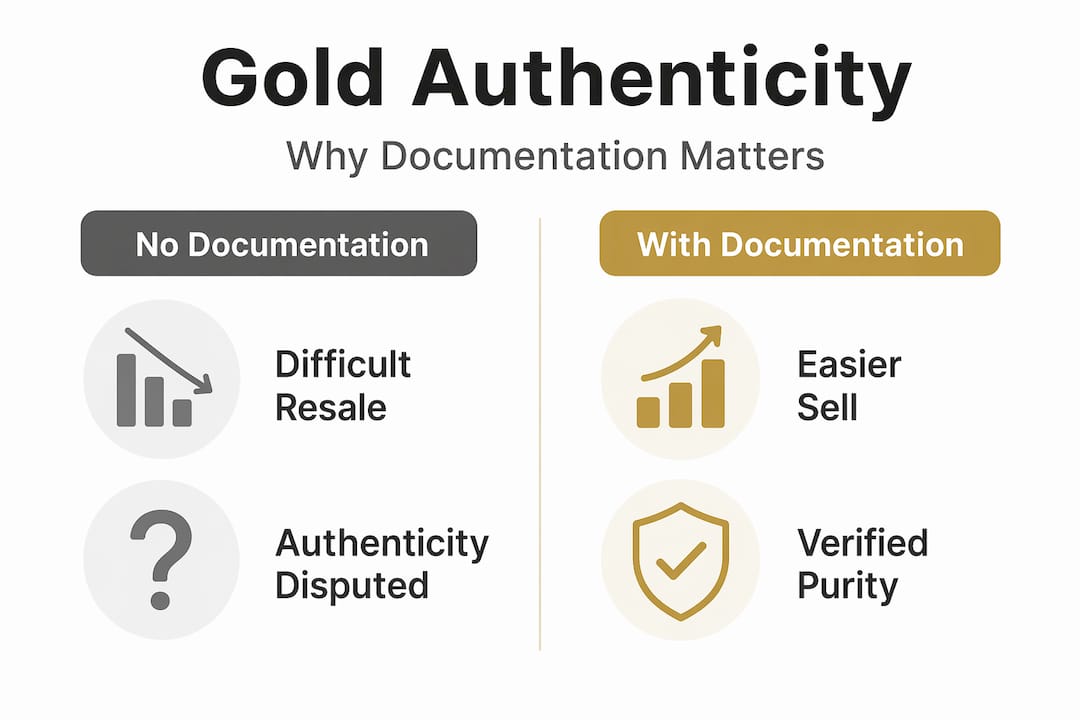
Good Delivery status also carries a major secondary benefit: improved resale liquidity. When your gold comes with recognized documentation, buyers and dealers in the secondary market accept it without costly or time-consuming re-verification. That matters when you eventually want to sell.
| Without documentation | With proper documentation |
|---|---|
| Authenticity disputed at resale | Accepted without re-assay |
| Lower or no resale offers | Competitive market-rate offers |
| No recourse for misrepresentation | Legal and financial recourse available |
| Limited to private sale markets | Access to institutional and dealer buybacks |
Compliance, chain of custody, and why they protect you
Buying gold from a credible US supplier means more than getting the metal. It means getting a paper trail. That documentation is what separates a legitimate transaction from one that could expose you to legal or financial risk down the line.
Reputable US gold dealers operate under KYC (Know Your Customer) and AML (Anti-Money Laundering) frameworks. These are not just bureaucratic hurdles. As institutional guidance confirms, KYC/AML compliance and chain-of-custody records are baseline requirements for any credible physical gold dealer. From a buyer’s perspective, these requirements work in your favor.
Here is why compliance documentation benefits you directly:
- It confirms the gold was legally sourced and not connected to conflict financing or smuggling networks
- It creates a traceable ownership record from the mine or refinery to your hands
- It meets the criteria institutional buyers and dealers require when you resell
- It satisfies the LBMA Responsible Gold Guidance, which sets ethical sourcing expectations globally
The chain of custody works in practice through matching serial numbers on the product, secure packaging that shows any tampering, and documentation that travels with the item through every step of the supply chain. If any link in that chain is broken or missing, the documentation loses its validity.
Pro Tip: Before completing any purchase, ask the supplier whether they can provide chain-of-custody documentation or provenance records. For jewelry, this may be a supplier certification or sourcing disclosure. For bullion, it should be a formal assay document with a traceable refinery.
Credibility in gold supply ultimately depends on operational compliance frameworks rather than marketing claims. Any seller can say their gold is authentic. A trustworthy US supplier proves it.
Service quality: what separates good suppliers from great ones
Product quality and compliance documentation matter enormously. But experienced gold buyers will tell you that service quality weighs heavily in the overall experience. A supplier who provides genuine gold but ships it carelessly, charges opaque fees, or disappears when you have a problem is still a bad supplier.
Here are the service factors that genuinely distinguish reputable US gold suppliers:
-
Transparent pricing. Reputable dealers publish their premiums over spot price clearly. You should know exactly what you are paying for the gold itself and what covers handling, insurance, and shipping before you check out.
-
Insured and secure shipping. Gold is valuable and targeted by theft. A trustworthy supplier ships using tracked, insured carriers and may require a signature on delivery. Free insured shipping on qualifying orders is a meaningful benefit that protects your investment in transit.
-
Accessible customer support. Can you reach a real person before, during, and after your purchase? Reputable suppliers offer multiple contact channels and response times measured in hours, not days.
-
Buyer education resources. The best US-sourced gold suppliers invest in helping you understand what you are buying. Guides on karat values, how to verify authenticity, and how to buy solid gold jewelry safely are a strong signal that a dealer respects their customers.
Pro Tip: Test a supplier’s customer support before making a large purchase. Send a question about their documentation or sourcing process. The speed, clarity, and depth of the response tells you a great deal about how they will handle a real problem.
Buying gold is genuinely a matter of purchasing trust and service quality as much as the metal itself. The suppliers who understand that distinction are the ones worth your business.

Market conditions and why supply reliability matters
U.S. gold demand rose 140% in 2025, driven largely by ETF investment, bringing total demand to 679 tonnes. That level of market activity puts enormous strain on dealer inventory and fulfillment capacity.
| Market indicator | 2025 figure |
|---|---|
| U.S. gold demand increase | 140% year over year |
| Total U.S. gold demand | 679 tonnes |
| ETF holdings value | $280 billion |
| Total ETF gold held | 2,019 tonnes |
What this means practically: during high-demand periods, less credible sellers may accept your payment and then fail to fulfill your order on time, or at the agreed price. Demand surges strain smaller or less organized dealers, resulting in delays, price adjustments after purchase, or outright cancellations.
Reputable US gold suppliers manage inventory proactively. They maintain relationships with established refineries, communicate transparently about availability, and honor confirmed orders at the agreed price regardless of market movement. That reliability is not a minor convenience. It directly affects whether your investment captures the price point you intended.
The benefits of US-sourced gold from established dealers become most visible during exactly these high-pressure moments. A supplier you can count on during peak demand is more valuable than one who performs adequately when the market is quiet.
Evaluating and choosing your gold supplier
Knowing the criteria matters. Applying them is what protects you. Before you commit to any supplier, run through this checklist:
- Does the supplier provide assay certificates or hallmarking documentation for every product?
- Are their KYC/AML compliance processes clearly stated on their website or available on request?
- Is the chain of custody traceable from the refinery to your purchase?
- Are shipping terms, insurance coverage, and delivery timelines stated clearly before checkout?
- Can you find independent reviews that specifically mention documentation quality and post-purchase support?
- Does the supplier have a published returns or dispute resolution policy?
Red flags to avoid: missing or unavailable assay documentation, prices significantly below market rate with no explanation, vague answers about sourcing or refinery origin, and no clear shipping insurance terms.
For practical guidance on verifying what you receive, Bakergoldchains offers a detailed buyer’s guide to real gold that covers density tests, karat stamps, and professional verification options. Learning to recognize authentic gold independently adds another layer of protection.
Pro Tip: Cross-reference any supplier against the Better Business Bureau and look specifically for complaints about unfulfilled orders or documentation issues. A pattern of those complaints is a reliable indicator of systemic problems, not isolated incidents.
Understanding hallmarks and purity standards before you buy makes it much harder for a dishonest seller to mislead you. Knowledge is your first line of protection.
My honest take on buying gold from reputable sources
I’ve followed the gold market closely enough to know that most buyers underestimate the role of supplier credibility until something goes wrong. The common assumption is that gold is gold and the price is what matters. That is incomplete thinking.
What I’ve learned is this: the documentation that travels with a gold purchase is often worth as much as the metal itself. I’ve seen buyers receive authentic-looking pieces that failed independent assay testing, simply because there was no verified paper trail connecting the item to a known refinery. The purchase price looked like a deal. The cost of discovering the problem was far higher.
In my experience, the top reasons to buy gold from established US suppliers have little to do with geography for its own sake. They have to do with accountability. A US-based supplier operates under consumer protection laws, regulatory oversight, and reputational pressure that creates strong incentives for honesty. An anonymous offshore seller has none of those pressures.
The intangible benefit that I’ve come to value most is simply peace of mind. Knowing your gold is documented, traceable, and backed by a supplier who will answer the phone is not a luxury. For anyone treating gold as a meaningful part of their financial picture, it is the baseline. I personally never finalize a gold purchase without confirming three things: the karat stamp is present, an assay certificate is available, and the supplier has verifiable customer reviews that specifically mention documentation quality.
— Blayne
Why Bakergoldchains stands out as a trusted gold source
If this article has clarified what to look for in a reputable supplier, Bakergoldchains is built around exactly those principles. Every piece in the collection, from 10K everyday chains to 18K fine jewelry, is sourced from established US suppliers and backed by authenticity documentation. Transparent pricing, free insured shipping on orders over $150, and a lifetime craftsmanship guarantee are not marketing language. They are commitments you can hold the brand to.
The product selection includes authenticated pieces like the 14K graduated bead necklace and the 14K small wedding hoops, both examples of the quality and craftsmanship Bakergoldchains delivers consistently. Whether you are buying for everyday wear, a special occasion, or long-term value, you will find pieces that meet the authenticity and service standards this article has outlined. Explore the full collection at Bakergoldchains.com and buy with confidence.
FAQ
What makes a US gold supplier trustworthy?
A trustworthy US gold supplier provides assay certificates, clear karat stamps, KYC/AML compliance documentation, and transparent pricing. Independent customer reviews that mention documentation quality are an additional reliable indicator.
Why does chain-of-custody documentation matter when buying gold?
Chain-of-custody records prove your gold was legally sourced and traceable from refinery to buyer. Without this documentation, resale is harder and you have limited recourse if authenticity is disputed.
How did U.S. gold demand change in 2025?
U.S. gold demand rose 140% in 2025, reaching 679 tonnes, largely driven by ETF investment. This surge made supplier reliability and inventory management more critical than ever for retail buyers.
What is an assay certificate and do I need one?
An assay certificate is a document that verifies a gold item’s purity, weight, serial number, and issuing lab details. For any gold purchase intended to hold long-term value, requesting an assay certificate is a smart and necessary step.
What are the biggest red flags when choosing a gold supplier?
The most serious red flags include prices far below market rate, unavailable or vague documentation, no stated shipping insurance, and complaints about unfulfilled orders in independent reviews. These patterns indicate a supplier you should avoid regardless of how appealing their pricing looks.

