

Earring Back Types: A Guide to Security and Comfort
For most shoppers, the choice comes down to one simple trade-off: screw and locking backs give you the best security, while push and flat backs give you the fastest, most comfortable convenience. Every earring back on the market falls somewhere on that spectrum, and knowing where each one sits helps you buy smarter and wear your jewelry with more confidence.
Here are the main families you’ll run into:
- Push, friction, or butterfly backs — the everyday default, easy on and off
- Screw backs — threaded posts that lock mechanically
- Flat or labret backs — low-profile, common on cartilage studs
- Leverback, latch, and hinged closures — used on dangles and hoops
- Omega and French clips — built to support heavier pieces
- Locking backs (La Pousette, Guardian) — a professional-grade middle ground
- Magnetic or tension backs — convenient, but the weakest on security
Choose based on the value of the stone, your activity level, and your own dexterity. If you’re outfitting a child, traveling with heirloom studs, or wearing a diamond you can’t afford to lose, prioritize security. If you’re swapping fashion earrings in and out several times a day, convenience wins.
Key Takeaways
Screw and locking earring backs deliver the strongest security, while push and flat backs offer the fastest comfort, and the right choice depends on stone value and lifestyle.
| Point | Details |
|---|---|
| Match back to stakes | Use screw or locking backs for valuable studs, children, and active wear; push backs for everyday fashion pieces. |
| Push backs wear out | Spring tension in friction backs degrades over time, so check it periodically rather than assuming it’s still snug. |
| Screw backs need thread care | Keep threads clean and check alignment before forcing a screw back closed. |
| Confirm post diameter | Locking systems like Guardian come in multiple sizes, so verify fit specs before ordering. |
| Bakergoldchains sources quality | Bakergoldchains offers solid gold earrings with U.S. sourcing, free insured shipping over $150, and a lifetime craftsmanship guarantee. |
Table of Contents
- What Are the Main Earring Back Types?
- Which Earring Backs Are Most Secure?
- How Do I Choose the Right Earring Back?
- Why Trust Baker Gold Chains on Earring Backs
- The Case Against One-Size-Fits-All Advice
- Ready to Upgrade Your Earring Backs?
- Frequently Asked Questions
- Sources
What Are the Main Earring Back Types?
Every earring back does the same basic job: it keeps the post from sliding back out through the earlobe. How it does that job, and how well, varies a lot.
Push, friction, or butterfly backs work by simple pressure. You slide the flat metal disc onto the post, and small internal ridges grip the metal to hold it in place. They’re the fastest backs to use, which is exactly why they’re standard on the vast majority of stud earrings sold today. The catch is that the spring tension inside a friction back wears down with repeated use, so a back that felt snug a year ago might feel noticeably looser now. Periodic tension checks matter here more than most shoppers realize.
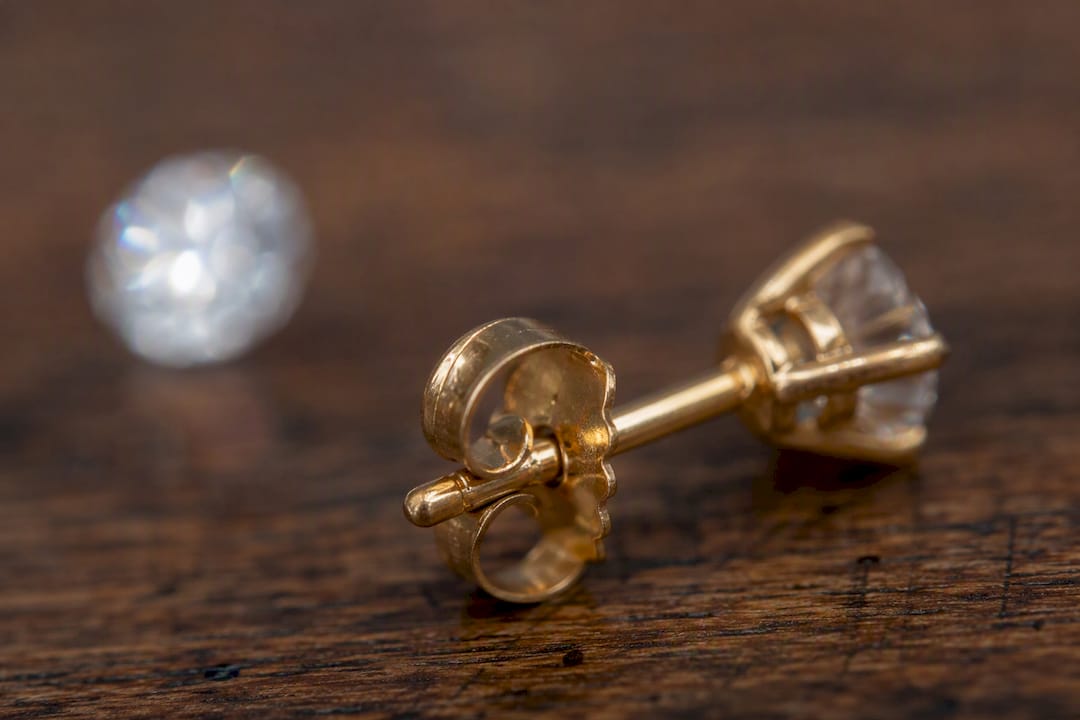
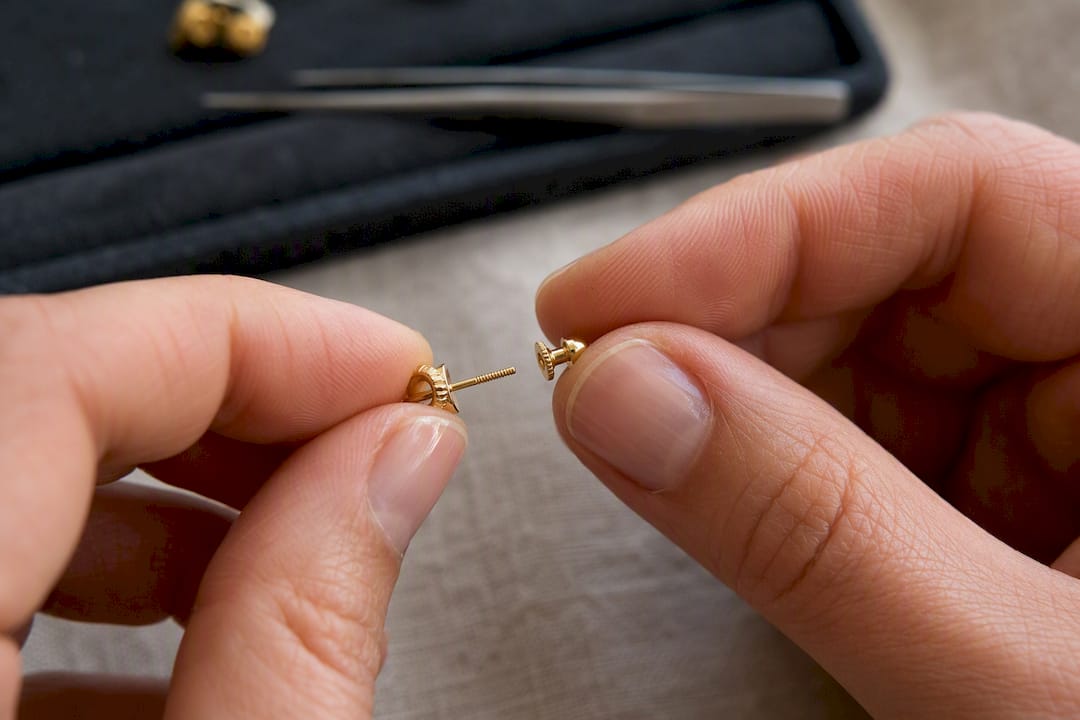
Screw backs solve that looseness problem with a threaded post and a matching nut you rotate to tighten. That mechanical lock is a real upgrade in security compared with friction backs, since accidental removal basically requires someone to unscrew the back on purpose. The trade-off is speed: screw backs take longer to put on and take off, and if the post isn’t threaded to begin with, converting it usually means a bench jeweler swaps the post entirely.
Flat or labret backs sit nearly flush against the ear, which makes them a favorite for cartilage piercings and any stud design that needs a low profile. They’re comfortable for sleeping and rarely catch on hair or clothing, though they don’t offer much more grip than a basic push back.
Leverback, latch, and hinged closures use a small lever or hinge that snaps shut over a loop, common on dangle earrings and many hoop styles. They’re quick to operate one-handed and stay closed reliably during normal wear, though a worn hinge spring can eventually lose its snap.
Omega and French clips are built to carry weight. You’ll see them on heavier drop earrings and certain hoop designs, where the wider clip distributes pressure across more of the earlobe instead of concentrating it on a single post.
Locking backs, like the Guardian system, add a positive-lock mechanism that clicks into a groove on the post rather than relying on friction alone. Jewelers often recommend them for higher-value studs or active wear when screw backs aren’t available on a given piece, and they’re sold in 14K, 18K, and platinum to match fine jewelry.
Magnetic and tension backs skip the post entirely, using magnets or spring pressure to hold the earring against the ear. They’re the go-to for non-pierced ears, but that same lack of a post means they offer the least holding power of any type here.
Pro Tip: If you love the fit of a push back but hate replacing lost earrings, ask your jeweler whether the post can be swapped to a screw or locking style instead of buying an entirely new pair.
Which Earring Backs Are Most Secure?
Security and comfort rarely max out together, and understanding why helps you pick correctly instead of guessing.
A friction back can fail simply from wear. The metal ridges inside a butterfly clutch flatten out over months of daily on-and-off use, and once the spring tension drops, the earring rides looser and can slip off without you noticing. A screw back avoids that failure mode almost entirely, since removal requires deliberate rotation. A locking back splits the difference: it’s not threaded, but the positive-lock click is far more resistant to accidental loss than plain friction. Magnetic backs fail the most easily of all, because a strong bump or a snag on clothing can pull the magnet apart with no warning.
Jewelers generally steer specific situations toward specific backs:
- Children’s earrings: screw backs, since kids tug and rub their ears constantly
- Travel and heirloom pieces: screw or locking backs for peace of mind in transit
- Gym and active wear: screw or locking backs to survive sweat, movement, and helmets
- Sleep and side-sleepers: flat or push backs for a low profile against the pillow
- Frequent daily swaps: push or flat backs for speed
Comfort trade-offs matter just as much as security. A longer post that sits proud behind the ear can dig into a pillow or a hood, while a locking or screw mechanism adds a small bump of hardware that some wearers feel more than others. According to jewelers who compare the two most common back styles, there’s no universal winner. The right choice depends on how you actually live, not on which back sounds more premium.
Maintenance is where most people fall short. Push-back springs degrade gradually, and inspecting that tension periodically rather than waiting for a loss catches the problem before it costs you a stud. Screw backs need a different kind of care: check the threads for grit or tarnish, since a gummed-up thread can strip if you force it.
How Do I Choose the Right Earring Back?
Work through these factors before you buy or replace a back:
- Stone value. A diamond or fine gold stud earns the extra step of a screw or locking back.
- Activity level. Gym-goers, parents chasing toddlers, and frequent travelers should lean toward mechanical locks over friction.
- Dexterity. If small threaded parts are hard to manage, a locking back offers more security than a screw back without the fine motor demands.
- Post diameter and ear thickness. A back has to physically match the post, so measure before you order a replacement.
- Metal sensitivity. Ask whether the back itself, not just the front of the earring, is nickel-free.
When you’re talking to a seller or jeweler, ask directly: Is the post threaded or friction-fit? What’s the exact post diameter? Can this back be replaced separately if it wears out? What metal is the back made from? Locking systems like Guardian come in more than one size, so confirming the post diameter against the manufacturer’s fit chart avoids an awkward return.
Watch for red flags before you hand over your card. A seller who can’t tell you what type of back is included, a friction back that already feels loose in the package, or a screw post paired with a back that doesn’t thread cleanly are all signs to walk away or ask for a swap.
Pro Tip: At the counter, push gently against a friction back to feel actual resistance, and turn a screw back a full rotation to confirm the threads align smoothly before you leave the store.
Why Trust Baker Gold Chains on Earring Backs
Bakergoldchains built its catalog around authentic, solid gold jewelry, sourcing from U.S. suppliers and standing behind every piece with a lifetime craftsmanship guarantee. That matters for earring backs specifically, since a well-made post and a properly fitted back are what actually keep a stud secure.
A few things worth knowing:
- Orders over $150 ship free and insured, which covers you while a new pair of studs is in transit.
- Financing options make it easier to upgrade to a higher-security back or a finer stone without paying all at once.
- Bakergoldchains’ gold earring style guide and its breakdown of earring styles and how to choose them both help match a back style to the piece you’re eyeing.
The Case Against One-Size-Fits-All Advice
The conventional advice on earring backs treats “most secure” as the only question worth asking, and that’s where it goes wrong. A locking back on a toddler’s ears solves a real problem. That same back on a fashion stud you swap out three times a day just slows you down for no real benefit.
What the evidence actually supports is matching the back to the stakes, not defaulting to whatever sounds strongest. A friction back with healthy spring tension is perfectly adequate for a $40 pair of studs you’ll lose interest in by next season. A screw or locking back earns its keep on anything you’d be upset to lose, whether that’s a diamond stud or a piece with family history behind it.
Where most buyers fall short isn’t choosing the wrong type. It’s never checking the back again after the purchase. A push back that was snug at checkout won’t stay that way forever, and the habit of inspecting it beats any single upgrade you could make at the register.
Ready to Upgrade Your Earring Backs?
If security and comfort both matter to you, Bakergoldchains gives you a way to buy earrings where the back is built to match the stone, not bolted on as an afterthought. Every piece is solid 10K, 14K, or 18K gold, sourced from U.S. suppliers, and backed by a lifetime craftsmanship guarantee, so you’re not choosing between a good back and a good earring.
For everyday hoops with a hinged closure that stays snapped shut through a full day of wear, the 14k two-tone gold hoop earrings in a hinged style are worth a look. If you’re upgrading to something with more presence and a closure built to hold its shape, browse the 14k tri-color gold open entwined ring earrings and check current availability before you decide.
Frequently Asked Questions
What is the most secure type of earring back? Screw backs and positive-locking backs like Guardian are the most secure, since both require a deliberate action to remove rather than relying on friction alone.
What’s the difference between screw back and push back earrings? Screw backs thread onto the post and lock by rotation, while push backs grip the post through spring pressure alone. Screw backs resist accidental loss better, but push backs go on and off faster.
What is the best stud back for men? Men who wear studs occasionally often prefer push or flat backs for quick removal, while screw backs suit anyone wearing a higher-value stud daily or working with their hands.
How often should I check a push-back earring for tightness? Check the tension every few months, especially on earrings you wear daily, since spring fatigue builds gradually and rarely announces itself before the earring feels loose.
Can any post be converted to a screw back? Not directly. A friction post generally needs to be replaced by a bench jeweler to accept a screw back, so specify a screw closure when you’re buying rather than trying to convert later.
Are locking backs better than screw backs? They’re comparable in security but different in mechanism. Locking backs click into place and don’t require rotation, which some wearers find faster and easier than threading a screw back.
Sources
- Guardian Positive Locking Earring Backs 6.1mm | Gold & Platinum: Otto Frei
- Screw Back vs Push Back Earrings: Which Is Safer? – Dvik Jewels
- Screw back vs push back: Which earring backing is right for your lab grown diamond studs? – Databazaar
- Screw-Back vs. Push-Back Earrings: Which Is Right for You? – customdiamjewel

