

How to Tell Real Gold: A Buyer's Practical Guide
You paid good money for that gold necklace. But is it actually gold? Knowing how to tell real gold from a convincing fake is one of the most practical skills any jewelry buyer can have. Fakes are common, and some are sophisticated enough to fool the untrained eye. This guide walks you through hallmark reading, safe at-home tests, and professional verification methods, so you can identify real gold jewelry with real confidence before spending a cent.
Table of Contents
- Key takeaways
- How to tell real gold from hallmarks
- Simple at-home tests to spot fake gold
- Professional gold testing methods
- Common mistakes when verifying gold
- What to do with your test results
- My take on gold authenticity after years of research
- Shop authentic gold you can trust at Bakergoldchains
- FAQ
Key takeaways
| Point | Details |
|---|---|
| Hallmarks are the first check | Look for a fineness stamp like 375, 585, or 750 to confirm gold purity at a glance. |
| At-home tests work best in combination | No single DIY test is foolproof; use at least two or three together for stronger confidence. |
| Tungsten fakes can deceive basic tests | Sophisticated counterfeits pass magnet and density tests, so professional verification matters for high-value pieces. |
| XRF testing is the gold standard | Non-destructive and highly accurate, XRF is the preferred method for professional gold purity verification. |
| Buy from verified sources | Reputable retailers who disclose karat, sourcing, and hallmarks reduce the need for additional testing. |
How to tell real gold from hallmarks
The single most reliable starting point for testing gold authenticity is checking the hallmark. A hallmark is an official mark stamped onto precious metal by an independent assay office. It is not the same as a manufacturer’s karat stamp, and that distinction matters more than most buyers realize.
Hallmarks have protected consumers for over 700 years by providing independent verification of gold purity. In the UK, hallmarking is a legal requirement for gold jewelry over 1 gram. A complete hallmark contains three components:
- Sponsor’s mark: The maker’s registered symbol, confirming who submitted the item for testing.
- Fineness mark: A three-digit number indicating the gold content in parts per thousand. Common marks are 375 (9K, about 37.5% gold), 585 (14K), and 750 (18K).
- Assay office mark: The symbol of the testing body. In the UK these include a leopard’s head for London, an anchor for Birmingham, a rose for Sheffield, and a castle for Edinburgh.
Assay office marks appear in discreet spots such as the inside of a ring band, on a necklace clasp, or along the inner edge of a bracelet. Use a jeweler’s loupe or a magnifying glass to find them. Clean the area gently first with a soft cloth, since tarnish or residue can obscure faint stamps.
One common mistake is treating a manufacturer’s fineness stamp, such as “14K” or “585,” as a full hallmark. Simple karat stamps alone do not carry the same legal weight as an independently verified hallmark. Anyone can stamp “18K” on a piece. Only an accredited assay office can apply a full hallmark, and that three-part combination is what gives you genuine assurance.
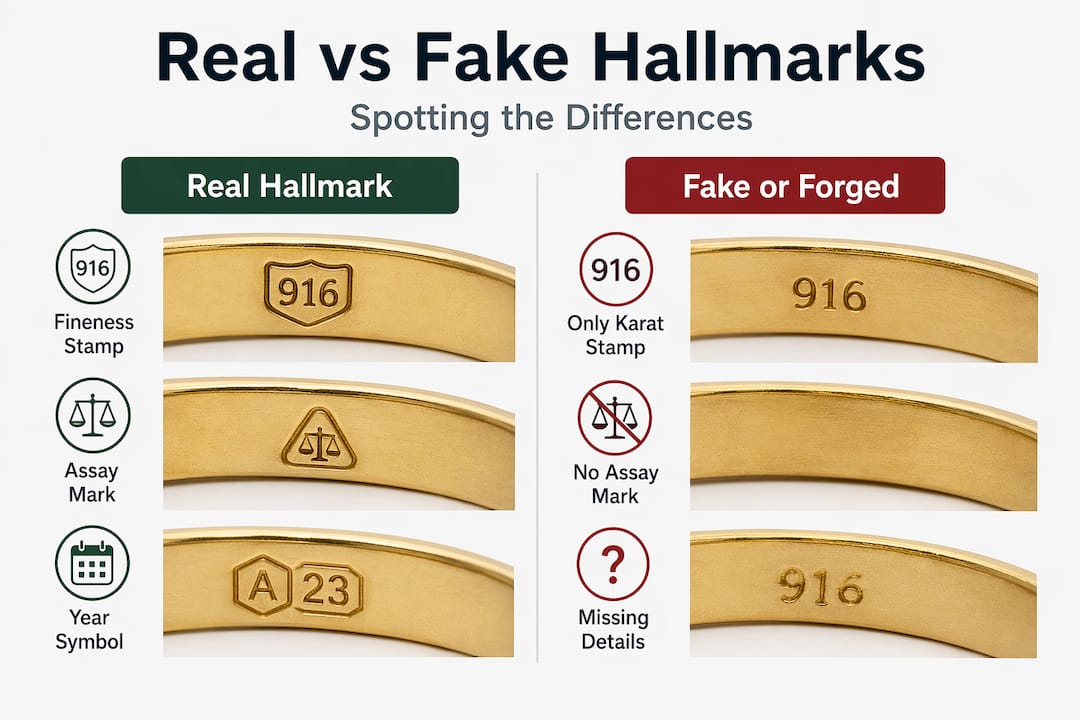

Pro Tip: If you are purchasing vintage or estate jewelry, have it examined under magnification before assuming any stamp is official. Worn hallmarks can look like manufacturer stamps, and vice versa.
Simple at-home tests to spot fake gold
Before spending money on professional testing, you can run a few quick checks at home. None of these tests are 100% conclusive on their own, but together they help you identify red flags and decide whether to seek expert verification.
-
The magnet test. Pure gold is non-magnetic. Hold a strong magnet near the piece. If it pulls toward the magnet, the metal contains ferromagnetic materials and is not solid gold. This is one of the fastest ways to spot a fake. However, passing this test does not confirm authenticity on its own.
-
The density test. Gold has a specific gravity of about 19.3 g/cm³, which is much heavier than most common metals. Drop the piece in water and check if it sinks quickly and feels unusually heavy for its size. Gold plated items often feel noticeably lighter. You can also weigh the piece and compare it to known gold weights for that size and style.
-
The ceramic test. Drag the piece across an unglazed ceramic tile. Real gold leaves a gold-colored streak. Fakes typically leave a dark gray or black streak. This test may leave a very faint mark on the metal surface, so consider using a small area that is not visible during wear.
-
The vinegar test. Apply a few drops of white vinegar to the metal and observe for 15 minutes. Real gold will not change color or corrode. Base metals often darken or show a chemical reaction.
-
The visual check. Look for green or dark discoloration on the skin at contact points, or on the metal itself. This is a sign of copper or other base metals reacting with sweat and oils. Also check for uneven color or flaking near edges and clasps.
Pro Tip: Run at least three of these tests before drawing a conclusion. A fake that passes one test might fail two others, giving you much clearer information.
If you want a deeper understanding of the differences between solid gold and plated pieces, the gold chain vs. gold plated guide at Bakergoldchains explains exactly what separates them in terms of durability and value.
Professional gold testing methods
At-home tests give you a reasonable starting point, but they have real limits. For expensive purchases, vintage jewelry, or anything where you have genuine doubts, professional testing is the right move.
| Method | Accuracy | Destructive? | Best For |
|---|---|---|---|
| XRF testing | ±0.5% to ±1% | No | Jewelers, buyers, banks |
| Acid test (touchstone) | Good | Slightly | General purity checks |
| Fire assay | Highest | Yes | Refineries, full analysis |
| Electronic testers | Moderate | No | Quick screenings |
X-ray fluorescence (XRF) testing is widely considered the preferred professional method. XRF analyzers measure elemental makeup without touching or damaging the piece. The device bounces X-rays off the metal and reads the composition in seconds. For high-karat gold, XRF testing provides accuracy within ±0.5% to ±1%, which is more than sufficient for consumer verification. Many reputable jewelers and pawn shops have XRF machines on site.
Acid testing uses a touchstone and a set of calibrated acids matched to different karat levels. Professional acid testing applies acid to a streak of metal left on the stone rather than directly to the piece, reducing the risk of damage. This method is accurate and widely used, but it should be left to professionals. Nitric acid is corrosive and improper use can permanently damage a piece or cause injury.
Fire assay is the most precise method available, but it destroys the sample. Fire assay melts the gold with additives to chemically separate impurities and measure exact gold content. Refineries and laboratories use this method, but it is not practical for regular consumers.
When should you see a professional? If you are spending more than a few hundred dollars, buying from an unknown seller, acquiring a vintage piece, or spotting conflicting results from at-home tests, book an appraisal. Many jewelers offer testing for a small fee or even for free if you are also considering a purchase.
Pro Tip: Ask any jeweler offering XRF testing to show you the printed readout. A trustworthy professional will hand it to you without hesitation.
There is one trap even professional tests can miss. Tungsten has a density of about 19.25 g/cm³, nearly identical to gold’s 19.3 g/cm³, and it is also non-magnetic. Tungsten-filled gold bars and jewelry exist specifically to defeat density and magnet tests. XRF testing, however, penetrates only the outer layer of a piece, so a thick gold shell over a tungsten core can still return a gold reading. This is an edge case, but it matters for high-value items.
Common mistakes when verifying gold
Even careful buyers make errors that lead to wrong conclusions. Knowing these pitfalls in advance saves you from costly mistakes.
- Trusting a single test. One passing result does not mean a piece is real. A gold-plated item will pass the magnet test. A tungsten fake will pass the density test. Using multiple methods together is the only way to build real confidence.
- Confusing stamps with hallmarks. A “14K” or “750” stamp from a manufacturer is not the same as a full official hallmark. Manufacturer stamps can be misused and do not carry independent verification.
- Skipping magnification. Hallmarks on small jewelry can be nearly invisible to the naked eye. Many people miss them entirely and assume there are none, when in fact they are present but faint from age or wear.
- Attempting DIY acid tests. This is genuinely risky. Nitric acid reacts aggressively with skin and clothing and can permanently damage jewelry. Leave acid testing to professionals.
- Ignoring wear patterns. Real gold does not peel or flake. If you notice the color lifting at edges, clasps, or high-contact areas, you are likely looking at gold plating over a base metal, not solid gold.
“The most common mistake I see is buyers treating a karat stamp as proof of purity. It is a starting point, not a guarantee. A full hallmark from an accredited office is the real signal to look for.”
If you are researching how to spot fake gold chains specifically, Bakergoldchains has a dedicated guide on spotting fake chains that covers visual red flags in detail.
What to do with your test results
Once you have run your checks, it is time to interpret what you found and decide on your next step. Here is a straightforward process for acting on your results.
-
Match the fineness mark to the gold purity. A 375 mark means 9K gold (37.5% pure). A 585 mark means 14K (58.5% pure). A 750 mark means 18K (75% pure). If the piece passes your at-home tests and carries one of these marks, you have solid preliminary evidence of authenticity.
-
Cross-reference with the selling price. If a seller is offering what appears to be 18K gold jewelry at prices far below market rates for gold, something is wrong. Current gold prices are publicly available, and you can quickly estimate what any piece should cost based on weight and purity.
-
Request documentation. Reputable retailers and jewelers can provide a certificate of authenticity or an appraisal document. For purchases above a certain value, this is not just a nice addition. It is a practical necessity for insurance and resale purposes.
-
Get a professional evaluation when in doubt. If your at-home tests produce mixed results, or if the hallmark looks worn or suspicious, do not talk yourself into confidence you do not have. A professional XRF test or appraisal gives you certainty.
-
Buy from transparent sources. The easiest way to verify gold authenticity is to buy from a retailer who discloses karat, sourcing, and product specifications upfront. Reading detailed product descriptions and reviews before purchasing reduces the need for post-purchase testing.
My take on gold authenticity after years of research
I have spent years reading about, researching, and evaluating gold jewelry, and the single thing that changed my approach the most was learning the difference between a manufacturer’s karat stamp and a full official hallmark. Before I understood that distinction, I treated any stamp on a piece as meaningful. It is not.
What I have come to believe is that most buyers underestimate how sophisticated some fakes can be, and simultaneously overestimate how difficult it is to protect themselves. The tools are available. Hallmark guides exist. XRF testing is accessible at most reputable jewelers. The knowledge is not hidden.
My honest recommendation is this: run the at-home tests as a first filter, but do not stop there for anything valuable. For a modest piece you are buying out of curiosity, a passing magnet test and a clear hallmark might be enough. For a gold chain, a ring, or a piece you are giving as a meaningful gift, get XRF confirmation or buy from a retailer whose authenticity you can verify directly.
The growing sophistication of counterfeits, particularly tungsten-based fakes, makes this non-negotiable for high-value purchases. Combining what you know with expert help is not overcautious. It is smart buying.
— Blayne
Shop authentic gold you can trust at Bakergoldchains
If going through authenticity tests every time you shop sounds exhausting, the simpler answer is buying from a source where the work is already done for you. Bakergoldchains carries solid gold jewelry in 10K, 14K, and 18K, sourced from reputable U.S. suppliers with full transparency on materials and craftsmanship.
Every piece comes with a lifetime craftsmanship guarantee and free insured shipping on orders over $150, so you are covered well beyond the point of purchase. Whether you are looking for everyday wear or a meaningful gift, the collection includes pieces like the graduated bead necklace in 14K yellow gold and the small wedding hoops in 14K yellow gold, both crafted from verified solid gold. Browse the full collection at Bakergoldchains and shop with the confidence that comes from knowing exactly what you are buying.
FAQ
How do I quickly identify real gold jewelry?
Check for a fineness mark (375, 585, or 750) in a discreet area like the inside of a band or a clasp, then follow up with a magnet test. Real gold is non-magnetic and will carry a clear purity stamp.
Can a magnet test confirm gold is real?
The magnet test shows that a piece does not contain ferromagnetic metals, but it cannot confirm gold. Tungsten, for example, is also non-magnetic with a density close to gold, so a passing magnet test is a starting point, not final proof.
What is the most accurate professional gold purity test?
XRF testing is the most practical professional method, offering accuracy within ±0.5% to ±1% without damaging the piece. Fire assay is technically more precise but destroys the sample and is used only in refinery settings.
Is a “14K” stamp on jewelry enough to verify it is real gold?
No. A karat stamp from the manufacturer is not the same as a full hallmark. Manufacturer fineness stamps can be misused and carry no independent verification. Look for a complete hallmark that includes an assay office mark for stronger assurance.
How can I tell real gold without damaging the piece?
Use non-destructive tests: check for hallmarks, run a magnet test, try the ceramic streak test, or visit a jeweler for XRF testing. Avoid DIY acid tests, which use corrosive nitric acid and risk permanently harming the jewelry.
Recommended
- What Is Authentic Gold? Purity, Hallmarks, and Smart Buying – Baker Gold Chains
- Gold Jewelry Value: What Every Buyer Needs to Know – Baker Gold Chains
- How to spot fake gold chains: your authenticity guide – Baker Gold Chains
- Solid gold jewelry: what it really means and why it matters – Baker Gold Chains

