Why Insured Shipping Matters for Your Jewelry in 2026
Why the importance of insured shipping jewelry cannot be overstated
Shipping jewelry without insurance is one of the most avoidable financial risks in the industry. A single lost package containing a solid gold chain or a diamond pendant can mean a complete, unrecoverable loss, with no carrier stepping in to make you whole. That is the core reality behind jewelry shipping insurance: it reimburses the full declared value of your piece if it is lost, stolen, or damaged in transit, rather than leaving you to absorb the cost yourself.
Here is what insured shipping for jewelry actually protects you against:
- Loss in transit: The package never arrives and the carrier cannot locate it.
- Theft: The parcel is stolen from a vehicle, facility, or doorstep.
- Physical damage: The item arrives broken, bent, or otherwise compromised.
- Mysterious disappearance: The package vanishes with no explanation from the carrier.
Buyers feel this risk acutely. Research shows that luxury consumers abandon brands after a single negative shipping experience, and that logistical trust gaps drive meaningful revenue loss for independent jewelers. When you offer transparent, fully insured delivery, you remove the hesitation that stops buyers from completing a purchase. For businesses, that confidence translates directly into fewer abandoned carts and stronger repeat sales.
How jewelry shipping insurance works during transit
Shipping insurance for jewelry operates through two distinct channels, and understanding the difference protects you from a costly assumption.
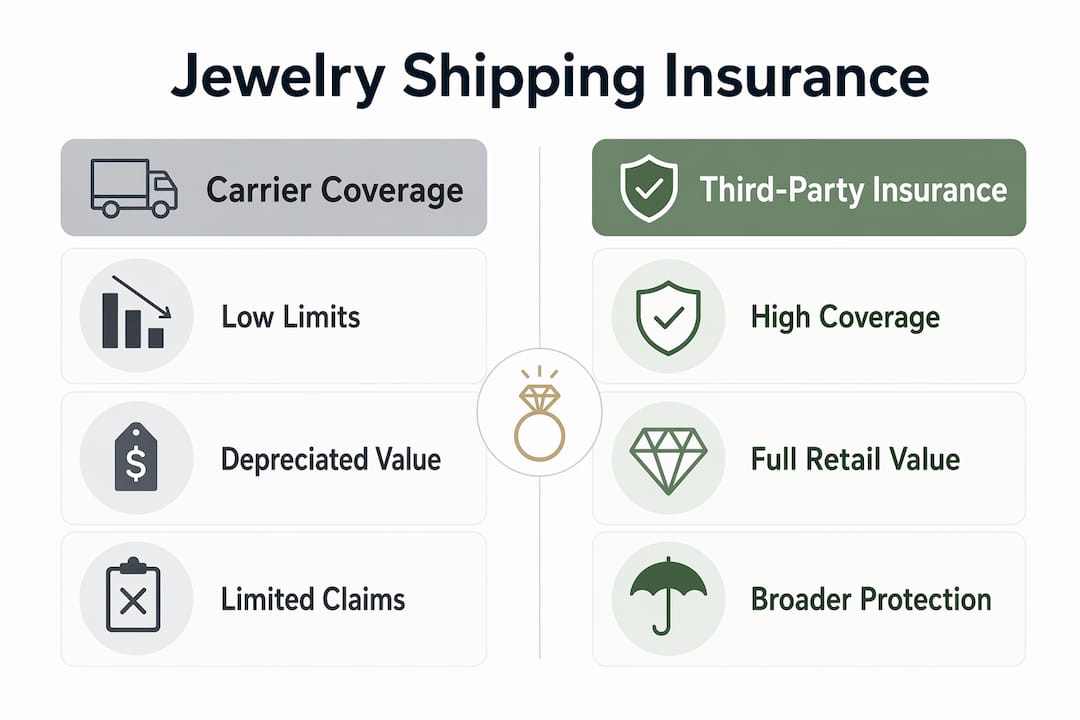
The first channel is carrier declared value. When you declare a value with FedEx, UPS, or USPS, you are not purchasing insurance in the traditional sense. You are establishing a contractual liability limit that the carrier will honor only if you can prove the loss was their fault. Carriers like FedEx and UPS cap their default liability at roughly $1,000 for jewelry, regardless of what you declare. Payouts are calculated on depreciated acquisition cost, not current market value, and claims can take 30–90 days to resolve.
The second channel is third-party all-risk insurance. This coverage pays out based on the full declared retail value of the item, without requiring you to prove carrier fault. Providers like Jewelers Mutual and ParcelPro specialize in high-value goods and typically settle claims far faster than carriers do.
For shipments above $10,000, combining a high-tier carrier service with a specialized third-party policy is the industry standard. Neither layer alone provides complete protection.
What jewelry shipping insurance typically covers
Coverage varies by provider, but most policies address the same core risks:
- Theft during transit: Covered by virtually all third-party jewelry policies.
- Loss or non-delivery: Covered when the package cannot be located by the carrier.
- Physical damage: Covered when the item arrives broken or deformed.
- Mysterious disappearance: Covered under most all-risk third-party policies, not standard carrier programs.
Carrier coverage limits matter here. USPS Registered Mail covers up to $50,000 domestically and uses a chain-of-custody protocol where every handler signs for the package. FedEx’s Declared Value Advantage program reaches up to $100,000 for contracted shippers. UPS caps liability at $1,000 for precious metals unless you have a negotiated High-Value Goods contract.
Third-party insurers fill the gaps above those caps and cover scenarios carriers exclude entirely. For international shipments, USPS Registered Mail’s international tier caps insurance at roughly $40 regardless of declared value, making private specialty insurance the only viable option for cross-border shipments above $1,000.

What typically voids coverage: improper packaging, under-declared value, no signature confirmation, and missing proof of contents. Know these exclusions before you ship.
How to obtain jewelry shipping insurance effectively
Getting the right coverage starts with an accurate declared value. Insure for the full retail replacement cost of the piece, not its wholesale price or what you paid for it. Under-declaring to save on premiums is one of the fastest ways to have a claim denied.
- Step 1: Get a current appraisal for any piece worth more than $1,000. Keep the appraisal document with your shipping records.
- Step 2: Decide whether carrier declared value or third-party insurance fits your shipment. For anything above $1,000, third-party coverage is the more reliable choice.
- Step 3: For shipments above $10,000, contact a specialty provider like Jewelers Mutual or ParcelPro directly. These providers require serialized inventory records and may ask for your packaging standard before issuing a policy.
- Step 4: Purchase the policy before the parcel is collected, not after. Most specialty insurers let you enter a tracking number and declare value in under two minutes.
- Step 5: Retain every document: the appraisal, the purchase receipt, the drop-off or pickup receipt, and the policy confirmation.
If you buy jewelry online from a reputable retailer, confirm that insured shipping is included before checkout. Bakergoldchains, for example, includes free insured shipping on orders over $150.
What does jewelry shipping insurance cost?
Jewelry shipping insurance costs typically range from 0.5% to 2% of the declared value depending on carrier, insurance provider, and shipment specifics. Specialty third-party premiums are generally lower per dollar than carrier declared value surcharges. Factors like declared value, destination, transit speed, and packaging standard all influence your final premium. Budget insurance as a fixed line item in your shipping cost, not an afterthought.
How to file a jewelry shipping insurance claim successfully
A claim lives or dies on documentation. Before you seal the box, photograph the jewelry from multiple angles, including any serial numbers or hallmarks. Keep that photo with a timestamp. Then photograph the packaged item before it leaves your hands.
When something goes wrong:
- Report immediately. Notify both the carrier and your insurer as soon as you discover the loss or damage. USPS requires claims for lost items within 60 days of mailing.
- Gather your proof. You need the appraisal, the purchase receipt, the timestamped pre-shipment photos, and the drop-off or pickup receipt.
- File through your insurer’s portal. Third-party providers typically resolve claims faster than carriers.
The most common reasons claims are denied: no serial-numbered inventory, under-declared value, improper packaging, and indirect signature delivery. Avoiding those four mistakes puts you in a strong position before a claim ever needs to be filed.
Best practices to securely ship jewelry with insurance
Insurance covers your financial loss. Good shipping practice prevents the loss from happening in the first place. Use both together.
- Double-box every shipment. Place the jewelry in a padded inner box, then seal that inside a plain outer box with no branding or value indicators.
- Remove identifying labels. Words like “Gold” or “Jewelry” on a label invite theft. Keep the outer box completely neutral.
- Require direct signature. Direct signature delivery is the single most effective defense against fraudulent “delivered but not received” claims. Pay the incremental fee.
- Schedule a pickup or use a staffed counter. Drop boxes are the weakest point in the chain of custody. A pickup receipt or counter receipt is often the deciding document in a claim.
- Share tracking and coverage details with the recipient. A buyer who knows the package is insured and tracked feels confident, not anxious.
Pro Tip: Photograph the sealed outer box next to the carrier’s tracking label before handing it over. That single image proves the parcel entered the carrier’s network in good condition.
Handling high-value or antique pieces
High-value and antique pieces require a different level of care than standard jewelry shipments. A contemporary 14K gold chain has a clear market price; an antique brooch or a one-of-a-kind heirloom piece does not. For those items, a certified appraisal from a credentialed gemologist or estate jewelry specialist is not optional. It is the document your insurer will use to determine the payout.
For high-value pieces, specialty armored carriers provide last-mile handling beyond standard parcel networks. The total shipping cost for a high-value heirloom can represent a small percentage of declared value once specialty insurance and armored delivery are factored in, which is generally justified by the risk exposure of shipping uninsured. Antique pieces should also be wrapped to prevent movement inside the box, since vibration damage during transit is a real and common claim category for fragile settings.
Choosing the right insurance provider
The right provider depends on your shipment value and how often you ship. For occasional personal shipments under $1,000, carrier declared value may be sufficient. For anything above that threshold, a specialty provider gives you better coverage terms and faster claims.
Jewelers Mutual and ParcelPro are the two most recognized names in high-value jewelry shipping. ParcelPro, a UPS subsidiary, offers coverage up to $200,000 per shipment and serves both domestic and international routes. Jewelers Mutual focuses specifically on jewelry and has higher claim acceptance rates than carrier-issued coverage. When evaluating any provider, ask three questions: Does the policy cover full retail value or depreciated cost? How long does claim resolution take? What documentation does the provider require upfront?
Working with a reputable jewelry supplier who already has specialty insurance relationships in place removes much of this burden from the buyer.
Comparing different insurance policies and coverage limits
Not all policies protect you equally. The table below shows how the major options compare on the factors that matter most.
| Coverage type | Maximum coverage | Claim basis | Typical resolution |
|---|---|---|---|
| USPS Registered Mail | $50,000 domestic | Replacement cost | Varies by claim |
| FedEx Declared Value Advantage | $100,000 (contracted) | Depreciated value | 30–90 days |
| UPS High-Value Goods contract | Negotiated ceiling | Depreciated value | 30–90 days |
| Specialty third-party (e.g., ParcelPro) | Up to $200,000 | Full retail value | Often within days |
The critical distinction is claim basis. Carrier programs pay depreciated acquisition cost, which can be far below what you paid or what the piece is worth today. Third-party specialty policies pay full retail value, which is what you actually need to replace the item. For any piece where current market value exceeds original purchase price, that difference is the entire argument for third-party coverage.
Legal considerations and liability during shipping
Carrier liability is a contractual matter, not a legal guarantee of full reimbursement. When you ship with FedEx, UPS, or USPS, you agree to their terms of service, which cap liability at specific amounts for jewelry and precious metals. UPS’s Terms and Conditions of Service, for example, cap liability at $1,000 for gold, silver, platinum, and loose gemstones absent a High-Value Goods contract, regardless of declared value.
Under-declaring value to reduce insurance cost can void your coverage entirely and may create legal complications if a claim is disputed. Always declare the actual value. For international shipments, accurate HS codes (typically 7113 for articles of jewelry made from precious metal) and a correct commercial invoice are legal requirements in most destination countries. Under-declaring to reduce customs duties voids most insurance policies and exposes you to customs penalties.
Sellers also carry a duty of care to buyers. If you ship a high-value piece without adequate insurance and it is lost, you may be legally obligated to refund the buyer in full, out of pocket. Insured shipping is not just financial protection for the item. It is protection for the commercial relationship.
Key Takeaways
Insured shipping for jewelry is the most direct way to protect both the financial value of a piece and the trust of the person receiving it.
| Point | Details |
|---|---|
| Carrier limits are low | FedEx and UPS cap default jewelry liability at $1,000; third-party insurance fills the gap above that. |
| Cost is modest | Specialty insurance costs typically range from 0.5% to 2% of declared value, depending on the shipment and provider. |
| Documentation wins claims | Timestamped photos, appraisals, and pickup receipts are the three documents that determine claim success. |
| Direct signature is non-optional | Requiring direct signature delivery is the most effective defense against fraudulent non-delivery claims. |
| High-value pieces need specialty providers | Pieces above $10,000 require a specialty insurer like Jewelers Mutual or ParcelPro for full retail value coverage. |
At Bakergoldchains, every order over $150 ships with free insured delivery, so your solid gold piece arrives protected from the moment it leaves our hands. Browse our 14K gold necklace collection and shop with the confidence that your purchase is covered.