

Why Jewelry Authenticity Matters for Gold Buyers
Jewelry authenticity is defined as independent, verifiable proof that a piece is genuine in its materials, craftsmanship, and provenance, confirmed through hallmarking systems, lab certifications, and official documentation. For anyone buying gold jewelry, this verification is not optional. It determines whether you are paying for real 14K or 18K gold or a convincing substitute. In 2026, tools like BIS hallmarking with HUID codes, GIA and IGI lab reports, and the BIS Care app have made the importance of jewelry authenticity more measurable and accessible than ever before. Understanding how to use these tools protects your money, your confidence, and the long-term value of every piece you own.
Why is jewelry authenticity important for buyers?
The importance of jewelry authenticity goes well beyond knowing a piece looks real. Authentication builds buyer confidence, supports resale value, and simplifies insurance appraisal processes. Without it, you are relying entirely on a seller’s word, which is a weak foundation for any significant purchase.
Here is what verified authenticity directly delivers for you as a buyer:
- Fraud prevention. Counterfeit gold pieces are sold with convincing karat stamps and packaging. Independent certification removes the seller from the equation and gives you an objective record of what the metal actually contains.
- Resale value. Certified diamonds resell for 15 to 25% more than uncertified stones, and the same principle applies to gold jewelry. Documented authenticity gives future buyers confidence, which translates directly into a higher selling price.
- Insurance and appraisal accuracy. Insurers require proof of what a piece is worth and what it is made of. A certified piece with documented metal fineness and provenance moves through the claims process faster and with fewer disputes.
- Emotional and milestone value. Jewelry tied to engagements, anniversaries, or inheritance carries personal significance. Authentication is emotionally critical because buyers want certainty that a piece represents exactly what it claims, especially when it marks a life event.
Buying gold jewelry without independent proof is the equivalent of buying a used car with no service history. You have less information, less leverage, and more risk.
The financial stakes are real. A gold chain sold as 18K but made from 10K gold represents a significant overpayment. Authenticity verification is the only reliable way to close that gap between what you are told and what you actually receive.
What are the main methods used to verify jewelry authenticity?

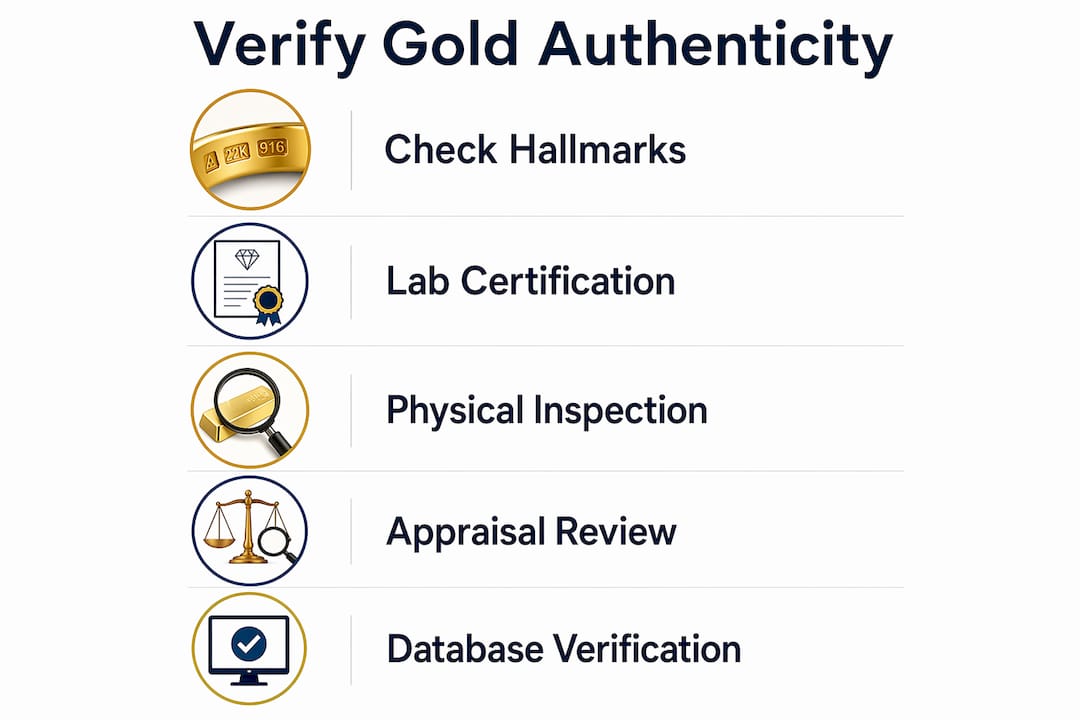
Several recognized systems exist for confirming that gold jewelry is genuine. Each serves a different purpose, and understanding the differences helps you know which to ask for before you buy.
Hallmarking systems
A hallmark is an official stamp applied to a metal item to certify its purity. In India, the BIS hallmarking system assigns a unique 6-character HUID code to every certified gold piece, which consumers can verify instantly using the BIS Care app. This system now covers over 60 crore items, making it one of the most extensive consumer protection programs in the gold market. In the United States, karat stamps such as 10K, 14K, and 18K serve as the primary purity indicators, though these are not independently verified by a government body the way BIS hallmarks are.
The critical limitation of physical hallmarks is that hallmark impressions can be polished off or counterfeited. A stamp alone is not enough. Unique verification codes tied to official databases provide durable, reliable proof that a physical stamp cannot.
Lab certifications
Organizations like GIA (Gemological Institute of America), IGI (International Gemological Institute), and AGS (American Gem Society) issue lab reports for diamonds and gemstones. These reports document cut, color, clarity, and carat weight with precision. GIA certification commands a 12 to 20% premium over IGI for similar quality stones, reflecting the market’s recognition of issuer reputation. For gold chains and solid gold jewelry, lab certifications focus on metal fineness and composition rather than gem grading.
Certificates vs. appraisals vs. physical inspections
These three terms are often confused, but they serve distinct purposes.
| Document type | What it confirms | Who issues it |
|---|---|---|
| Lab certificate | Metal purity, gem quality, item identifiers | GIA, IGI, AGS, BIS |
| Appraisal | Market or replacement value | Licensed appraiser |
| Physical inspection | Visual condition, hallmark presence | Jeweler or buyer |
A lab certificate is objective and standardized. An appraisal reflects market conditions and can vary between appraisers. A physical inspection is a starting point, not a conclusion. For high-value gold purchases, you want all three.
Pro Tip: Use the BIS Care app to scan the HUID code on any BIS-hallmarked gold piece before you agree on a price. The app returns purity details within seconds and costs nothing to use.
How can buyers practically verify authenticity before purchasing?
Knowing the verification tools is useful. Knowing how to apply them step by step is what actually protects you. Consumer verification workflows in 2026 recommend a three-step process: authenticate the certificate, confirm the physical item matches the certificate, then make your pricing decision.
Here is how to apply that process:
- Check the hallmark first. Look for a karat stamp (10K, 14K, 18K) or a BIS HUID code on the piece. The stamp should be clean, clearly engraved, and located in a standard position such as the clasp or inner band. If the stamp is blurry, inconsistent, or missing, treat that as a warning.
- Verify the certificate against the issuer’s database. GIA, IGI, and BIS all maintain online databases where you can enter a report number and confirm the document is genuine. Do not accept a scanned PDF as final proof. Cross-check the report number directly on the issuer’s website.
- Match the certificate to the physical item. Certificates must be validated as applying to the exact physical piece via matching identifiers. Look for laser inscriptions on diamonds or HUID codes on gold items and confirm they match what the certificate states.
- Request XRF testing for high-value purchases. X-ray fluorescence (XRF) testing measures actual metal composition without damaging the piece. Combined with certificate verification, this covers both the document and the metal itself. Many reputable jewelers offer this service or can direct you to a testing facility.
- Avoid common pitfalls. Do not rely on a magnet test alone. Gold is not magnetic, but many gold-plated items also pass this test. Do not accept verbal assurances in place of documentation. And do not skip database verification just because the certificate looks professional.
Pro Tip: When buying gold jewelry online, ask the seller for the exact report number before purchase. Verify it yourself on the issuer’s database before your payment clears.
For a deeper look at how to distinguish genuine marks from decorative engravings, the guide on authentic gold and hallmarks at Bakergoldchains covers the specifics clearly.
Common misconceptions about jewelry authenticity
Several widespread beliefs about jewelry authenticity lead buyers to make poorly informed decisions. Knowing where these misconceptions fall short gives you a real advantage.
- A certificate is not automatic proof. A certificate proves what was tested in a lab at a specific time. It does not prove the item in front of you is the same item. High-value jewelry buyers should treat certificates as data to verify, not as automatic proof of authenticity. Pairing an authentic certificate with a fake item is a known fraud method.
- Maker marks are not the same as purity stamps. A brand logo or designer mark tells you who made the piece. It says nothing about metal content. Only an official karat stamp or BIS hallmark confirms purity.
- Hallmarks can be faked. Counterfeit hallmarks exist. A stamp that looks like a legitimate BIS mark or karat designation can be applied to base metal. This is why database lookup of unique codes is the standard, not visual inspection alone.
- Visual inspection has real limits. Gold-plated brass and solid gold can look identical to the naked eye. Even experienced jewelers use testing equipment rather than relying on appearance alone.
- FTC labeling rules apply to sellers, not just manufacturers. FTC 2026 guidance requires transparent labeling and disclosure of stone origin and treatment. If a seller’s marketing does not match these standards, that is a signal to ask more questions before buying.
The consistent thread across all of these misconceptions is the same: independent verification matters more than any single document or visual check.
How authenticity affects insurance, resale, and long-term investment
Verified authenticity has measurable downstream effects on what your jewelry is worth over time. These effects show up most clearly in three areas: insurance, resale, and estate planning.
For insurance, documented metal fineness and provenance allow insurers to set accurate coverage values. A piece with a BIS HUID or GIA report moves through the claims process with less friction because the insurer has objective data to work from. Without documentation, you are negotiating replacement value from a weaker position.
For resale, the financial advantage of certification is concrete. Certified pieces command measurable price premiums because buyers in the secondary market face the same authenticity concerns you do now. A gold chain or pendant with a verifiable hallmark and original documentation sells faster and at a better price than an identical piece without paperwork.
For estate planning and heirlooms, provenance documentation creates a clear record of what a piece is, where it came from, and what it was worth at the time of purchase. This record simplifies the transfer of jewelry assets and reduces disputes among heirs. In 2026, industry standards increasingly demand better proof of authenticity at every stage of a piece’s life, from manufacture to inheritance.
The practical takeaway is straightforward: not all certificates carry equal weight. Issuer reputation, traceability, and database verification determine their real value in resale and insurance contexts. A GIA report carries more market weight than a certificate from an unknown lab, and a BIS HUID code is more durable proof than a karat stamp alone.
Key takeaways
Verified jewelry authenticity is the single most reliable protection a gold buyer has against fraud, financial loss, and long-term value erosion.
| Point | Details |
|---|---|
| Authenticity defined | Independent proof of genuine materials and provenance through hallmarks and lab certifications. |
| Certification premiums | Certified pieces resell for 15 to 25% more, making documentation a direct financial asset. |
| Three-step verification | Check the certificate, verify it against the issuer’s database, then match it to the physical item. |
| Hallmarks have limits | Physical stamps can be faked or polished off; database-linked HUID codes provide durable proof. |
| Long-term value | Documented authenticity supports insurance accuracy, resale pricing, and estate planning. |
What I have learned from watching buyers skip verification
I have seen the same pattern repeat itself more times than I can count. A buyer falls in love with a piece, the price feels right, and the seller produces a certificate that looks entirely legitimate. The buyer skips the database check because the document looks professional. Weeks or months later, they discover the certificate does not match the item, or the karat stamp is on base metal with a thin gold wash.
The uncomfortable truth is that the jewelry market rewards buyers who verify and penalizes those who trust without checking. This is not a cynical view. It is a practical one. The tools to verify authenticity are free, fast, and widely available in 2026. The BIS Care app takes seconds. GIA and IGI database lookups take less than a minute. There is no good reason to skip these steps on any purchase above a few hundred dollars.
What I find most interesting is how authentication has shifted buyer expectations across the entire market. Consumers who understand verification now ask better questions, negotiate from a stronger position, and build collections that hold their value. The buyers who treat authenticity as a formality are the ones who end up with pieces they cannot insure properly or resell at a fair price.
My advice is simple: treat every certificate as a starting point, not a conclusion. Verify it. Match it to the item. And if a seller resists that process, that resistance tells you everything you need to know.
— Blayne
Shop certified gold jewelry from Bakergoldchains
Bakergoldchains sources every piece from reputable U.S. suppliers, with hallmark-certified 10K, 14K, and 18K gold across chains, pendants, earrings, and bracelets. Every item comes with transparent material documentation so you know exactly what you are buying before it ships. If you want the peace of mind that comes from verified, solid gold jewelry, the 14K yellow gold bead necklace is a strong starting point. Free insured shipping applies on orders over $150, and a lifetime craftsmanship guarantee backs every purchase. Browse the full collection at Bakergoldchains and buy with confidence.
FAQ
What is jewelry authenticity?
Jewelry authenticity is verified proof that a piece is made from the materials it claims, confirmed through hallmarks, lab certifications, or official documentation. It distinguishes genuine gold and gemstones from plated, synthetic, or misrepresented alternatives.
Why do jewelry authenticity certificates matter?
Certificates from recognized labs like GIA or IGI provide an independent record of metal purity and gem quality that supports insurance, resale, and buyer confidence. Without a verifiable certificate, buyers have no objective basis for the seller’s claims.
How do I verify jewelry authenticity before buying?
Check the hallmark or HUID code, verify the certificate number against the issuer’s official database, and confirm the physical item matches the certificate’s identifiers such as laser inscriptions. For high-value pieces, XRF testing confirms actual metal composition.
Can hallmarks be faked?
Yes. Counterfeit hallmarks can be applied to base metal, and legitimate stamps can be polished away over time. Database-linked codes like BIS HUID numbers provide more reliable proof than visual inspection of a physical stamp alone.
Does certified jewelry sell for more?
Certified pieces command measurable resale premiums. Certified diamonds resell for 15 to 25% more than uncertified stones, and the same principle applies to documented gold jewelry in the secondary market.

