

Why Buy Jewelry Online: Benefits, Safety, and Savings
Buying jewelry online gives you access to a wider selection, more competitive pricing, and greater shopping flexibility than any physical store can match. The practice of purchasing fine jewelry through e-commerce platforms has matured significantly, and today’s online retailers offer independent grading reports, virtual try-on tools, and clear return policies that make the experience both safe and rewarding. Whether you are shopping for a solid gold chain, a diamond ring, or a pair of everyday earrings, understanding the benefits of buying jewelry online helps you make smarter decisions with confidence.
Why buy jewelry online instead of in a store
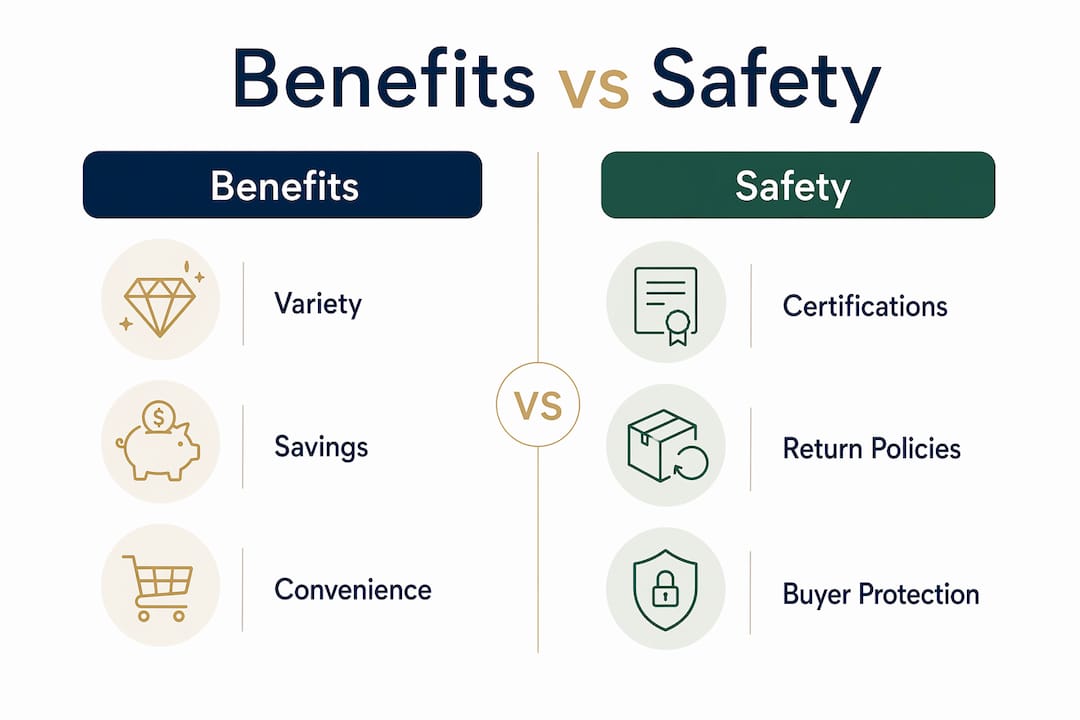
The most compelling reason to buy jewelry online is the ability to verify detailed product information independently and compare inventory extensively without sales pressure. In a physical store, your choices are limited to what fits in a display case. Online, you can browse hundreds of styles, metal types, and price points in the time it takes to drive to a mall.
Online retailers also operate with lower overhead than brick-and-mortar stores, and those savings pass directly to you. Rent, staffing, and display costs add up fast for physical retailers, which is why their prices are typically higher for comparable pieces. Online stores offer larger inventories and lower overhead, leading to more variety and competitive pricing compared to traditional stores. That means you can often find a better piece at a lower price per carat or per gram when shopping online.

Shopping online also removes the time pressure that comes with an in-store visit. You can research a piece over several days, read reviews, compare specifications, and return to your cart without a salesperson hovering nearby. That calm, unhurried process leads to better decisions.
What certifications and product details assure quality online
Independent grading reports from labs like GIA (Gemological Institute of America) or IGI (International Gemological Institute) are the gold standard for verifying diamond and gemstone quality online. Reputable online jewelers provide grading reports with detailed measurements, color grades, clarity grades, and high-resolution images or 360° videos. These reports replace the in-store loupe and give you objective data rather than a salesperson’s description.
Here is what to look for when reviewing a product listing:
- Grading report number: Every certified diamond or gemstone has a unique report number. Confirm the number on the product listing matches the certificate posted online.
- Color and clarity grades: GIA grades diamonds on a D-to-Z color scale and a Flawless-to-Included clarity scale. Knowing where a stone falls on both scales tells you exactly what you are buying.
- Clarity plot: A clarity plot is a diagram showing the location of inclusions inside the stone. It is a reliable indicator that the certificate matches the actual product.
- High-resolution images and 360° video: Static photos are not enough. Look for listings that include multiple angles and video so you can assess brilliance and surface quality.
- Metal specifications: For gold jewelry, check for karat stamp information (10K, 14K, 18K), metal weight in grams, and construction details like solid versus hollow.
Comparing grading report numbers with the actual product online is feasible and reduces the risk of misrepresentation significantly. This one step separates informed buyers from those who rely on trust alone.
Pro Tip: Before purchasing any certified diamond online, search the GIA or IGI database directly using the report number provided in the listing. If the number does not return a match, do not proceed with the purchase.
How do virtual try-on tools improve online jewelry shopping?
Virtual try-on technology is one of the most significant advances in online jewelry retail. Virtual ring try-on features simulate realistic placement and sparkle on your hand using your device’s camera, so you can see how a ring looks before you buy it. This directly addresses one of the biggest concerns shoppers have about buying jewelry online: not knowing how it will look when worn.
The best virtual try-on tools go beyond a simple overlay. They include:
- Multi-ring stacking: Test how multiple rings look together on the same finger.
- Real-world sparkle simulation: See how a stone catches light in different environments.
- Accurate scaling: The ring appears at the correct size relative to your hand, not just as a decorative graphic.
- Multiple viewing angles: Rotate the piece to see it from the side and front.
Virtual try-on tools must include accurate scaling and multiple viewing angles to truly reduce uncertainty. Glam photos alone are not a reliable substitute for seeing a piece on your actual hand. When a retailer offers a well-built try-on feature, it signals that they take product transparency seriously.
360-degree product videos serve a similar purpose for chains, bracelets, and earrings. Seeing a piece move under light tells you far more about its finish and construction than a single flat photograph. Retailers like those featured on designer jewelry platforms increasingly use interactive visuals as a standard part of the product experience, raising the bar for what shoppers should expect.
What buyer protections make online jewelry purchases low risk?
Buying jewelry online is safe when you shop with retailers who offer clear, documented protections. The three most important safeguards are a solid return policy, insured shipping, and your credit card dispute rights.
-
Review the return policy before you buy. Clear return policies, such as a 30-day window for returns on unworn items, make outcomes predictable. Read the conditions carefully: some policies require original packaging, unaltered items, or a return authorization number.
-
Confirm insured shipping is included. Jewelry lost or damaged in transit is a real risk. Reputable retailers include insured shipping on orders above a minimum threshold. Bakergoldchains, for example, offers free insured shipping on orders over $150, which means your purchase is protected from the moment it leaves the warehouse.
-
Use a credit card, not a debit card. Credit card dispute rights under the Fair Credit Billing Act give you leverage when items are damaged, not received, or misrepresented, with roughly 60 days to file a dispute. That protection does not exist with debit cards or wire transfers.
-
Document everything. Save your order confirmation, product photos, and any seller communications. If an issue arises, this documentation is your evidence.
-
Contact the seller first, then escalate. Dispute escalations are most effective when buyers act promptly, document purchase details, and escalate before credit card dispute deadlines. Start with the retailer’s customer service team, and if that fails, file a dispute with your card issuer before the deadline.
Pro Tip: Screenshot the product listing, including the description and price, before completing your purchase. Product pages can change, and that screenshot serves as proof of what was advertised if a dispute arises.
How does online jewelry shopping offer better variety and pricing?
The pricing and selection advantages of online jewelry retail are real and measurable. Physical stores carry what fits their floor space and what their buyers chose months in advance. Online retailers carry far broader catalogs, including diverse cuts, settings, lab-grown and natural diamonds, and multiple metal types, all accessible from one search bar.
| Factor | Physical store | Online retailer |
|---|---|---|
| Inventory size | Limited by floor space | Hundreds to thousands of SKUs |
| Price per carat | Higher due to overhead | Lower due to reduced operating costs |
| Comparison shopping | Requires visiting multiple stores | Side-by-side in one browser tab |
| Sales pressure | Present | None |
| Availability | Store hours only | 24/7 |
When calculating total cost online, factor in shipping fees, applicable taxes, and whether insurance is included. Many online retailers offer free insured shipping above a threshold, which can make the total cost lower than an in-store purchase even before accounting for the base price difference. The ability to compare products and pricing side by side in one browser tab is a structural advantage that physical retail simply cannot replicate.
What practical tips help you buy jewelry online safely?
Safe online jewelry shopping comes down to knowing what to look for and what to avoid. These tips apply whether you are buying a solid gold chain from Bakergoldchains or a diamond ring from any other reputable retailer.
- Check seller transparency. Transparent seller disclosures on metal type, weight, and construction are non-negotiable. Vague descriptions or missing weight information are red flags. A trustworthy listing tells you the karat, the gram weight, and how the piece is constructed.
- Read reviews for product-specific details. Look for reviews that mention durability, wear over time, and whether the piece matched the listing. Generic five-star reviews without specifics are less useful than detailed accounts of real wear experience.
- Request certificates and verify them. For diamonds and gemstones, ask for the GIA or IGI report number and verify it directly in the lab’s online database before purchasing.
- Use sizing guides and ask for close-up photos. Most reputable retailers publish ring sizing guides and chain length guides. If you need a close-up of a clasp, a link, or a karat stamp, email the retailer and ask. A good seller will respond quickly.
- Avoid deals that seem too good to be true. A 14K solid gold chain priced at a fraction of market value is almost certainly not solid gold. Use current gold spot prices as a reference point and be skeptical of listings that fall far below the material cost.
Pro Tip: Before buying solid gold jewelry online, read guides like how to buy solid gold jewelry to understand what to look for in a listing and how to spot red flags before you spend.
Key takeaways
Buying jewelry online is safe, cost-effective, and offers more variety than physical stores when you know how to verify quality and use available protections.
| Point | Details |
|---|---|
| Certifications verify quality | Always request GIA or IGI grading reports and confirm the report number matches the product. |
| Virtual try-on reduces uncertainty | Use tools with accurate scaling and multiple angles to assess fit and appearance before buying. |
| Return policies and insured shipping protect you | Confirm a clear return window and insured shipping before completing any purchase. |
| Credit card rights are your safety net | The Fair Credit Billing Act gives you roughly 60 days to dispute damaged, undelivered, or misrepresented items. |
| Transparency is the top red flag indicator | Missing metal weight, vague descriptions, or no certificate information signal an untrustworthy seller. |
Why I think online jewelry shopping is smarter than most people realize
I have spent years watching people hesitate to buy jewelry online out of fear, and in almost every case, that fear came from a lack of information rather than a real risk. The tools available today, from GIA certificate verification to virtual try-on to credit card dispute rights, have made online jewelry purchasing objectively safer than walking into an unfamiliar store and trusting a stranger’s word.
What changed my perspective was realizing that the verification process online is actually more rigorous than in-store. When you buy in a store, you rely on the salesperson’s claims. Online, you can cross-reference a grading report number against a lab database, read dozens of real customer reviews, and compare the same piece across multiple retailers in minutes. That is more information than any in-store visit provides.
The one area where I still advise caution is with sellers who lack transparency on materials and weight. A listing that does not tell you the gram weight of a gold chain or the karat of the metal is not a listing worth trusting, regardless of how good the photos look. Stick with retailers who publish authentic jewelry benefits clearly and back their products with real guarantees. The combination of education and the right retailer makes online jewelry shopping one of the smartest purchasing decisions you can make.
— Blayne
Shop solid gold jewelry with confidence at Bakergoldchains
Bakergoldchains makes it straightforward to put everything in this article into practice. Every piece in the catalog is made from solid 10K, 14K, or 18K gold sourced from reputable U.S. suppliers, with full material transparency on every listing.
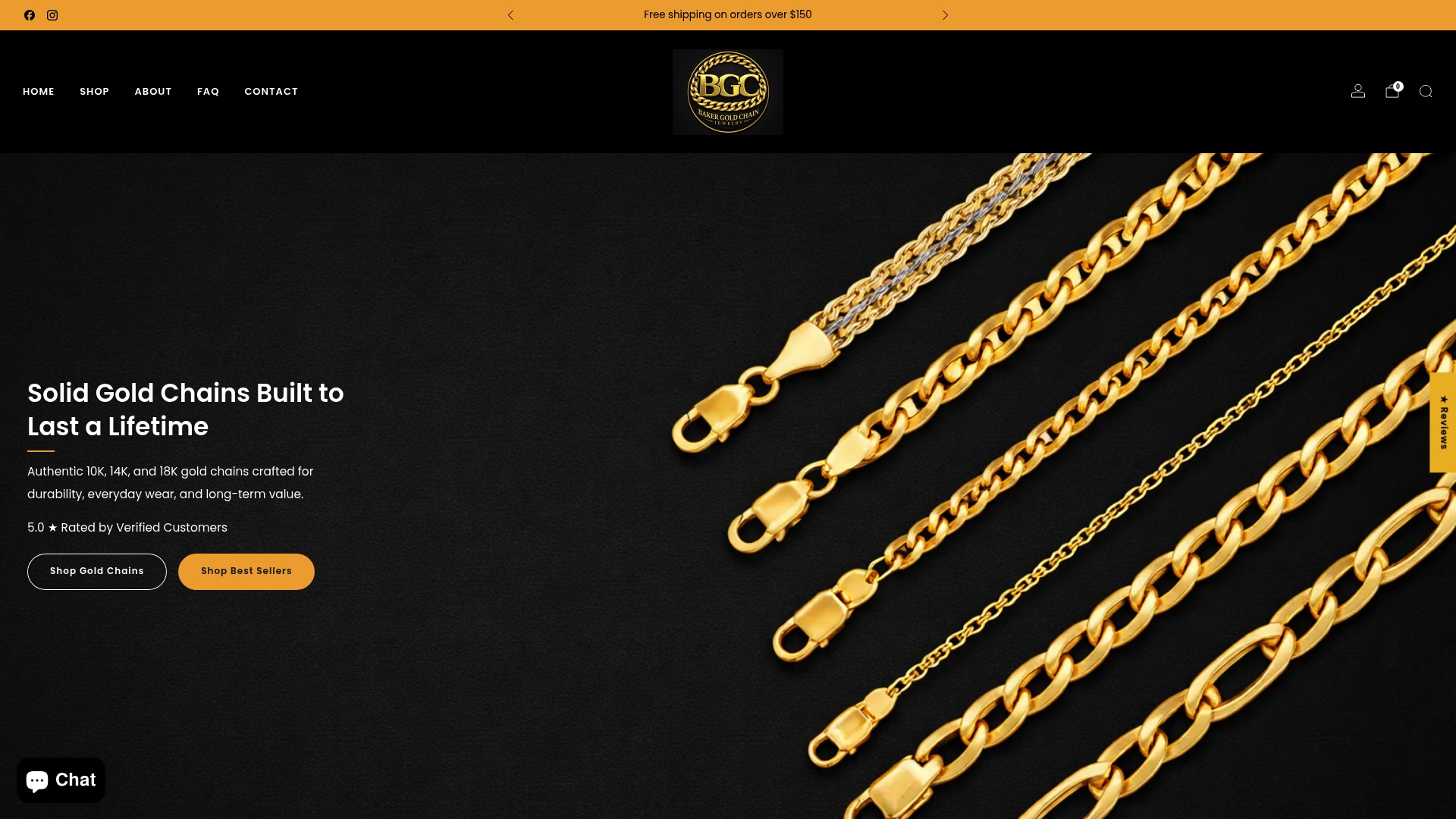
Two pieces worth exploring right now: the 14K yellow gold bead necklace is a timeless everyday piece with a graduated design that photographs beautifully and wears even better. For earrings, the 14K yellow gold wedding hoops offer clean, classic style with the durability you expect from solid gold. Both ship free and insured on orders over $150, and both are backed by Bakergoldchains’ lifetime craftsmanship guarantee. Browse the full catalog at bakergoldchains.com to find the right piece at the right price.
FAQ
Why buy jewelry online instead of in a store?
Buying jewelry online gives you access to larger inventories, lower prices due to reduced overhead, and the ability to compare products side by side without sales pressure. Independent grading reports and virtual try-on tools make the experience as informed as any in-store visit.
Is it safe to buy jewelry online?
Yes, buying jewelry online is safe when you shop with retailers who provide independent lab certificates, clear return policies, and insured shipping. Credit card dispute rights under the Fair Credit Billing Act add an additional layer of protection for roughly 60 days after purchase.
How do I verify the quality of jewelry bought online?
Request the GIA or IGI grading report number from the listing and verify it directly in the lab’s online database. For gold jewelry, confirm the karat stamp, gram weight, and construction details are clearly disclosed in the product description.
What should I look for in an online jewelry return policy?
Look for a minimum 30-day return window on unworn items, clear conditions for eligibility, and confirmation that return shipping is either free or insured. Clear return and refund policies are a major factor that turns online jewelry buying from a risky proposition into a predictable and safe experience.
How do I spot a trustworthy online jewelry seller?
A trustworthy seller discloses metal type, karat, gram weight, and construction details on every listing. They provide independent lab certificates for diamonds and gemstones, publish real customer reviews with product-specific details, and offer insured shipping with a documented return policy.

