

Pendant necklace guide: Styles, meaning, and how to choose
A pendant necklace and a plain chain necklace might look similar hanging in a jewelry case, but they are two very different things. Mistaking one for the other can lead to a gift that misses the mark or a purchase that doesn’t work the way you expected. If you’ve ever wondered exactly what makes a pendant necklace distinct, how its parts work together, and which style fits your needs, you’re in the right place. This guide covers the definition, anatomy, popular styles, and practical selection tips so you can shop with real confidence.
Table of Contents
- What defines a pendant necklace?
- The anatomy: Chain, pendant, and bail explained
- Pendant necklace styles and their meaning
- How to choose a pendant necklace: Practical tips
- A jeweler’s perspective: What most buyers overlook about pendant necklaces
- Find your perfect pendant necklace at Baker Gold Chains
- Frequently asked questions
Key Takeaways
| Point | Details |
|---|---|
| Pendant necklace basics | A pendant necklace is a chain with a decorative ornament that dangles from a loop called a bail. |
| Importance of bail compatibility | The chain and pendant bail must match in size and strength for both style and safety. |
| Variety and meaning | Pendant necklaces come in many styles, each offering unique symbolism and gift potential. |
| Smart buying tips | Choose chain types and weights that fit the pendant for optimal look and longevity. |
What defines a pendant necklace?
The simplest way to understand a pendant necklace is to think of it as two things working together: a chain and a hanging ornament called a pendant. A plain chain necklace is worn on its own, with no attached ornament. A pendant necklace always features something that dangles from the chain, whether that’s a gemstone, a symbol, a locket, or a sculpted design.
Here’s a quick breakdown of how the two compare:
| Feature | Plain chain necklace | Pendant necklace |
|---|---|---|
| Main element | Chain only | Chain plus pendant |
| Style focus | Texture and links | The hanging ornament |
| Customization | Limited | High (swap pendants) |
| Common occasion | Everyday layering | Gift giving, milestones |
| Price range | Varies by metal | Varies by metal and stone |
The pendant is the focal point. It carries meaning, personality, and visual impact. Pendant styles and quality can vary enormously, from a tiny diamond solitaire to a large religious medallion.
The connection between the pendant and the chain is made through a small component called a bail (sometimes called a loop). As noted by jewelry experts, a pendant connects to the chain via a small loop (often called a bail), which allows the pendant to hang and sometimes slide for movement. This detail matters more than most buyers realize, and we’ll explain exactly why in the next section.
Key components at a glance:
- Chain: The structural element worn around the neck
- Pendant: The decorative ornament that hangs from the chain
- Bail: The connector loop that joins pendant to chain
“Understanding the relationship between these three parts is the foundation for making a smart, confident purchase. Skip this step and you risk buying a beautiful pendant that simply won’t work with your chain.”
The anatomy: Chain, pendant, and bail explained
Now that you know what makes a pendant necklace, let’s look closely at each part and why it matters when you’re shopping.
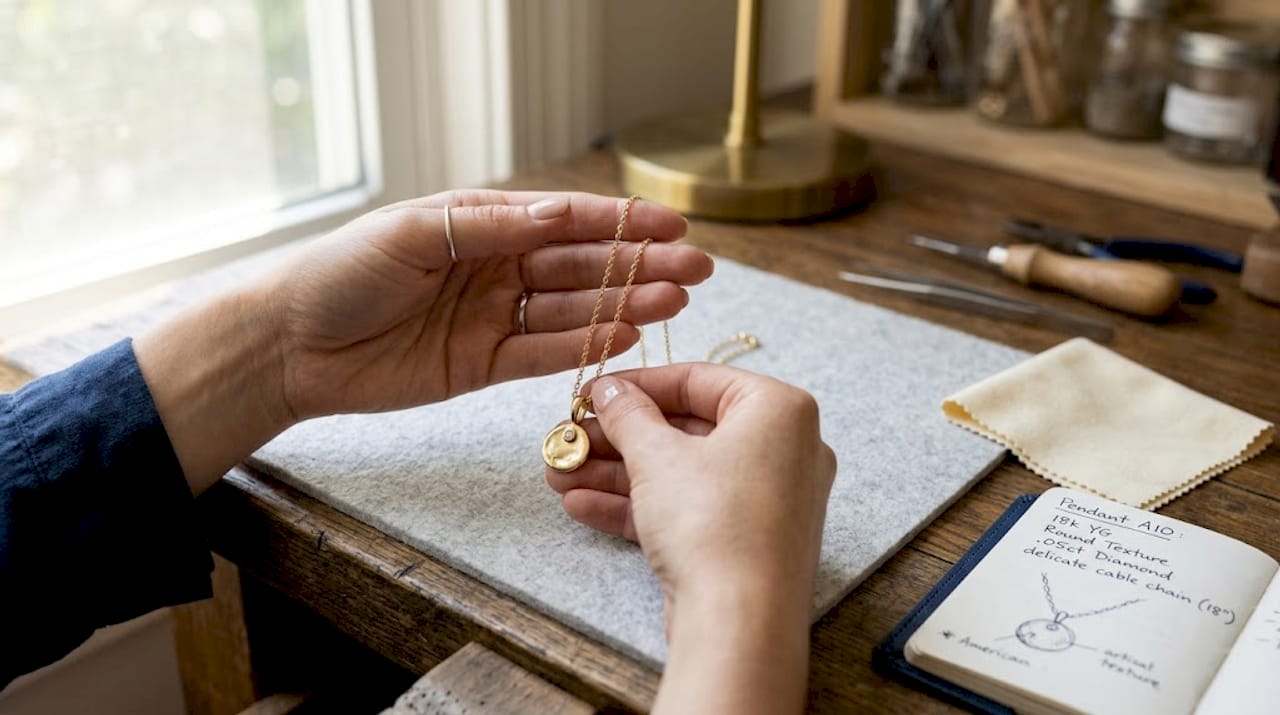
The chain is the backbone of the whole piece. It determines how the necklace sits on your body, how durable it is over time, and how well it can carry the weight of the pendant. Not every chain style is equally suited for a pendant. Some link types are delicate and work best with lightweight ornaments. Others are sturdy enough to handle heavy medallions or gemstone drops.
The pendant is where the design story lives. It can be as simple as a polished gold disc or as elaborate as a pavé diamond cross. Size, weight, and material all affect how the pendant wears on a daily basis. A large, heavy pendant on a thin chain will pull uncomfortably and may even damage the chain over time.
The bail is the unsung hero of pendant necklace design. It’s the small loop, ring, or clasp at the top of the pendant that the chain threads through. There are three main bail types you’ll encounter:
- Classic fixed bail: A simple soldered loop. Common on solitaire pendants and gemstone drops. The chain stays centered.
- Enhancer bail: A clip or pinch mechanism that lets you attach and remove the pendant from the chain without opening a clasp. Great for interchangeable pendant collections.
- Split bail (double loop): Two loops side by side, allowing the pendant to lie flatter against the chest and distribute weight more evenly. Often seen on diamond halo pendants.
Here’s a comparison of bail types to help you decide:
| Bail type | Best for | Chain compatibility |
|---|---|---|
| Classic fixed bail | Solitaires, simple pendants | Most chain styles |
| Enhancer bail | Interchangeable sets | Specific box or cable chains |
| Split bail | Heavier or larger pendants | Wider chains |
When it comes to matching chain and bail, size and weight alignment is critical. Heavier pendants need thicker, more robust chains, and the chain must be compatible with the pendant’s bail or loop. A chain that is too thin will flex and eventually break. A bail that is too narrow won’t allow a standard chain to pass through comfortably.
Your pendant chain selection should always start with knowing the bail’s interior diameter. Most retailers list this measurement, and matching it correctly means your pendant will hang smoothly and securely.
Understanding how chain style impacts durability is equally important. A delicate Singapore chain might look elegant under a small gold charm, but it wouldn’t hold up under a solid gold medallion. Franco and rope chains, by contrast, are built for weight and daily wear.
Pro Tip: When shopping online, always check the bail’s inner diameter (measured in millimeters) and compare it to the chain width you’re considering. If the chain is wider than the bail opening, the pendant simply won’t thread on.
Pendant necklace styles and their meaning
With the anatomy covered, it’s time to explore what’s actually out there. Pendant necklace styles are one of the most varied categories in jewelry, and the right style carries real personal meaning.
As a reference point, a pendant is the hanging ornament attached to the chain, and every style listed below falls into that definition, even though they look dramatically different from one another.
Here are the most popular styles and what they typically represent:
- Solitaire pendant: A single gemstone, usually a diamond or colored stone, set in a simple prong or bezel. It represents clarity, elegance, and timeless taste. Ideal for anniversaries, birthdays, and milestone gifts.
- Locket pendant: A small hinged case that opens to hold a photo or keepsake. Lockets carry deep sentimental value and are popular for memorial gifts or romantic gestures.
- Initial pendant: A letter shaped in gold or set with diamonds. It’s personal and direct, making it a great gift for someone who loves subtle personalization.
- Religious pendant: Crosses, stars of David, and other symbols of faith. These pieces often mark baptisms, confirmations, bar mitzvahs, or graduations.
- Charm pendant: A single decorative charm with symbolic meaning, such as a heart, star, moon, or animal. Very popular across all age groups.
- Gemstone drop: A colored gemstone in a teardrop setting. Often chosen by birthstone, adding another layer of personal meaning.
- Nature and motif pendants: Designs like butterflies, flowers, or dragonflies. These are often chosen for their artistic beauty rather than symbolic weight, though many cultures do assign meaning to specific animals and plants.
- Designer motif pendants: Bold, sculptural pieces that function more as wearable art. Often chosen by buyers who want a statement piece.
“The pendant you choose is often the piece people remember. It tells a story at a glance.”
When selecting a pendant as a gift, think about the occasion first. A religious milestone calls for a cross or faith symbol. A romantic anniversary is well suited to a solitaire diamond or heart locket. A birthday gift lands better with a birthstone drop or initial charm. For those who want something unique and personal, gold pendant styles cover a wide range of options to explore.
Matching the pendant’s visual weight to the occasion also matters. Larger, bolder pendants suit celebratory moments. Smaller, refined pieces work for everyday wear or understated elegance.
How to choose a pendant necklace: Practical tips
You now have the background knowledge. Here’s how to put it to work with a practical, step-by-step approach to choosing the right pendant necklace.
Step 1: Choose the pendant first. The pendant is the centerpiece of the whole piece, so start here. Decide on the style, size, and material before you think about the chain. Consider who will wear it and what the occasion is.
Step 2: Note the pendant’s weight and bail size. A lightweight pendant (under 5 grams) gives you more chain options. A heavier pendant (10 grams or more) requires a sturdier chain. Measure or ask for the bail’s inner diameter in millimeters.
Step 3: Select a chain that matches. Match the chain width to the bail opening. For daily wear, rope, cable, or Franco chains offer reliable strength. For a more delicate look, Singapore or box chains work well with lighter pendants.
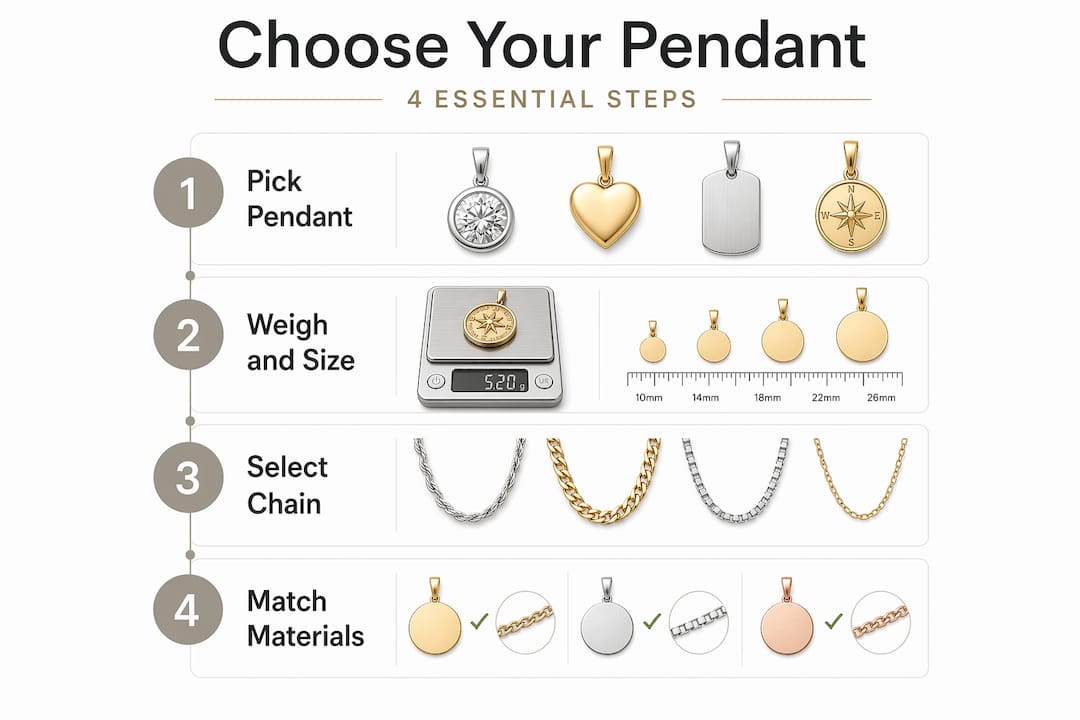
Step 4: Confirm karat compatibility. If your pendant is 14K gold, consider a 14K chain for a consistent look and matched durability. Mixing karats is fine visually, but it’s worth knowing that 10K gold is harder and more scratch-resistant, while 18K gold is softer but richer in color.
Step 5: Think about chain length. A 16-inch chain sits near the collarbone. An 18-inch chain rests just below. A 20-inch chain falls at the top of the chest. Match the length to the neckline of clothing typically worn and the visual impact you want the pendant to have.
Common mistakes to avoid:
- Choosing a chain that’s too thin for the pendant’s weight
- Ignoring the bail’s inner diameter and ending up with incompatible pieces
- Buying a low-quality chain for an expensive pendant, which shortens the life of the whole piece
- Overlooking chain length and ending up with a pendant that hides under clothing
Avoiding common gold chain mistakes makes a real difference in how long your jewelry lasts and how good it looks over time. It’s also worth understanding the difference between solid gold and plated options. Learning about gold chain versus gold plated quality will help you make a decision that holds its value.
Heavier pendants need thicker, more robust chains and the chain must be compatible with the bail or loop. This rule is simple but frequently ignored.
Pro Tip: For daily wear pendants, choose a chain that is at least 1.2mm wide for lightweight pendants and 2mm or wider for anything over 8 grams. This keeps your chain from bending, stretching, or breaking at stress points near the bail.
A jeweler’s perspective: What most buyers overlook about pendant necklaces
Most buying guides focus on style and price, and that’s where they stop. But after years of seeing how pendant necklaces actually perform in real life, a few things stand out that don’t get nearly enough attention.
The first is bail size. It’s the smallest part of the whole piece, and it causes the most problems. Buyers often fall in love with a pendant’s design, order a chain they already own, and then discover the chain won’t thread through the bail at all. Or the chain fits, but it’s so tight that the pendant can’t move freely, creating a stiff, awkward look. Always check bail measurements before buying.
The second overlooked issue is chain quality relative to pendant value. It’s surprisingly common to see someone pair a beautiful 14K gold pendant worth several hundred dollars with a low-quality or gold-plated chain. That chain will tarnish, stretch, or break, and then the pendant sits unworn in a drawer. If you invest in a meaningful pendant, match it with a chain that will last. Understanding how chain style impacts durability isn’t just a technical detail; it’s the difference between a piece you wear daily for decades and one that fails within a year.
The third point is comfort. A pendant that is too heavy for its chain length will constantly slide backward, ending up at the back of your neck instead of the front. This is not a design flaw you can live with. It’s a mismatch between pendant weight and chain weight distribution. Heavier pendants pair better with shorter chain lengths or wider chains that sit firmly in place.
Finally, think about heirloom potential. A pendant necklace made with solid gold and matched carefully to the right chain becomes a piece that lasts generations. The design may be beautiful, but the materials and construction are what make something truly last. Spend a little more on quality here, and you’ll never regret it.
Find your perfect pendant necklace at Baker Gold Chains
You’ve done the learning. Now you can shop with real clarity about what you’re looking for and why each component matters.
At Baker Gold Chains, we carry solid gold chains and pendants designed to work beautifully together. Whether you’re starting with the chain or the pendant, our collection is built for both everyday wear and milestone moments. A 10K yellow gold Singapore chain is a graceful, versatile starting point for lightweight pendants. For something with real presence, our round pendant with split bail and diamond halo in 14K white gold pairs beautifully with a matching white gold chain. And for those drawn to distinctive artistry, the 18K yellow gold and sterling silver dragonfly pendant makes an unforgettable statement. Every piece ships with free insured shipping on orders over $150, backed by our lifetime craftsmanship guarantee.
Frequently asked questions
What is the difference between a necklace and a pendant necklace?
A necklace is a chain worn around the neck on its own, while a pendant necklace includes a dangling ornament attached via a loop or bail. As jewelry experts explain, a pendant connects to the chain via a small loop (often called a bail), which is what sets it apart from a plain chain.
Which chain styles are best for pendant necklaces?
Stronger chains like rope, cable, or Singapore styles are reliable choices because they can carry the weight of most pendants without stretching or breaking. Chain selection from jewelry retailers always emphasizes matching pendant weight to chain strength for long-term wearability.
How do I know if my pendant fits my chain?
The chain must thread easily through the bail’s interior opening, and both pieces should be proportionate in weight and width. Jewelry guidance notes that heavier pendants need thicker chains and the chain must be compatible with the pendant’s bail or loop for a secure and comfortable fit.
What is the bail on a pendant necklace?
The bail is the loop at the top of a pendant that connects it to the chain and allows it to hang and move freely. According to jewelry experts, a small loop called a bail is what allows the pendant to be attached to and slide along the chain.
Are pendant necklaces suitable for gifts?
Yes, absolutely. Their wide range of meaningful designs, from religious symbols and initials to gemstones and lockets, makes them one of the most thoughtful and customizable gift choices for any occasion or budget.

