

How to Prevent Patina on Your Gold Chain
Keep your gold chain looking its best with four habits: keep it dry, avoid chemicals, wipe it after every wear, and store it separately from other jewelry. If you’re unsure whether your chain is solid gold or plated, treat it as plated. That single rule prevents most irreversible damage.
Your quick-start checklist:
- Put your chain on last, after perfume, lotion, and hairspray have dried
- Remove it before swimming, showering, working out, or cleaning with household products
- Wipe it with a soft, dry cloth after each wear
- Store it in a dry, individual pouch away from other pieces
- When in doubt about the finish, treat the piece as plated and clean accordingly
Key Takeaways
Consistent daily habits, conservative cleaning choices, and dry storage prevent most gold chain patina before it starts.
| Point | Details |
|---|---|
| Treat unknown finishes as plated | When you can’t confirm the finish, use only warm water and mild soap to avoid stripping a thin gold layer. |
| Soap and water is the default clean | A 10–15 minute soak with mild dish soap handles most buildup safely across all chain types. |
| Store dry and separated | Individual soft pouches with anti-tarnish strips prevent moisture damage and surface scratches between wears. |
| See a jeweler for base-metal exposure | Green or black skin discoloration means plating is gone; cleaning won’t fix it, but replating can. |
| Bakergoldchains solid gold chains | Solid 10K, 14K, and 18K options backed by a lifetime craftsmanship guarantee require no replating schedule. |
Table of Contents
- What is the difference between patina and tarnish on gold?
- Which gold chains tarnish the fastest?
- What daily habits prevent patina from building up?
- How do you safely clean a gold chain at home?
- How should you store a gold chain to prevent long-term patina?
- When should you see a jeweler instead of cleaning at home?
- Bakergoldchains’ expert care recommendations
- The case for prevention over restoration
- Solid gold chains from Bakergoldchains: built to last
- Sources
What is the difference between patina and tarnish on gold?
Patina and tarnish are often used interchangeably, but they describe different things. Patina is a surface change that develops gradually over time. On some metals, a subtle patina is considered desirable. On gold chains, though, most people want to avoid it because it dulls the surface and can look like discoloration.
Tarnish is a specific chemical reaction. It happens when the alloy metals mixed into gold, most commonly copper, silver, or nickel, react with sulfur compounds, oxygen, or moisture in the environment. Pure 24K gold does not chemically tarnish because it contains no reactive alloy metals. The lower the karat, the more alloy content, and the more reactive the piece.
Several everyday substances speed up this process:
- Sweat and skin oils, which contain salts and acids
- Perfumes, colognes, and hairspray, which contain alcohol and chemical compounds
- Lotions, sunscreen, and cosmetics that coat the surface and trap moisture
- Chlorine in pools and hot tubs, which aggressively attacks alloy metals
- Household bleach and cleaning sprays
- Sulfur compounds in the air, especially in urban environments
Most darkening you notice on a gold chain is removable buildup from these sources, not permanent chemical damage. A careful soap-and-water soak and a polishing cloth will restore shine in the majority of cases.
Which gold chains tarnish the fastest?
The finish type and karat of your chain determine how quickly it shows discoloration and how carefully you need to clean it. Understanding your chain type is the foundation of gold chain patina prevention.
Karat and tarnish risk:
Higher-karat gold contains more pure gold and less reactive alloy metal. A 24K chain resists chemical tarnish but still collects oils and residue that dull its surface over time. An 18K chain has less alloy content than 14K and 10K chains. Higher-karat gold contains more pure gold and is less reactive, while lower-karat gold contains more alloy metals that increase discoloration risk over time.
Finish types and their sensitivity:
- Solid gold (10K–24K): The most durable finish. Tolerates gentle cleaning methods including mild soap and water, and occasional baking-soda paste for deeper cleaning.
- Gold-filled: A thick layer of gold mechanically bonded to a base metal core. More durable than plating and tolerates soap-and-water cleaning, but abrasives and harsh chemicals will eventually wear through the layer.
- Vermeil: Sterling silver base with a gold layer at least 2.5 microns thick. More sensitive than gold-filled. Avoid abrasives and alcohol-based cleaners.
- Gold-plated: A very thin gold layer over a base metal. The most sensitive finish. Stick to warm water and mild soap only. Abrasives, acids, and even rubbing alcohol can strip the plating quickly.
- PVD (Physical Vapor Deposition): A hard, thin coating applied at the molecular level. More scratch-resistant than traditional plating but still vulnerable to harsh chemicals and abrasives.
Knowing the difference between vermeil and gold-plated finishes matters because the wrong cleaning method can strip a finish in a single session.
Pro Tip: If you don’t have documentation for your chain and can’t confirm the finish, treat it as gold-plated. This conservative approach prevents you from accidentally stripping a thin layer with a method that’s only safe for solid gold.
What daily habits prevent patina from building up?
Daily habits prevent the majority of tarnish and plating wear before any cleaning is ever needed. The most effective single habit is putting your jewelry on last. Applying perfume, lotion, or hairspray before your chain means those products land on your skin and hair, not on the metal.
Daily habits worth building:
- Put your chain on after all personal care products have dried
- Remove it before any water exposure: showers, pools, hot tubs, dishwashing
- Take it off before workouts, since sweat accelerates alloy reactions
- Remove it before using any household cleaning products
- Give it a quick wipe with a soft, lint-free cloth after each wear to remove oils and residue
Occasional habits (monthly or every few weeks):
- Do a full soap-and-water clean based on how often you wear the piece
- Inspect the clasp and individual links for stiffness, bending, or visible wear
- Check for any darkening at the clasp or link joints, where buildup concentrates
Storage and travel:
- Store each chain in its own soft pouch or lined compartment to prevent scratches and tangling
- Add an anti-tarnish strip or silica gel packet to your jewelry box or storage pouch to absorb moisture
- When traveling, lay chains flat in a small zip pouch rather than coiling them loosely in a bag
- Avoid leaving jewelry in a hot car or a humid bathroom, where temperature swings and moisture accelerate surface changes
Pro Tip: Anti-tarnish strips are inexpensive and last several months. Placing one in each storage pouch is one of the lowest-effort ways to slow patina between wears.

How do you safely clean a gold chain at home?
The right cleaning method depends on your chain’s finish. Using the wrong one can cause more damage than the tarnish itself. Warm water and mild dish soap is the safest default for all gold types, and it handles most buildup without any risk.
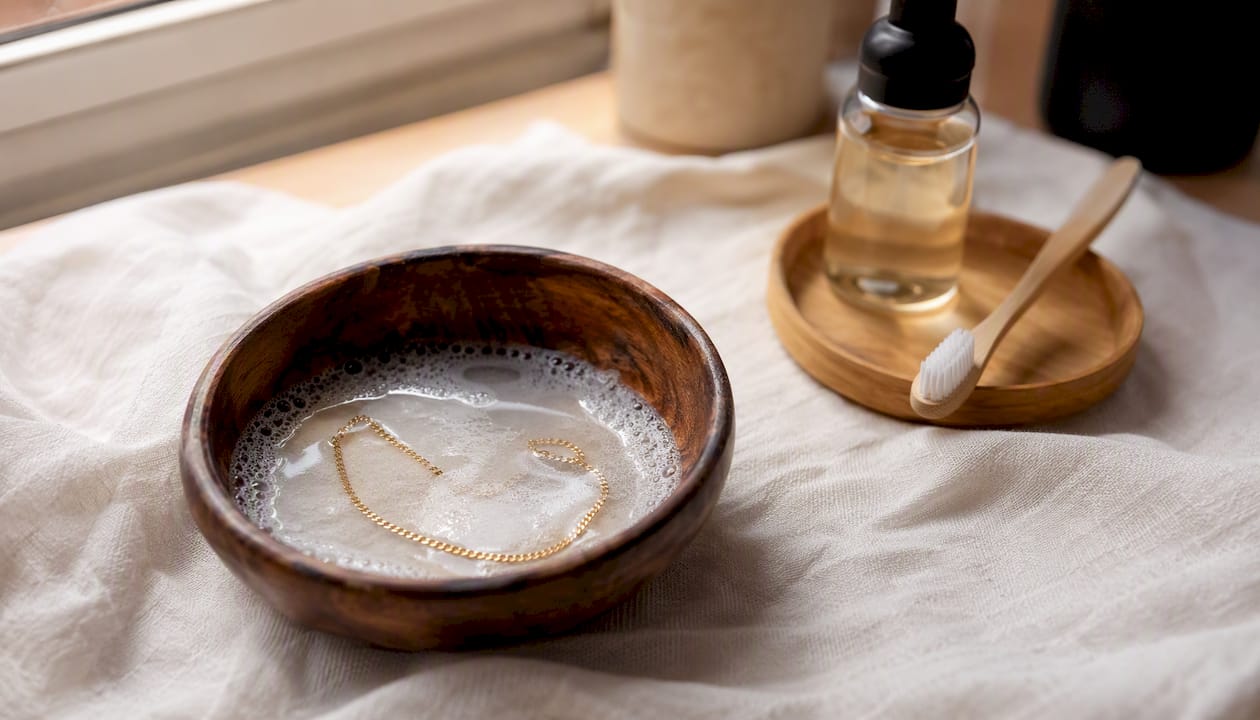
Cleaning methods by chain type:
| Method | Best for | Safety level | Frequency | Risk |
|---|---|---|---|---|
| Warm water + mild dish soap | All types | Safe for all | Weekly to monthly | None when done gently |
| Baking-soda paste | Solid gold only | Moderate | Every 2–3 months max | Dulls finish; strips plating |
| Isopropyl alcohol | Solid gold, gold-filled | Use carefully | Occasional | Can damage some plated finishes |
| Ultrasonic cleaner | Solid gold only | Safe for solid | Monthly | Damages plating and loose stones |
| Commercial dip solutions | Solid gold with caution | Moderate | Rarely | Harsh on alloys; strips plating fast |
Step-by-step soap-and-water routine:
- Fill a small bowl with warm (not hot) water and add two to three drops of mild dish soap.
- Place your chain in the bowl and let it soak for 10–15 minutes.
- Use a soft-bristled brush (a baby toothbrush works well) or your fingertip to gently clean link joints and the clasp.
- Rinse thoroughly under clean, lukewarm water. Filtered or distilled water reduces mineral deposits.
- Pat dry with a soft, lint-free cloth. Do not rub aggressively.
- Let the chain air-dry completely on a clean surface before storing or wearing it.
What permanently damages gold chains:
- Chlorine, bleach, and household cleaning sprays can permanently discolor gold alloys and strip plating in a single exposure
- Toothpaste and baking soda on plated pieces: both are abrasive enough to wear through a thin gold layer
- Acids (vinegar, lemon juice) accelerate alloy corrosion
- Acetone and nail polish remover dissolve adhesives and strip some plated finishes
Escalation ladder:
- Repeat the soap-and-water routine if light buildup returns after a few weeks
- If darkening persists after two gentle cleanings, stop and see a jeweler
- If you see green or black discoloration on your skin from the chain, the plating has likely worn through. Cleaning won’t restore it. Replating or replacement is needed.
How should you store a gold chain to prevent long-term patina?
Good storage prevents most of the moisture and contact damage that builds up between wears. The basics are straightforward, but a few details make a real difference.
- Keep chains in a dry location away from bathroom humidity. A bedroom dresser drawer is better than a bathroom counter.
- Store each piece in its own soft pouch or a lined jewelry box compartment. Contact between chains causes micro-scratches that dull the surface and wear plating faster.
- Place a silica gel packet or anti-tarnish strip inside your storage container. Both absorb moisture and slow oxidation. Replace silica packs every few months and anti-tarnish strips every three to six months.
- For long-term jewelry storage, consider airtight zip pouches or small resealable bags for pieces you don’t wear regularly.
Travel tips:
- Use a small, rigid travel jewelry case with individual compartments or hooks to keep chains from tangling.
- Lay chains flat rather than coiling them tightly, which stresses clasps and links.
- Avoid packing jewelry in checked luggage where temperature and humidity fluctuate.
Maintenance schedule:
- Light wipe after every wear
- Full soap-and-water clean every 4–6 weeks for daily-wear pieces
- Adjust frequency based on how often you wear the piece and how much you sweat
Pro Tip: A small zip-lock bag with the air pressed out is a practical, low-cost travel solution for a single chain. It keeps moisture out and prevents contact with other items in your bag.
When should you see a jeweler instead of cleaning at home?
Some problems can’t be fixed at home, and trying to force a solution can make them worse. Knowing when to stop is part of good gold chain care.
| Problem | Why home methods won’t fix it | Jeweler solution |
|---|---|---|
| Persistent dark tarnish after multiple cleanings | Deep alloy oxidation or surface pitting | Professional polish or ultrasonic + steam cleaning |
| Visible worn-through plating (skin turns green or black) | Plating is gone; base metal is exposed | Replating service |
| Deep micro-scratches across the surface | Abrasion removes metal; polishing cloth won’t reach | Professional buffing and refinishing |
| Broken or stiff clasp | Structural issue; home repair risks further damage | Clasp repair or replacement |
| Loose stone in a pendant setting | Stone can fall out; cleaning worsens the risk | Setting tightening or re-setting |
For daily-wear pieces, an annual inspection is a reasonable baseline. If your chain shows base-metal exposure, clasp stiffness, or persistent discoloration, bring it in sooner rather than waiting for the annual visit.
On cost: minor repairs like clasp replacement tend to be low-cost. Replating runs moderate depending on the piece’s size and complexity. Full refurbishment, which may include polishing, replating, and structural repairs, sits at the higher end. A jeweler can give you an accurate estimate after a quick inspection.
Bakergoldchains’ expert care recommendations
Bakergoldchains sources its chains from reputable U.S. suppliers and backs every piece with a lifetime craftsmanship guarantee. That guarantee reflects a straightforward belief: a well-made chain, properly cared for, should last a lifetime.
The care approach Bakergoldchains recommends aligns with what professional jewelers advise:
- Annual inspection for daily-wear pieces, or sooner if you notice clasp issues or base-metal exposure
- Soap-and-water cleaning as the default routine, matched to your chain’s finish type
- Professional replating or polishing when home methods no longer restore the surface
- Conservative cleaning for any piece whose finish you can’t confirm: treat it as plated
Bakergoldchains also publishes detailed care resources, including a step-by-step cleaning guide and guidance on common mistakes that accelerate wear, so you have a reliable reference at every stage of ownership.
Solid gold chains in 10K, 14K, or 18K are the most forgiving to care for because they tolerate a wider range of cleaning methods and don’t carry the risk of plating wear. If long-term durability and low maintenance are priorities, solid gold is the right starting point.
The case for prevention over restoration
Most gold chain owners focus on cleaning after discoloration appears. The smarter approach is building the habits that stop it from developing in the first place. Wiping your chain after each wear, putting it on last, and keeping it out of water takes less than a minute a day and prevents the majority of patina problems.
When something does go wrong, start with the most conservative method available: warm water and mild soap. Reserve stronger approaches for solid gold only, and stop at the first sign that a method isn’t working. Professional help restores most damage, but not all. Worn-through plating, deep scratches, and some chemical discoloration are permanent. Prevention is genuinely easier than restoration.
Solid gold chains from Bakergoldchains: built to last
If you want a chain that tolerates daily wear without the fragility of plating, solid gold is the practical choice. Bakergoldchains offers authentic 10K, 14K, and 18K gold chains sourced from U.S. suppliers, each backed by a lifetime craftsmanship guarantee. You’re not managing a thin coating that wears away. You’re working with solid metal that responds well to the simple routines described in this article.
The 14K yellow gold graduated bead necklace is a good example of what low-maintenance solid gold looks like in practice: no plating to worry about, no replating schedule, and a finish that a soap-and-water routine keeps looking sharp for years. Free insured shipping applies to orders over $150, and financing options are available at checkout. Browse the full collection at Bakergoldchains and find a chain built to hold up to real daily wear.

