

Gold Chain Shower Safety Guide: Practical Rules for Daily Wear
You can shower with a solid gold chain, but the safest habit is to take it off first. Soap residue, hard water minerals, and steam cause gradual buildup that dulls your chain’s finish and accelerates wear on clasps and links over time. If you’re unsure whether your chain is solid gold or plated, treat it as plated and apply the most conservative care possible.
Quick rules to follow right now:
- Remove your chain before using shampoo, conditioner, or body wash.
- Never wear any chain in a pool, hot tub, or the ocean.
- If you do shower with it, rinse with lukewarm water immediately after and dry completely.
- When you can’t confirm the metal type, take it off. No exceptions.
Bakergoldchains builds its care guidance around these same principles, and everything in this guide reflects the practical advice that keeps solid gold looking its best for years.
Table of Contents
- Why water and soap are harder on gold chains than you think
- How karat, plating, and chain construction change your shower risk
- The everyday shower hazards ranked by how much damage they cause
- If you decide to shower with your chain: a step-by-step routine
- Cleaning, drying, and when to call a jeweler
- Quick yes/no rules for every shower scenario
- What Bakergoldchains recommends for chain care
- Key Takeaways
- The case for just taking it off
- Chains built for everyday wear, from Bakergoldchains
- Useful sources
Why water and soap are harder on gold chains than you think
The damage from showering isn’t dramatic. You won’t see your chain corrode overnight. What happens instead is slow, cumulative, and easy to miss until the finish looks permanently dull.
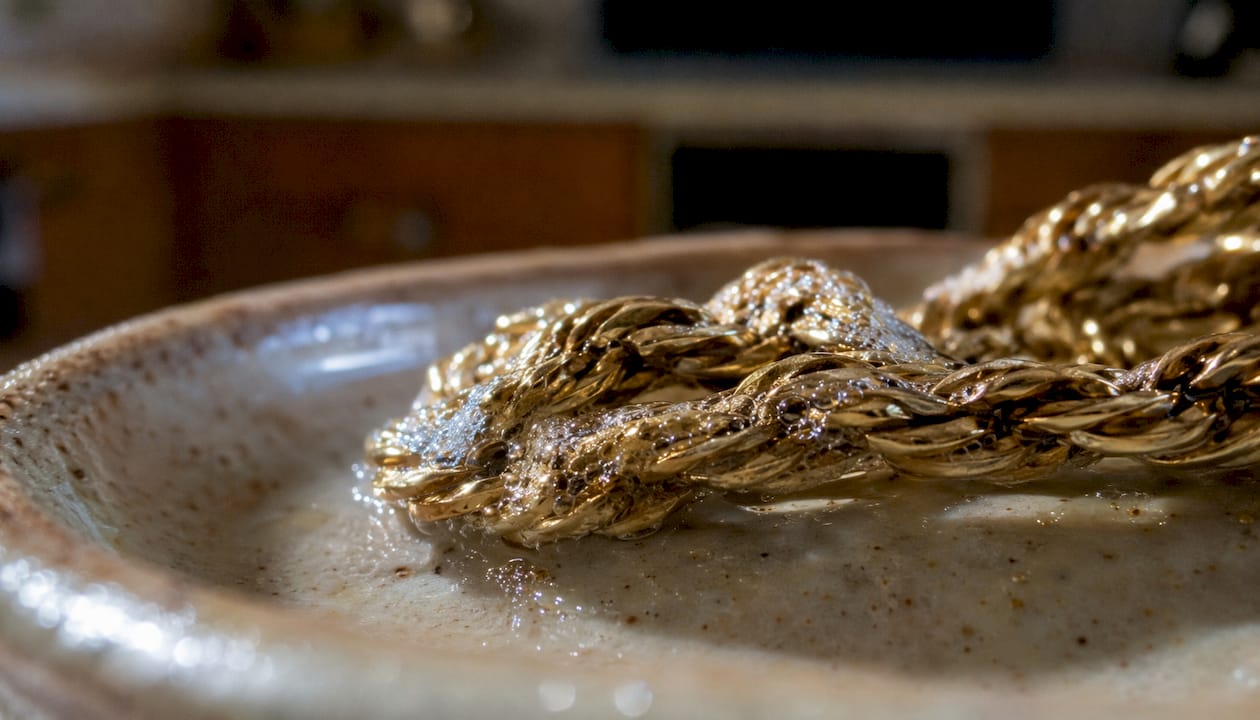
Soap, shampoo, conditioner, and body wash all leave thin films that settle into the gaps between links. Over time, those films trap skin oils and microscopic debris. According to metal fatigue research, that trapped debris acts like fine sandpaper inside the chain, grinding the interior surfaces of links with every small movement. The outer surface can look fine while the inside is already wearing down.
Hard water makes this worse. Calcium and magnesium minerals in unfiltered tap water leave a whitish film on metal surfaces that accelerates dulling when you shower frequently. You’ll notice it first as a loss of reflectivity, then as a hazy coating that a quick rinse won’t remove.
Steam and temperature cycles add another layer of stress. The heat opens microscopic gaps in plated finishes, and the rapid cool-down contracts them. Repeated exposure weakens the bond between the gold layer and the base metal. Clasps are especially vulnerable because they have more moving parts and more surface area for moisture to collect.
The film that builds up from skin oils, lotion, and product residue sits between the links and on the surface, blocking the reflectivity that makes gold look the way it should. Knowing how to clean your chain correctly restores that finish without stripping it.
How karat, plating, and chain construction change your shower risk
Not all gold chains face the same risk in the shower. The metal type and chain construction together determine how quickly damage shows up.
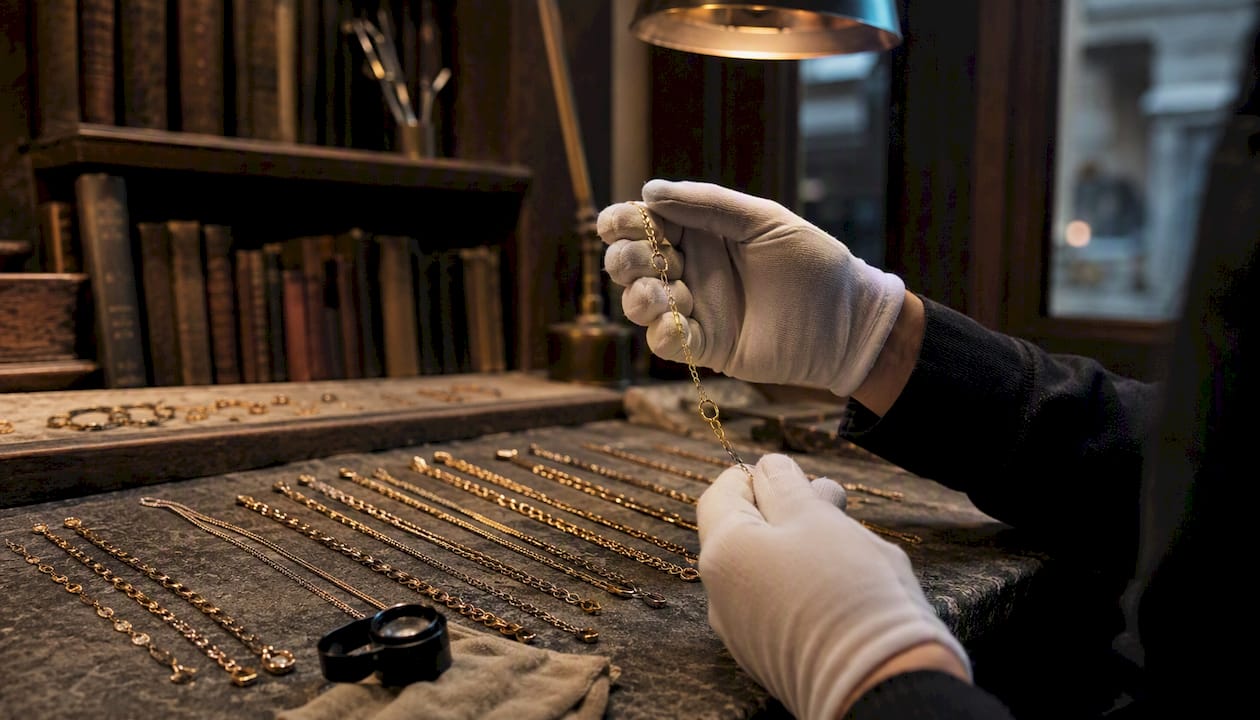
Solid gold vs. plated and coated finishes
| Chain Type | Gold Layer | Cleaning Sensitivity | Shower Risk |
|---|---|---|---|
| Solid gold (10K–18K) | No plating, solid throughout | Low — most methods safe | Low to moderate |
| Gold-filled | 5% gold by weight, bonded | Medium-low — durable but not abrasion-proof | Moderate |
| Gold vermeil | microns minimum over sterling | Medium — gentle pressure only | Moderate to high |
| Gold-plated | microns or less over brass/copper | High — avoid abrasives, heat, alcohol | High |
| PVD-coated stainless steel | Molecular bond, ~5+ microns | Very low — most resistant | Low |
Solid 10K–18K gold is the most forgiving in the shower because there’s no plating layer to strip. The primary concern is residue buildup in links and clasps, not corrosion of the metal itself. Plated chains are the opposite: even gentle exposure to soap and water removes a small amount of the gold layer each time, and once that layer is gone, replating is the only fix.
Higher karat gold (18K) is purer but softer, which means it scratches more easily and is more susceptible to mechanical fatigue from repeated bending. Lower karat gold (10K, 14K) contains more alloy metals, making it harder and more resistant to everyday wear. For a chain you plan to wear daily, 10K and 14K solid gold offer the best balance of durability and appearance.
Which chain constructions trap the most debris
Chain style matters as much as metal type. Rope chains twist multiple strands together, creating interior gaps where soap and oils accumulate and a brush can’t reach. Herringbone and snake chains have flat, tightly fitted links that trap moisture and are prone to kinking if they catch on anything. Figaro and curb chains are more open and easier to clean, but their clasps still collect residue. Franco chains are dense and durable, making them one of the better options for daily wear.
Pro Tip: If you can’t identify whether your chain is solid gold or plated, assume it’s plated. This prevents you from using any cleaning method that could strip an already-thin gold layer. The treat-as-plated rule is the industry’s standard conservative approach.
The everyday shower hazards ranked by how much damage they cause
Some exposures are minor annoyances. Others cause permanent damage. Here’s how the most common shower hazards stack up.
High risk (causes lasting damage quickly):
- Chlorine from pools and hot tubs corrodes alloy metals and strips plating permanently. Even brief exposure can discolor the metal beneath a plated finish.
- Saltwater is abrasive and corrosive, especially to clasps and jump rings. Ocean swimming and saltwater hot tubs both qualify.
- Hair spray and perfume contain alcohol and chemical compounds that break down plated finishes. Apply these before putting on your chain, never after.
Medium risk (causes gradual wear over weeks and months):
- Conditioner and leave-in treatments leave oily films that are harder to rinse out than regular soap. They settle deep into rope and herringbone links.
- Shampoo is slightly less damaging than conditioner but still contributes to residue buildup around clasps.
- Hard water minerals create a whitish film that builds up with each shower and dulls the finish progressively.
Lower risk (manageable with consistent care):
- Plain water from a standard shower is the least harmful exposure, but it still carries dissolved minerals and, over time, contributes to tarnishing on plated pieces.
- Sweat from gym showers is mildly acidic and can accelerate tarnishing on plated chains. Rinse promptly after any workout.
Pro Tip: Timing matters with hair products. If you’re showering after applying henna or other cosmetic treatments, the timing of your rinse affects both the treatment and your jewelry. Remove your chain before any rinse-off step involving product.
Hot tubs deserve a specific warning. The combination of chlorine, high heat, and pressurized jets accelerates every form of damage simultaneously. A single hot tub session can do more harm to a plated chain than months of careful showering.
If you decide to shower with your chain: a step-by-step routine
The safest choice is always to remove your chain before showering. But if you choose to keep it on, these steps reduce the risk significantly.
Before you step in:
- Check the clasp and make sure it’s fully secured. A loose clasp is more likely to catch on a washcloth or drain cover.
- Identify your chain type. If it’s plated or you’re unsure, reconsider leaving it on.
- Remove any pendants, especially those with stones. Porous stones like turquoise and opal absorb water and cleaning solutions.
- Tie long hair back so it doesn’t drag the chain or pull it toward the drain.
During the shower:
- Keep the chain away from direct high-pressure water flow. Let it hang naturally rather than aiming the showerhead at it.
- Apply shampoo, conditioner, and body wash with the chain tucked away from the lather zone as much as possible.
- Never let hair products sit on the chain. Rinse them off immediately if contact happens.
Immediately after:
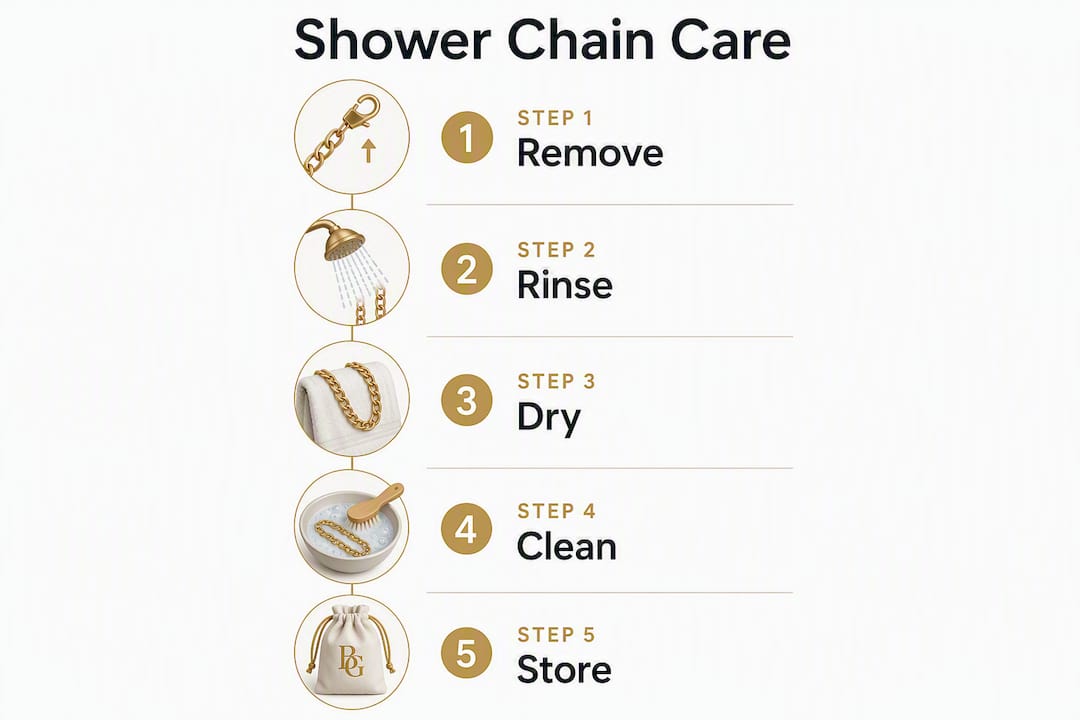
- Rinse the chain with lukewarm water to remove any soap or product residue.
- Pat it dry with a soft, lint-free cloth. Don’t rub.
- Let it air-dry completely on a flat surface before putting it away. Trapped moisture inside rope or herringbone links accelerates tarnishing on plated pieces.
Pro Tip: Never store your chain on the bathroom vanity. Bathroom steam and humidity accelerate tarnishing faster than almost anything else. Keep a small jewelry dish or soft pouch in your bedroom instead.
Cleaning, drying, and when to call a jeweler
A good cleaning routine removes the residue that showering leaves behind and extends the time between professional services.
The baseline cleaning method
For solid gold, gold-filled, and gold vermeil chains, this method is safe and effective. For plated chains, use it with extra care and skip the brush.
- Fill a small bowl with warm water and add 2–3 drops of mild, unscented dish soap.
- Place the chain in the solution and let it soak for 10–15 minutes. Soaking does most of the work.
- For solid gold and gold-filled chains, use a soft-bristled toothbrush to work along the links with light circular strokes. Pay extra attention to the clasp and the section that rests at the back of the neck.
- For plated chains, skip the brush and use your fingertips only.
- Rinse thoroughly under lukewarm running water until all soap is gone. Leftover soap dries on the surface and leaves a film.
- Pat dry with a lint-free cloth and let the chain air-dry flat before storing.
This soap-and-water routine is the recommended baseline for all gold types and handles most buildup from skin oils and product residue.
Escalation: when to go further
| Situation | Method | Who It’s Safe For |
|---|---|---|
| Routine maintenance | Warm water + mild dish soap | All gold types |
| Deeper tarnish on solid gold | Baking soda paste (diluted, sparingly) | Solid gold only — no more than every 2–3 months |
| Stubborn buildup on solid gold | Soft toothbrush with soap solution | Solid gold and gold-filled |
| Structural break or kink | Professional jeweler | All types |
| Worn-through plating | Replating service | Plated, vermeil |
Baking soda is more abrasive than most people realize. It strips plating faster than daily wear does, so reserve it for solid gold only. Never use abrasive household cleaners, bleach, or the dishwasher on any chain. These methods warp clasps and cause irreversible damage to plating.
For daily-wear chains, a full soap-and-water cleaning every 2–4 weeks handles deeper buildup. A quick wipe with a soft cloth after each use is enough for routine maintenance between full cleanings. You can find a more detailed schedule in Bakergoldchains’s gold chain cleaning guide.
When a jeweler is the right call
Some problems can’t be fixed at home. Take your chain to a professional when you notice a broken or bent link, a clasp that no longer closes securely, or a plated finish that has worn through to the base metal. Soldering a broken link on a hollow or very delicate chain carries the risk of deforming the piece; professionals sometimes recommend replacement over repeated repairs for thin trend chains. Replating restores the gold layer on plated pieces but is a recurring cost if the underlying habits don’t change.
Quick yes/no rules for every shower scenario
Use these to make fast decisions without second-guessing yourself.
- Everyday shower, solid gold chain: Generally safe, but residue builds up. Remove it if you use hair products.
- Everyday shower, plated chain: Remove it. Every shower removes a small amount of the gold layer.
- Using shampoo or conditioner: Remove the chain first, every time.
- Swimming in a pool or hot tub: Remove it. Chlorine causes permanent discoloration and strips plating.
- Ocean swimming: Remove it. Saltwater corrodes clasps and is abrasive to all finishes.
- Gym shower after a workout: Remove it. Sweat is mildly acidic and accelerates tarnishing.
- Sleeping with your chain on: Remove it. Repeated mechanical stress from movement causes link fatigue over time.
- You can’t identify the metal: Remove it. The conservative rule applies without exception.
Pro Tip: Thin, trend-style chains are at the highest risk of breakage from mechanical stress. If your chain is delicate or lightweight, treat it more conservatively than you would a heavier rope or Franco style, regardless of the metal type.
What Bakergoldchains recommends for chain care
Bakergoldchains sources its chains from U.S. suppliers and backs every piece with a lifetime craftsmanship guarantee. That guarantee reflects a straightforward position: quality materials and proper care together determine how long a chain stays in good condition.
The care advice Bakergoldchains provides aligns directly with the conservative approach in this guide:
- Remove before showering whenever possible, especially if you use hair products or have a plated piece.
- Rinse and dry immediately after any water exposure you couldn’t avoid.
- Store outside the bathroom in a soft pouch or jewelry box to avoid humidity damage.
- Clean regularly with the soap-and-water method, and have solid gold pieces professionally cleaned once a year.
Solid gold can survive occasional showers, but removing jewelry for bathing significantly extends the interval between needed maintenance and repairs. The chains that stay looking their best are the ones whose owners build simple removal habits early.
Bakergoldchains offers transparent metal certification on its pieces, so you always know exactly what you’re buying. If you have questions about warranty coverage or need guidance on care for a specific piece, their team can help directly. For a broader look at care practices across all gold jewelry types, the 2026 gold jewelry care guide covers maintenance schedules, storage, and when to seek professional service.
Key Takeaways
Solid gold chains can handle occasional shower exposure, but consistent removal and prompt drying after any water contact is what keeps them looking new.
| Point | Details |
|---|---|
| Solid gold is safest in water | 10K–18K solid gold resists corrosion, but soap and mineral residue still build up in links and clasps. |
| Plated chains need extra protection | Every shower removes a small amount of the gold layer; remove plated chains before any water exposure. |
| Treat unknown pieces as plated | When you can’t confirm the metal type, apply the most conservative care to avoid irreversible damage. |
| Clean every 2–4 weeks | A warm water and mild dish soap soak handles routine buildup for all gold types. |
| Bakergoldchains for daily wear | Solid 10K and 14K chains from Bakergoldchains come with a lifetime craftsmanship guarantee and transparent metal certification. |
The case for just taking it off
Most of the wear patterns I see on gold chains come down to one repeated choice: leaving the chain on because removing it feels like a hassle. The damage is never dramatic at first. A slight dullness here, a stiff clasp there. By the time the finish looks noticeably worn or a link snaps, the cumulative exposure has been building for months.
The math is simple. A solid 14K chain that gets removed before every shower and stored in a soft pouch will look better in five years than the same chain worn through daily showers, even with regular cleaning. Cleaning restores appearance. It doesn’t reverse structural fatigue inside the links.
For daily wearers, the most practical habit isn’t a complicated cleaning schedule. It’s a small hook or dish outside the bathroom where the chain lives while you shower. Thirty seconds of effort, every day, prevents most of the repairs and replating costs that come from accumulated exposure. Store your chain outside the bathroom, and the humidity problem solves itself at the same time.
Chains built for everyday wear, from Bakergoldchains
If you want a chain that handles daily life without constant worry, the answer is solid gold construction in 10K or 14K. These pieces resist the everyday exposures that wear down plated finishes, and they’re built to last with proper care rather than in spite of neglect.
Bakergoldchains carries solid 14K options built for exactly this kind of daily wear. The 14K graduated bead necklace is a clean, durable choice for everyday use, and the 14K yellow gold necklace with diamond love symbol pairs durability with a design worth protecting. Every piece comes with free insured shipping on orders over $150, a lifetime craftsmanship guarantee, and certified metal transparency so you know exactly what you’re buying. Browse the full collection at bakergoldchains.com and find a chain built to go the distance.
Useful sources
The claims in this guide draw from the following resources. Each one is worth bookmarking if you want to go deeper on a specific topic.
- How to Clean a Gold Chain — The Jewelry Care: The primary source for cleaning methods, residue buildup mechanics, hard water effects, and the baking soda escalation guidance.
- The Jewelry Care — care philosophy and metal fatigue notes: Background on the “treat as plated” conservative heuristic and microscopic link fatigue from trapped debris.
- Gold Chain Repair: Easy 2026 Fixes — The Diamond Guys: Repair escalation guidance, thin chain breakage risk, and the specialist recommendation on replacement versus repeated soldering.
- How to Clean Gold Chain Necklace — Atolea Jewelry: Detailed chain-type comparison table, cleaning sensitivity by finish, and rope chain-specific soaking advice.
- Bakergoldchains — Gold Chain Cleaning Guide: Brand-specific maintenance schedules and at-home cleaning steps for different chain types.
- Bakergoldchains — Solid Gold vs. Plated Guide: Authoritative comparison of how different finishes respond to water, cleaning, and daily wear.
- Bakergoldchains — Common Gold Chain Mistakes: Common causes of chain damage and practical prevention habits.
Recommended
- Daily wear gold jewelry: style, durability, and quality – Baker Gold Chains
- Avoid these common gold chain mistakes for lasting shine – Baker Gold Chains
- Why solid gold jewelry is worth wearing every day – Baker Gold Chains
- Gold chain buying guide: Choose authentic, durable jewelry – Baker Gold Chains

