

Lobster Clasp vs Spring Ring: Which Should You Choose?
For most everyday jewelry, the lobster clasp is the better default. It closes more securely, holds up longer under daily wear, and is easier to operate with one hand. Industry supplier comparisons consistently rate lobster clasps higher for strength and durability, making them the practical choice for necklaces with pendants, bracelets, and any chain you wear regularly.
That said, the spring ring still earns its place in specific situations:
- Default pick: Lobster clasp for daily-wear necklaces, bracelets, heavier chains, and any piece carrying a pendant or charm.
- Spring ring makes sense when: The chain is ultra-delicate (under 1mm) and a lobster clasp would look bulky; you’re restoring a vintage piece where period-correct hardware matters; or the piece is a budget gift where keeping costs low is the priority.
- Accessibility note: If dexterity is limited, neither small clasp is ideal. A magnetic clasp or a trigger clasp with a larger lever is a more practical solution for wearers with arthritis or fine motor challenges.
Key Takeaways
The lobster clasp is the stronger, more secure, and easier-to-use default for most jewelry, with spring rings reserved for delicate, vintage, or budget pieces where a low profile matters more than long-term durability.
| Point | Details |
|---|---|
| Default clasp choice | Lobster clasps offer higher security and easier one-handed use for daily-wear pieces. |
| Spring ring best use | Spring rings suit ultra-fine chains, vintage restorations, and lightweight layering necklaces. |
| Size matching matters | Match clasp length to chain weight: 10–12mm for fine chains, 16–20mm for heavy rope or Cuban styles. |
| Metal quality over clasp type | A solid-gold spring ring outlasts a cheap plated lobster; material quality often determines longevity. |
| Bakergoldchains | Offers solid-gold chains in 10K, 14K, and 18K with matched clasps, a lifetime craftsmanship guarantee, and transparent metal certification. |
Table of Contents
- How a lobster clasp works and why it’s so popular
- How a spring ring clasp works and where it fits
- Lobster clasp vs spring ring: a direct comparison
- Which clasp fits your specific piece?
- How to choose, maintain, and replace a clasp
- How metal choice and plating affect your clasp’s longevity
- A jeweler’s honest take on clasp failures
- Solid gold chains with the right clasp, backed by a lifetime guarantee
- Sources
How a lobster clasp works and why it’s so popular
A lobster clasp, also called a lobster-claw clasp, uses a hinged lever on the outside of a spring-loaded closing arm. Press the lever down, the arm retracts, and you slip the ring or jump ring in. Release it, and the spring snaps the arm shut. The mechanism is simple, but the two-part closure means the clasp stays shut unless you actively press the lever open.
Common shapes include oval, pear, and tapered profiles. Sizes typically run from 9mm to 20mm in length, with 12–14mm being the most common range for necklaces and 16–18mm for bracelets. Materials span the full spectrum of fine jewelry: sterling silver, 10K, 14K, and 18K solid gold, stainless steel, and gold-filled options.
Pros:
- High security; the spring-loaded arm won’t open accidentally under normal wear
- Easier one-handed operation than a spring ring
- Available in a wide size range to match heavier chains
- Durable construction with more metal mass than a spring ring
Cons:
- Visually larger and heavier than a spring ring, which can look out of place on very fine chains
- Costs more to produce, so it adds to the price of a piece
- The lever can wear down on low-quality or heavily plated versions over time
Pro Tip: Match the clasp length to your chain’s end-link opening. A clasp that’s too large for the end link creates stress on the jump ring with every open-and-close cycle. For heavy rope or Cuban link bracelets, a swivel lobster clasp reduces torsion on the chain by letting the clasp rotate freely.
How a spring ring clasp works and where it fits
A spring ring clasp is a hollow circular ring with a small tab that retracts along the inside of the ring when you push it. Slip the jump ring in through the gap, release the tab, and it springs back to close the circle. The entire mechanism lives inside the ring itself, which is why spring rings stay so compact and low-profile.
Standard fine-jewelry sizes run from 6mm to 10mm in diameter. Supply guides note that sizes 18mm and above are sometimes called bolt rings and behave more like a heavy-duty variant than a typical spring ring. For most delicate necklaces, a 6mm or 8mm spring ring is the norm.
Pros:
- Very discreet; sits nearly flush with the chain and barely visible from the front
- Lower cost, making it practical for budget-conscious or mass-market pieces
- Lightweight, which keeps the balance of a delicate chain intact
Cons:
- The small tab is genuinely difficult to manipulate, especially with long nails or limited dexterity
- The internal spring fatigues faster under daily stress than a lobster clasp mechanism, leading to gaps that can allow a chain to slip free
- Harder to replace without soldering, since the ring must be cut and a new one soldered in
Pro Tip: If you want the discreet look of a spring ring but need better durability, ask for a higher-gauge spring ring in solid sterling or solid gold rather than plated base metal. A well-made 8mm spring ring in solid 14K gold will outlast a cheap plated lobster clasp by years. For a lightweight necklace like a clavicle chain, this is often the right compromise.
Lobster clasp vs spring ring: a direct comparison
Side-by-side comparisons from supply sources consistently identify strength and ease-of-use as lobster’s decisive advantages, and smaller size and lower cost as spring ring’s. Here’s how the two clasps stack up across the dimensions that matter most when choosing for a specific piece.
| Dimension | Lobster Clasp | Spring Ring |
|---|---|---|
| Strength and durability | High; solid construction with more metal mass | Moderate; internal spring fatigues over time |
| Security against accidental opening | High; lever must be actively pressed to open | Moderate; worn springs can create a gap |
| Ease of use and accessibility | Good; one-handed operation is practical | Harder; small tab requires fine motor control |
| Size and visual profile | Larger; noticeable on fine chains | Compact; nearly invisible on delicate chains |
| Cost | Higher; more metal and construction complexity | Lower; simpler to produce |
| Material compatibility and plating | Available in all fine-jewelry metals; plating wears on lever first | Available in all metals; plating wears on tab mechanism |
| Repair and replacement | Lever can be replaced; full clasp swap is straightforward | Requires cutting and soldering; more labor-intensive |
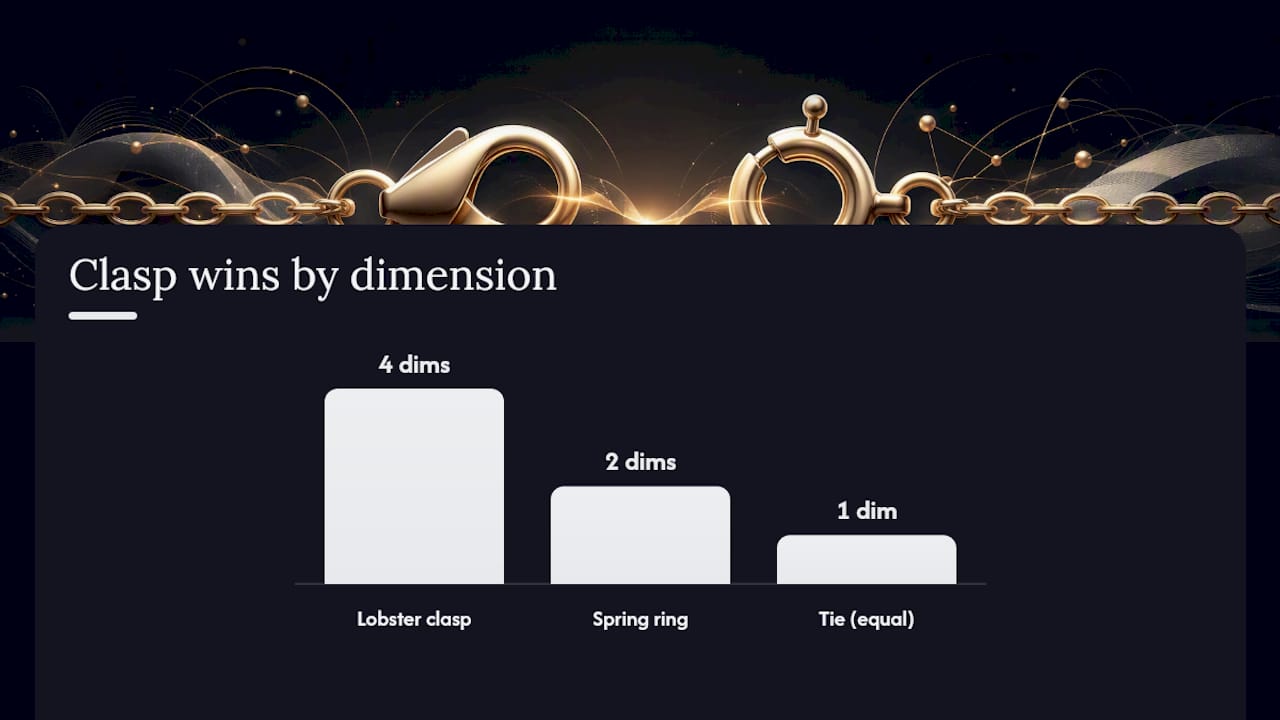
Where lobster wins clearly: daily-wear pieces, bracelets that need one-handed closure, heavier chains (rope, Cuban, Franco), and any necklace carrying a pendant. Lobster clasps are the standard recommendation for everyday pieces precisely because of this combination of security and usability.
Where spring ring holds its own: ultra-fine chains where a lobster clasp would look disproportionate, vintage or period-style pieces where a round clasp is historically appropriate, and lightweight layering necklaces where keeping the total weight down matters.
Which clasp fits your specific piece?
Matching clasp to piece is mostly about chain weight, wear frequency, and who’s putting it on. Here’s how to think through the most common use cases:
- Pendant necklaces: Use a lobster clasp sized to the chain’s end link. The pendant adds weight and movement, which stresses the clasp more than a plain chain. A 12–14mm lobster is the standard choice for most 14K or 18K gold pendant necklaces.
- Plain chain necklaces: A spring ring works well here if the chain is fine (under 1.5mm) and worn occasionally. For daily wear, even on a plain chain, a lobster clasp holds up better over time.
- Bracelets: Lobster clasp, consistently. Putting on a bracelet with one hand is already awkward; a spring ring’s small tab makes it genuinely frustrating. A minimalist bracelet with a small lobster clasp strikes the right balance between security and ease.
- Anklets: Anklets flex constantly with movement and are more prone to accidental snagging. A lobster clasp reduces the risk of the piece opening unintentionally. If you prefer a lower profile, a small 10–12mm lobster is less obtrusive than a large one.
- Children’s jewelry: Keep clasps small and simple. A 6–8mm spring ring on a very lightweight chain is common, but a small lobster clasp is safer for a piece worn daily. Avoid large clasps that catch on clothing.
- Vintage restoration: If authenticity matters, match the original clasp type. Pre-1970s pieces often used spring rings; replacing one with a lobster clasp changes the piece’s character. A well-made spring ring in the correct metal is the right call here.
- Layered necklaces: When stacking multiple chains, clasp weight and position affect how the layers sit. Lighter spring rings on finer chains keep the stack balanced; a heavy lobster clasp on one layer can pull the others out of alignment.
For chain thickness, a general guide: chains under 1.5mm pair naturally with spring rings or small lobster clasps (10–12mm); chains from 1.5mm to 3mm work best with a 12–16mm lobster; chains above 3mm or heavier rope and Cuban styles need a 16–20mm lobster clasp to match the visual weight and handle the load. You can find more detail on matching chain weight to hardware in the complete gold chain buyer’s guide from Bakergoldchains.
How to choose, maintain, and replace a clasp
Getting the clasp right at purchase saves you a repair visit later. Here’s a practical checklist before you buy or commission a piece:
- Check the chain’s end-link opening. The clasp’s jump ring or hook must fit through it cleanly without forcing. A tight fit stresses the metal every time you open and close the clasp.
- Match the clasp weight to the chain weight. A heavy lobster on a fine chain pulls it to one side and looks wrong. A tiny spring ring on a thick rope chain won’t hold the load.
- Consider the wearer’s dexterity. If the person wearing the piece has difficulty with small mechanisms, a lobster clasp with a larger lever is the right call. For significant dexterity challenges, a magnetic clasp is worth discussing with your jeweler.
- Think about wear frequency. Daily wear accelerates fatigue on any spring mechanism. If the piece is worn every day, a lobster clasp in solid metal is the more durable investment.
- Set a realistic budget for the clasp. The clasp is not the place to cut costs on a valuable chain. A quality clasp in matching metal protects the whole piece.
Maintenance steps to extend clasp life:
- Clean the clasp when you clean the chain. Soap, lotion, and skin oils accumulate in the spring mechanism and accelerate wear.
- Test the spring every few months by pressing and releasing the lever or tab. It should snap back firmly with no hesitation.
- Avoid submerging clasps in chlorinated water or saltwater. Both accelerate corrosion, especially on plated pieces.
- Store necklaces unclasped or loosely clasped to reduce spring tension during storage.
Red flags that mean it’s time to replace:
- A visible gap when the clasp is fully closed
- The lever or tab feels loose or wobbles
- The spring no longer snaps back quickly
- Plating is flaking around the mechanism, exposing base metal
Upgrading a spring ring to a lobster clasp is a standard jeweler service and usually a straightforward repair. Read more about common chain care mistakes that shorten the life of both the chain and its clasp.
How metal choice and plating affect your clasp’s longevity
The clasp type matters, but the metal it’s made from often matters more. A well-made spring ring in solid 14K gold can outlast a cheap gold-plated lobster clasp by years. Material and construction quality frequently determine longevity more than clasp category alone. This is worth understanding before you buy.
Solid gold (10K, 14K, 18K): The most durable option for clasps. The spring mechanism stays clean and corrosion-resistant over time, and the piece can be soldered, resized, or repaired by any jeweler. Higher karat gold is softer, so 10K and 14K are generally better choices for clasps that take mechanical stress daily.
Gold-filled: A thick layer of gold bonded to a base metal core. More durable than plating and a reasonable mid-range option, but the base metal core can corrode if the gold layer is breached at the mechanism’s moving parts.
Gold-plated and vermeil: The thinnest gold layer sits directly on the moving parts of the clasp. Every press of the lever or tab wears the plating faster than it wears the rest of the chain. Once the base metal is exposed at the mechanism, corrosion sets in quickly, and the clasp often needs full replacement rather than repair.
Stainless steel: Highly corrosion-resistant and durable, but not solderable with standard jewelry tools. A stainless clasp that fails usually requires a full swap rather than a repair.
For repairability, solid gold and sterling silver are the easiest materials to work with. A jeweler can solder a new jump ring, replace a lever, or swap a clasp entirely without damaging the chain. Plated and stainless pieces typically require a full clasp replacement.
When you’re buying a gold chain, verify that the clasp carries the same karat stamp as the chain itself. A 14K chain with an unmarked or base-metal clasp is a mismatch that affects both durability and resale value. Bakergoldchains provides transparent metal certification on its chains and findings, so you know exactly what you’re getting at every link.
Pro Tip: Ask your jeweler to show you the karat stamp on the clasp separately from the chain. On quality pieces, both should be marked. If only the chain is stamped, the clasp may be a different metal. You can find a detailed breakdown of solid vs plated options in the gold chain vs gold plated guide from Bakergoldchains.
A jeweler’s honest take on clasp failures
The most common repair request I see is a spring ring that’s lost its snap. The internal spring fatigues gradually, and most wearers don’t notice the gap until the chain has already slipped off once. By that point, the clasp has usually been worn past the point where cleaning or adjusting it helps. The whole clasp needs to come off and a new one goes on.
Lobster clasps fail differently. On quality pieces, the lever wears slowly and the spring stays reliable for years. On cheap plated versions, the lever wobbles first, then the plating flakes around the hinge, and the base metal corrodes. The failure mode is slower and more visible, which gives you more warning.
My standard advice: if a customer brings in a delicate necklace with a worn spring ring and asks whether to repair or replace, I recommend upgrading to a small lobster clasp in matching metal. The cost difference is minor, and the piece becomes noticeably easier to wear every day.
Solid gold chains with the right clasp, backed by a lifetime guarantee
Bakergoldchains stocks solid-gold chains in 10K, 14K, and 18K gold, each paired with a clasp sized and matched to the chain’s weight and style. Whether you’re looking for a 14K gold bead necklace with a secure lobster clasp or a lighter fashion chain where a discreet clasp keeps the look clean, every piece comes with transparent metal certification and a lifetime craftsmanship guarantee.
Free insured shipping applies to orders over $150, and financing options are available if you’re investing in a higher-karat piece. If you want guidance on which chain and clasp combination fits your needs, the gold chain buying guide is a practical starting point. Browse the full collection at Bakergoldchains and find a piece built to last.
Sources
- Lobster Clasp vs Spring Clasp: Which Is Right for Your Jewelry – Atlanta Findings
- Clasps 101: Lobster vs Trigger vs Toggle vs Magnetic (Pros & Cons) – Wholesale Findings
- Spring Ring Clasp vs. Lobster Clasp – Which Is Best for Your Jewelry?
- Lobster Clasp vs Spring Ring: Which is Best for Your Jewelry
Recommended
- Your guide to the most popular types of gold clasps – Baker Gold Chains
- Gold chain vs gold plated: How to choose quality jewelry – Baker Gold Chains
- 14K White Gold Sparkle Spring Chain Bracelet (2.10 mm) – Baker Gold Chains
- Sterling Silver Rhodium Plated Paperclip Toggle Bracelet (10.20 mm) – Baker Gold Chains

