

Gold Jewelry Retailer Policies: What to Compare Before You Buy
When comparing gold jewelry retailer policies, the five elements that matter most are the return window, refund method, warranty scope, insured return shipping, and resizing terms. Bakergoldchains maps well to all five, offering a lifetime craftsmanship guarantee, free insured shipping on qualifying orders, and transparent metal certification. The Federal Trade Commission advises getting every policy in writing before you pay, and that advice alone can save you from a costly surprise.
Before you buy from any retailer, check these five policy elements first:
- Return window: How many days do you have, and does the clock start at purchase or delivery?
- Refund method: Full refund to your original payment, or store credit only?
- Warranty scope: Does the guarantee cover manufacturing defects, and for how long?
- Insured return shipping: Who pays, and is the shipment insured for the item’s full value?
- Resizing and customization rules: Does resizing or engraving void the return or warranty?
Key Takeaways
Strong retailer policies are the clearest signal that a seller stands behind their product, and the five elements that matter most are return window, refund method, warranty scope, insured return shipping, and resizing terms.
| Point | Details |
|---|---|
| Return window and refund method | Confirm days from delivery and whether you get cash back or store credit only. |
| Warranty and craftsmanship guarantee | A lifetime craftsmanship guarantee offers broader protection than a standard one-to-three-year warranty. |
| Insured return shipping | Verify who pays and whether the shipment is covered for the item’s full declared value. |
| Escalation resources | FTC, state attorney general (NAAG), and BBB are your three main options if a retailer won’t resolve a dispute. |
| Bakergoldchains | Offers a lifetime craftsmanship guarantee, free insured shipping on orders over $150, and transparent metal certification. |
Table of Contents
- What do gold jewelry retailer policies actually cover?
- How to compare retailer policies side by side
- Special rules that apply to gold and fine jewelry
- How to start a return, warranty, or repair request
- Red flags to watch for and where to get help in the U.S.
- How Bakergoldchains’ policies map to the checklist
- What the checklist actually tells you about a retailer
- Bakergoldchains offers transparent policies for gold jewelry buyers
- Sources
What do gold jewelry retailer policies actually cover?
Comparing gold jewelry retailer policies starts with understanding what each term means, because retailers use the same words to mean very different things.
- Return vs. exchange: A return gives you money back; an exchange swaps the item for another. Some retailers offer only exchanges within a certain window.
- Refund method: Refunds can go back to your original payment method or come as store credit. Store credit is not the same as a refund, and the FTC’s jewelry buying guidance recommends confirming this in writing before purchase.
- Final sale: Items marked final sale cannot be returned or exchanged under any circumstances. Clearance pieces and custom orders frequently carry this designation.
- Warranty vs. craftsmanship guarantee: A warranty is a written promise about product quality, governed by federal law under the Magnuson-Moss Warranty Act. A craftsmanship guarantee is a retailer’s voluntary pledge to repair or replace defective work, often with broader or longer coverage than a standard warranty.
- Repair policy: Separate from warranty, this covers the cost and turnaround time for fixes like prong re-tipping, clasp replacement, or chain soldering.
- Restocking fee: A percentage deducted from your refund for processing a return. Common in fine jewelry; ranges from 10%–20% at some retailers.
- Proof of purchase and certification: Most retailers require an order number and original receipt. For diamond pieces, a GIA lab report or equivalent certificate is often required to validate authenticity and support warranty claims.
- Insured return shipping: Coverage that protects the item’s declared value during transit back to the retailer. Without it, you bear the loss if the package is damaged or lost.
To see how the same term plays out differently in practice: a 30-day return window for unworn gold chains is standard at many online retailers, while bridal or engagement ring categories at the same store may carry only a 14-day inspection window with no resizing allowed before the return is processed. Product-level notes often override the sitewide policy, so always read both.
Hallmarking and karat stamps are trust signals that also affect policy eligibility. A piece without a visible karat mark (10K, 14K, or 18K) or a retailer that cannot provide documentation of metal content creates a harder return or warranty dispute. Understanding jewelry transparency signals before you buy reduces that risk significantly.
How to compare retailer policies side by side
A practical workflow, supported by independent policy comparisons, is to check the sitewide policy page first, then the individual product page, then request written confirmation from customer service for any exceptions before you pay.
Use this checklist on every retailer you consider:
- [ ] Return window (days from delivery, not order date)
- [ ] Refund method (original payment vs. store credit)
- [ ] Restocking or service fees (percentage and conditions)
- [ ] Warranty scope and length (what defects are covered, for how long)
- [ ] Repair turnaround time (standard and expedited options)
- [ ] Insured return shipping (who pays, declared value coverage)
- [ ] Proof or certification required (order number, GIA report, appraisal)
- [ ] Final-sale and exclusion categories (clearance, custom, engraved)
Pro Tip: When two retailers are priced similarly, use these four tiebreakers: (1) inspection period length, (2) whether resizing voids the return, (3) how clearly final-sale items are labeled at checkout, and (4) who covers insured return shipping costs. These details rarely show up in ads but decide your real flexibility after purchase.
Editorial roundups like Forbes Vetted’s jewelry store guide consistently flag inspection windows and resizing terms as the most overlooked differentiators for online buyers.
Special rules that apply to gold and fine jewelry
Gold and fine jewelry carry category-specific exceptions that most general return-policy guides skip entirely.
Hallmarks and karat certification directly affect your ability to make a warranty or return claim. A piece stamped 14K from a retailer that also provides a supplier certificate or hallmark documentation is far easier to dispute if quality falls short. Without that paper trail, you are relying on the retailer’s goodwill alone.
GIA or lab certificates for diamond pieces matter for the same reason. The GIA’s diamond quality factors explain how cut, color, clarity, and carat weight are graded, and those grades are what a retailer’s warranty is implicitly promising when they describe a stone. If the certificate is missing, you have no independent baseline for a dispute.
Resizing and engraving almost always change return eligibility. Most retailers treat a resized or engraved ring as a modified item, which typically disqualifies it from a standard return. Some offer a one-time complimentary resize within a set window, but that resize usually ends the return option. Ask before you resize.
Category-specific rules to know:
- Earrings: Many retailers apply hygiene restrictions that make worn earrings non-returnable, even within the standard window.
- Engagement and bridal rings: Longer inspection windows (sometimes 30–60 days) are common, but resizing rules vary widely. Confirm in writing.
- Clearance and final-sale items: These are almost always non-returnable. The FTC’s jewelry buying guidance specifically recommends confirming final-sale status before purchase, not after.
- Custom and personalized pieces: Retailers generally cannot resell these, so returns are rarely accepted. Verify before ordering.
Understanding why insured shipping matters for high-value pieces is especially relevant here: a custom piece that cannot be returned still needs full insurance coverage during delivery, because damage in transit is the retailer’s responsibility only if they shipped it insured.
How to start a return, warranty, or repair request
Knowing the process before you need it saves time and protects your claim.
- Locate the retailer’s return or warranty page. Save a screenshot with the date. Policy pages can change, and a dated screenshot is evidence of what was promised when you bought.
- Check the product-level notes. Sitewide policies often have product-specific overrides. Confirm the item you bought is eligible under the terms you read.
- Request an RMA (Return Merchandise Authorization) or open a warranty claim. Most online retailers require this step before you ship anything. Skipping it can void your claim.
- Gather your documentation. You will typically need: order number, original receipt or confirmation email, photos of the item and any defect, GIA or lab certificate if applicable, and proof of appraisal for high-value pieces.
- Pack and insure the return shipment. Use a carrier that offers declared-value coverage. Do not ship a gold piece without insurance, regardless of who is paying for shipping.
- Ship and track. Keep the tracking number and carrier receipt until your refund or repaired item arrives.
- Wait for inspection and resolution. Returns typically resolve in 7–30 days after the retailer receives the item. Repairs and warranty service generally take 2–8 weeks, longer during peak seasons like November through January.
Before you ship, photograph or document:
- The item from multiple angles, including any hallmarks or karat stamps
- The original packaging and any included certificates
- The defect or damage you are claiming
- The shipping label and carrier receipt
Seasonal delays are real. A repair submitted in late November may not return until January. If timing matters, ask the retailer for an estimated turnaround before you send the piece.
Red flags to watch for and where to get help in the U.S.
Some policy problems are visible before you buy. Others surface only when you try to make a claim. Either way, knowing the warning signs protects you.
Red flags in retailer policies:
- Final-sale language that appears only in fine print at checkout, not on the product page
- No visible contact information or claims process on the policy page
- Store credit as the only refund option, with no explanation or exception path
- Return windows shorter than 14 days for fine jewelry sold online
- No mention of insured return shipping for orders above a reasonable value threshold
- Warranty terms that exclude manufacturing defects or require fees to activate coverage
Where to get help if a retailer won’t resolve your issue:
- FTC fraud portal: Reportfraud accepts consumer complaints about deceptive practices and inaccurate product representations.
- State attorney general: NAAG’s complaint portal connects you to your state AG’s office, which can mediate disputes under state consumer-protection law.
- Better Business Bureau: Check a retailer’s BBB complaint history before you buy, and file a complaint if a dispute goes unresolved. BBB complaints are public and often prompt faster retailer responses.
- Credit card chargeback: If a retailer misrepresented the product or refused a valid return, a chargeback through your card issuer is a legitimate option. File within your card’s dispute window, typically 60–120 days from the statement date.
- Small claims court: For disputes under your state’s small-claims limit (varies by state, generally $5,000–$10,000), this is a low-cost option that does not require an attorney.
The FTC advises consumers to get all return, repair, and warranty policies in writing before completing a purchase, and to keep records of the seller’s representations, receipts, and any communications. Those records are your strongest evidence if a dispute escalates beyond the retailer.
Pro Tip: Check a retailer’s BBB profile and read complaint responses, not just the rating. A retailer that responds promptly and resolves complaints shows how they actually handle problems, which matters more than a star rating alone.
How Bakergoldchains’ policies map to the checklist
Bakergoldchains is a direct-to-consumer online retailer specializing in solid gold chains and fine jewelry in 10K, 14K, and 18K gold, sourced from U.S. suppliers. Here is how its policies align with the comparison checklist:
| Policy dimension | Bakergoldchains |
|---|---|
| Return window | Standard return window; check product page for item-specific terms |
| Refund method | Refund to original payment method for eligible returns |
| Restocking or service fees | Not publicly listed as a standard fee; confirm at checkout |
| Warranty scope and length | Lifetime craftsmanship guarantee covering manufacturing defects |
| Repair turnaround | Contact customer service for current turnaround estimates |
| Insured return shipping | Free insured shipping on qualifying orders over $150 |
| Proof required | Order number and original receipt; certificates for diamond pieces |
| Final-sale exclusions | Custom and personalized items; confirm on product page |
Two trust signals stand out. First, the lifetime craftsmanship guarantee is a meaningful commitment: most standard warranties cover one to three years, so a lifetime guarantee signals confidence in the product’s construction. Second, free insured shipping on orders over $150 removes one of the most common friction points in online jewelry returns, the cost and risk of shipping a high-value piece back at your own expense.

Bakergoldchains also provides transparent metal certification and karat documentation, which directly supports warranty and return claims. For diamond pieces like the round pendant with diamond halo in 14k white gold, certification details are available on the product page, giving you the documentation baseline the FTC recommends.
For a deeper look at what a jewelry guarantee legally covers and what exclusions are common, the jewelry guarantee guide at Bakergoldchains walks through the key terms in plain language.
What the checklist actually tells you about a retailer
Policy comparison is really a proxy for something simpler: how much does this retailer stand behind what they sell?
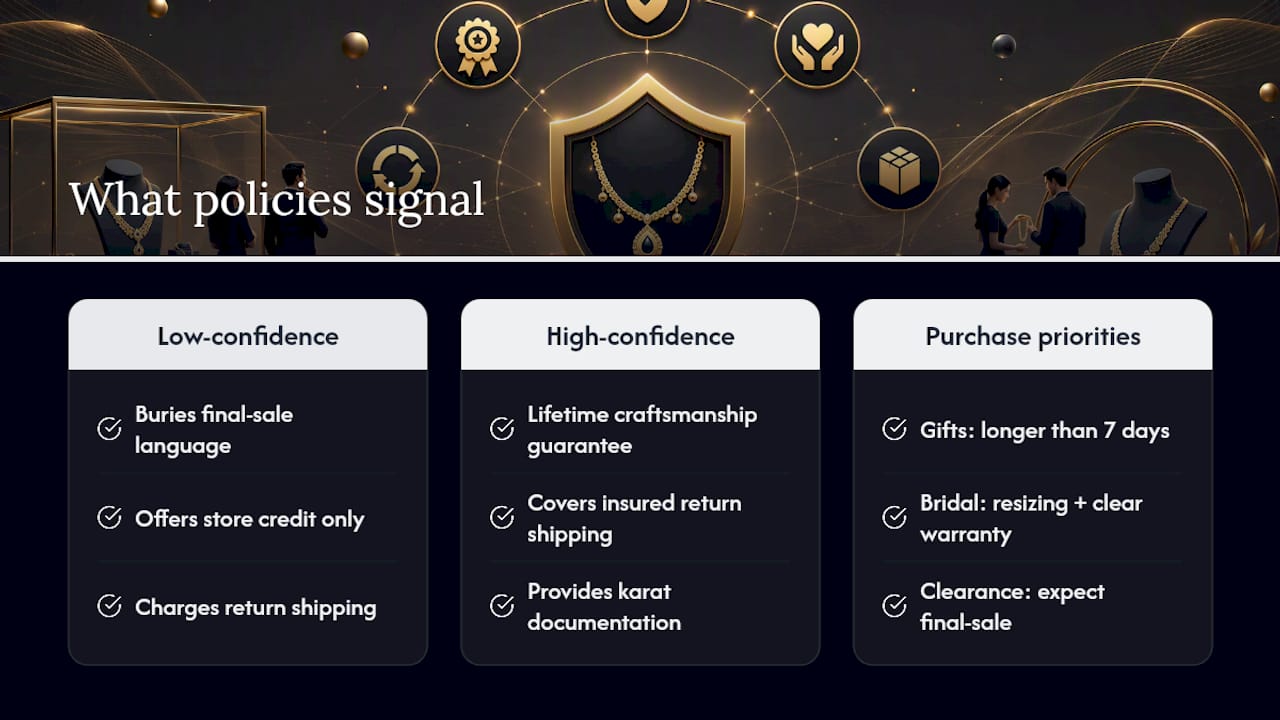
A retailer that buries final-sale language, offers only store credit, and charges you to ship a return is telling you something about their confidence in their own product. A retailer that publishes a lifetime craftsmanship guarantee, covers insured return shipping, and provides karat documentation is telling you something different.
For gift purchases, the inspection window is the single most important element. The person receiving the gift needs time to evaluate the piece, and a 7-day window is not enough. For bridal purchases, resizing terms and the clarity of the warranty are what matter most. For clearance buys, accept that final-sale is the norm and price accordingly.
One practical habit worth keeping: save a screenshot of the policy page and the product page on the day you order. Policies can change, and a dated screenshot is the clearest evidence of what was promised. Your order confirmation email is the second document to save.
Bakergoldchains offers transparent policies for gold jewelry buyers
If you have worked through the checklist and want a retailer whose policies hold up under scrutiny, Bakergoldchains is a strong fit. The lifetime craftsmanship guarantee covers manufacturing defects without an expiration date. Free insured shipping applies to qualifying orders over $150, so you are not absorbing the risk of a return shipment on a solid gold piece; see Pricing and price-adjustment policies overview for typical retailer practices. Metal certification and karat documentation come with the product, giving you the paper trail the FTC recommends for any fine jewelry purchase.
The product range covers solid gold chains in 10K, 14K, and 18K gold, plus pendants, earrings, rings, and certified diamond pieces, all sourced from U.S. suppliers. Whether you are buying a 14k yellow gold bead necklace for everyday wear or a diamond pendant as a gift, the policy terms are the same: written, clear, and backed by a lifetime guarantee. Browse the full collection at Bakergoldchains and confirm the product-level terms before checkout.
Sources
These resources are worth bookmarking before you shop or file a dispute.
- Buying Platinum, Gold, and Silver Jewelry
- Businessperson’s guide to federal warranty law
- Diamond quality factors | GIA
- Better Business Bureau
- File a consumer complaint | NAAG
Save these links before you need them. A dispute is much easier to resolve when you know exactly where to go on day one.

