

The Role of Gold Carat in Jewelry Quality and Value
Gold carat is the measurement of gold purity in a piece of jewelry, expressed on a 24-part scale where each unit represents one part out of 24. The role of gold carat goes far beyond a simple number stamped on a ring or chain. It determines how much pure gold you are actually buying, how the piece will hold up over time, what color it will appear, and what it is worth today and years from now. Whether you are shopping for a daily wear chain, a special occasion gift, or a long-term investment, understanding gold carat gives you the knowledge to make a confident, informed decision.
How gold carat affects jewelry quality, color, and durability
Gold carat defines the physical character of a piece just as much as its design. Pure 24K gold is very soft and not suitable for daily wear, which is why jewelry makers mix it with alloy metals like copper, silver, zinc, and palladium to create a harder, more practical material. The alloy composition does not just change strength. It also changes color, weight, and how the piece responds to everyday wear.
Here is how carat level connects to appearance and durability:
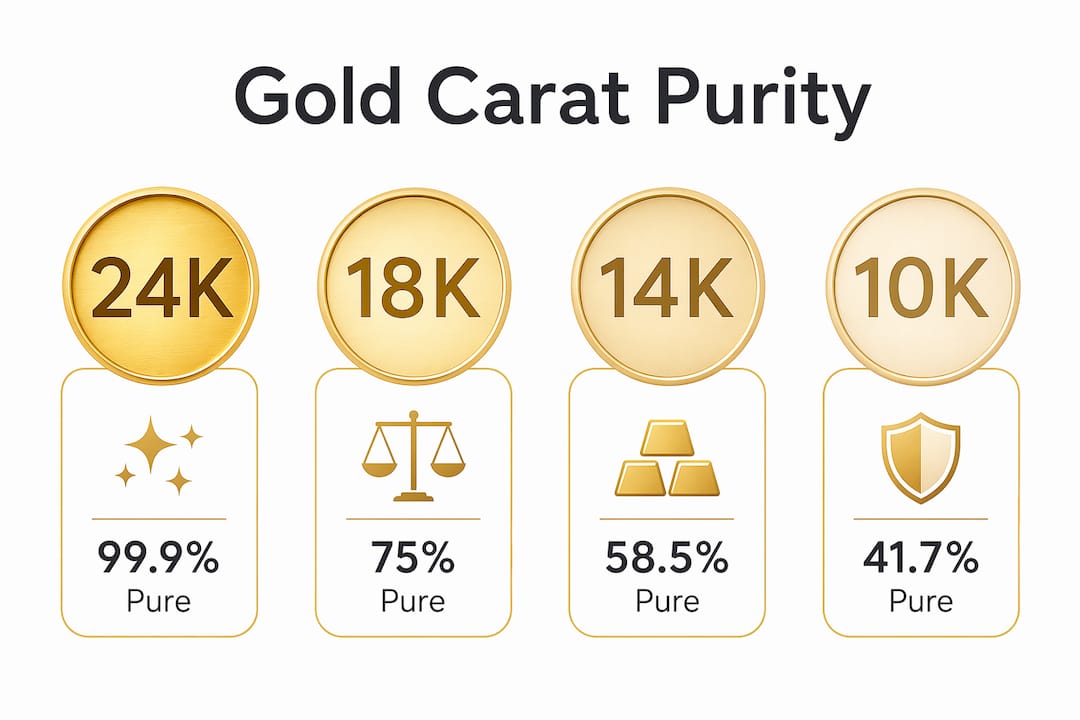
- 24K gold delivers the richest, deepest yellow color but dents and scratches easily. It is best reserved for ceremonial pieces or investment bars, not rings or bracelets worn every day.
- 18K gold contains 75% pure gold and strikes a strong balance between color richness and durability. It is the standard for fine jewelry in many European markets.
- 14K gold contains 58.5% pure gold and is the most popular choice in the United States for everyday jewelry. It resists scratching well and holds its shape under regular wear.
- 10K gold contains 41.7% pure gold and is the most durable option in the standard range. It is also the most affordable, making it a practical choice for high-contact pieces like bracelets and chains.
The alloy metals used also determine whether a piece becomes yellow gold, rose gold, or white gold. Rose gold gets its warm pink tone from a higher copper content. White gold is typically alloyed with palladium or nickel and often finished with a rhodium plating. This means two pieces with the same carat can look completely different depending on their alloy mix. Alloy selection and jewelry construction influence wearability as much as the nominal gold carat itself.
Pro Tip: If you plan to wear a piece every day, prioritize 14K or 10K gold. The lower alloy content does not mean lower quality. It means the piece is built for real life.
What are the common gold carat standards and purity percentages?
Understanding the specific purity percentages behind each carat level removes the guesswork from buying gold jewelry. The karat system uses a 24-part scale where 24K represents approximately 99.9% pure gold. Each step down from 24K reflects a higher proportion of alloy metals blended in.
Alongside the karat stamp, most gold jewelry also carries a millesimal fineness number. This is a three-digit figure that represents parts per thousand of pure gold. For example, 750 means 75% gold, which is the equivalent of 18K. Both systems are legally recognized and often appear together on a single piece.
| Karat | Purity (%) | Millesimal Fineness | Common Use |
|---|---|---|---|
| 24K | 99.9% | 999 | Bullion bars, investment coins |
| 22K | 91.6% | 916 | High-end jewelry, coins |
| 18K | 75.0% | 750 | Fine jewelry, engagement rings |
| 14K | 58.5% | 585 | Everyday jewelry (U.S. standard) |
| 10K | 41.7% | 375 | Affordable, durable jewelry |
Regional preferences vary significantly. In the United States, 14K is the dominant standard for retail jewelry because it balances cost, durability, and gold content well. In India and the Middle East, 22K is strongly preferred for its richer color and cultural significance. In the United Kingdom, 9ct gold marked 375 is legally recognized and widely sold, a standard that does not exist in the American market. Knowing these regional differences helps you interpret hallmarks on imported pieces and understand why the same carat may carry different price expectations in different markets.
How does gold carat influence value and investment potential?
The gold purity significance of a piece directly affects its price per gram and its long-term value. Higher karat gold costs more per gram because it contains a greater proportion of pure gold, which tracks the live spot price of gold on global markets. An 18K chain will cost more per gram than a 14K chain of identical weight, simply because it contains more actual gold.
That said, how gold carat affects value is not a one-variable equation. Consider these factors:
- Pure gold content is the baseline. A 10-gram piece of 18K gold contains 7.5 grams of pure gold. That pure gold weight is what determines its intrinsic, melt-down value.
- Craftsmanship and brand add margin. Two similar pieces can vary widely in price even at the same carat because design complexity, labor, and brand reputation all factor into the retail price.
- Bullion is valued differently than jewelry. A 24K gold bar or a 22K American Gold Eagle coin is priced almost entirely on its pure gold weight. Jewelry carries a fabrication premium that you do not recover at resale.
- 22K and 24K bullion coins with the same gold weight have comparable intrinsic value despite their purity difference. What matters for investment purposes is the stated pure gold weight, not the carat number alone.
For buyers focused on investment, professionals treat karat and fineness interchangeably for liquidity but focus on stated pure gold weight in valuation. For buyers focused on jewelry they will wear and enjoy, the carat choice is about finding the right balance of gold content, durability, and price for your lifestyle.
Practical tips for identifying and evaluating gold carat
Reading a gold piece correctly before you buy protects you from overpaying or purchasing something misrepresented. Hallmark stamps are the most reliable starting point. They are typically found inside ring bands, near clasps on necklaces and bracelets, or on the back of pendants. Hallmarks may be small and located in less obvious areas, so a jeweler’s loupe or a 10x magnifying glass is a practical tool to have when inspecting a piece.
The numbers to look for are the millesimal fineness stamps: 375 for 10K, 585 for 14K, 750 for 18K, and 999 for 24K. These appear alongside or instead of the karat stamp depending on where the piece was manufactured. A piece without a visible hallmark is not automatically fake. Older pieces, hand-crafted items, and some imported jewelry may lack stamps, but reputable retailers will provide documentation or certification to confirm purity.
Beyond the stamp, the gold jewelry value you receive depends on more than purity alone. Weight, construction quality, and the reputation of the seller all factor into whether a piece is worth its price. A well-constructed 14K chain from a trusted source will outlast and outperform a poorly made 18K piece from an unknown supplier.
Pro Tip: When buying online, always look for sellers who clearly state the karat, weight in grams, and millesimal fineness number. Bakergoldchains lists all three for every piece in its collection, so you know exactly what you are getting before you buy.
For a deeper look at reading stamps and confirming authenticity, the guide on authentic gold and hallmarks at Bakergoldchains walks through the full process step by step.
Key takeaways
Gold carat determines the proportion of pure gold in a piece and directly shapes its color, durability, price, and investment value.
| Point | Details |
|---|---|
| Carat measures purity | The 24-part scale defines how much of a piece is pure gold versus alloy metals. |
| Higher carat means richer color, less durability | 24K and 22K are vivid but soft; 14K and 10K are better suited for daily wear. |
| Hallmarks confirm purity | Look for stamps like 375, 585, or 750 to verify the gold content of any piece. |
| Investment value tracks pure gold weight | Intrinsic value depends on grams of pure gold, not the carat number alone. |
| Price reflects more than purity | Craftsmanship, weight, and brand all affect the final cost beyond the carat level. |
What I’ve learned about choosing the right gold carat
Most people walk into a gold purchase thinking higher carat automatically means better. That assumption costs them. I have seen buyers choose 18K for a daily wear chain because it sounds more luxurious, only to find it scratched and misshapen within a year. The right carat for daily wear is the one that matches how you actually live, not the highest number on the tag.
My honest view is that 14K is the most practical choice for the majority of jewelry buyers in the United States. It holds up under real conditions, it contains enough gold to hold meaningful value, and it looks genuinely beautiful. For investment purposes, I would not buy jewelry at all. Bullion coins and bars in 22K or 24K serve that purpose far better because you are not paying a fabrication premium you cannot recover.
The one thing I would push back on is the idea that lower carat means lower quality. A well-crafted 10K piece built with quality alloys and solid construction will outlast a poorly made 18K piece every time. The carat tells you about purity. It does not tell you about the skill of the maker or the integrity of the build. Pay attention to both.
— Blayne
Shop gold jewelry with clear carat standards at Bakergoldchains
Bakergoldchains carries a curated selection of 10K, 14K, and 18K gold jewelry, each piece clearly labeled with its karat, millesimal fineness, and weight so you always know what you are buying. Every item is sourced from reputable U.S. suppliers and backed by a lifetime craftsmanship guarantee. If you want a piece that balances gold purity with real-world durability, the 14K graduated bead necklace is a strong starting point. It delivers 58.5% pure gold content in a design built to last. Free insured shipping applies to orders over $150, and flexible financing options are available at checkout.
FAQ
What does carat mean in gold jewelry?
Carat measures the proportion of pure gold in a piece on a 24-part scale. A 24K piece is approximately 99.9% pure gold, while a 14K piece contains 58.5% pure gold and the rest is alloy metals.
What is the difference between 10K, 14K, and 18K gold?
The key gold carat differences are purity and durability. 10K contains 41.7% gold and is the most durable for everyday wear. 14K contains 58.5% gold and is the U.S. standard for fine jewelry. 18K contains 75% gold and offers richer color with slightly less scratch resistance.
How do I find the carat stamp on a gold piece?
Hallmark stamps are typically located inside ring bands, near clasps, or on the back of pendants. Look for numbers like 375, 585, or 750, which represent 10K, 14K, and 18K gold respectively. A jeweler’s loupe makes them easier to read.
Does higher carat gold always mean higher value?
Higher carat gold contains more pure gold per gram, so it costs more per gram at purchase. However, the total value of a piece also depends on its weight, craftsmanship, and brand, not purity alone.
Is 24K gold a good choice for investment?
24K gold bullion bars and coins are the standard for investment because their value tracks the spot price of gold directly. For wearable jewelry, 24K is too soft for practical daily use and carries a fabrication premium that reduces its resale efficiency compared to bullion.

