

The Role of Hallmarking in Jewelry: A Buyer's Guide
Hallmarking is the independent, official certification of precious metal purity in jewelry, and it is the most reliable protection you have against buying misrepresented gold or silver. The role of hallmarking in jewelry goes far beyond a small stamped number. It creates a legally traceable chain of accountability from the manufacturer to your hands. Regulated by government-authorized bodies like assay offices and hallmark councils, hallmarking confirms that what a jeweler claims about a piece is actually true. Understanding how it works gives you real confidence when you spend money on gold.
What do hallmarks actually tell you about a piece?
A hallmark is not a single mark. It is a set of symbols, each communicating a specific fact about the jewelry. Knowing what each one means turns you from a passive buyer into an informed one.
The most important component is the fineness mark, which expresses metal purity as a number out of 1,000. Common fineness marks include:
- 375 = 9 karat gold (37.5% pure gold)
- 585 = 14 karat gold (58.5% pure gold)
- 750 = 18 karat gold (75% pure gold)
- 925 = sterling silver (92.5% pure silver)
These numbers come from verified purity standards and tell you exactly how much precious metal is in the piece. A mark of 750 on a chain means three-quarters of its weight is pure gold.
Beyond fineness, a complete hallmark typically includes an assay office mark showing where the piece was independently tested, and a sponsor or maker’s mark identifying the manufacturer. Registering a sponsor’s mark with an assay office legally binds the manufacturer to the piece, creating a traceable accountability chain. Some hallmarks also include optional date letters and metal symbols, though these vary by country and era.
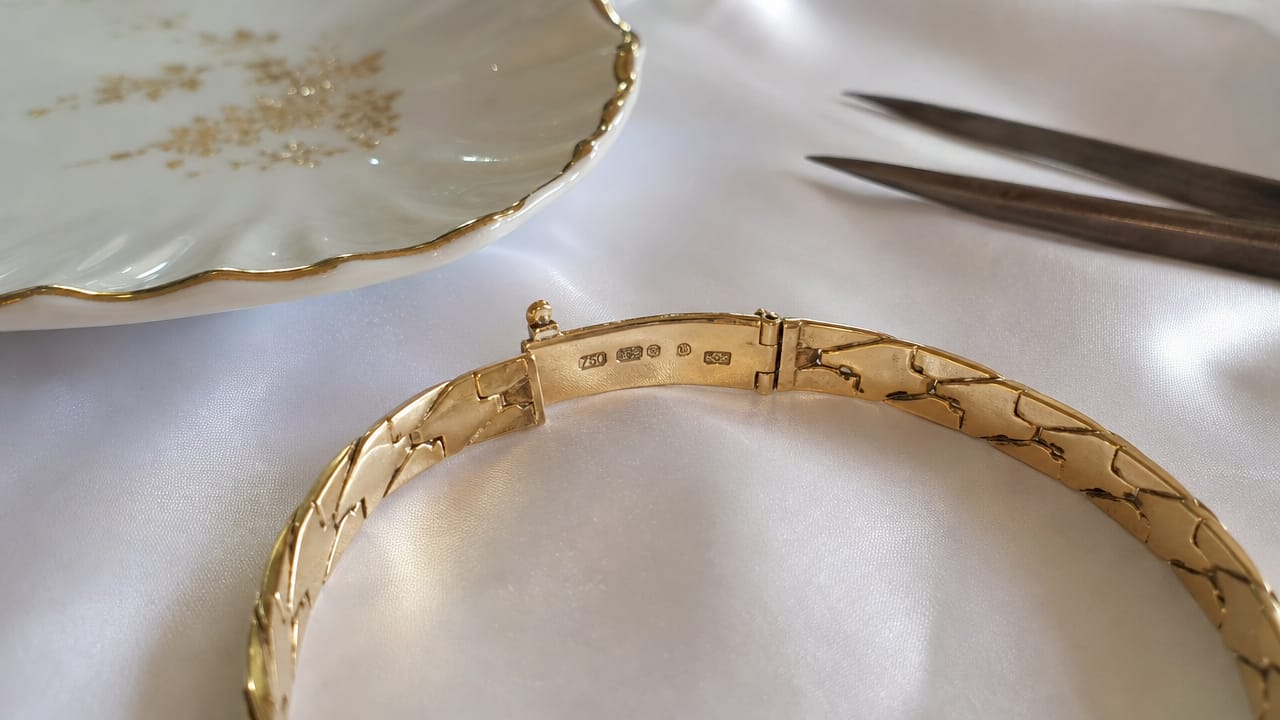
The critical distinction is between an official hallmark and a brand or workshop mark. Official hallmarks come from government-authorized assay offices after chemical testing. Brand marks are applied by the maker and carry no independent verification. A logo or brand name on a piece tells you who made it. A hallmark tells you what it is made of.
Pro Tip: When comparing two pieces at similar price points, always check whether the purity mark is an official fineness number like 585 or 750, or just a brand stamp. Only the fineness number from an assay office guarantees the metal content.
How do hallmarking regulations protect consumers?
Hallmarking regulations create legal teeth behind the certification process. Without them, sellers could stamp any number on a piece and face no consequences. With them, buyers have recourse and sellers have accountability.
The framework varies by country, but the core principle is consistent: independent testing before sale.
-
United Kingdom. The Hallmarking Act 1973 requires any precious metal item over 1 gram to carry an independent hallmark before it can be legally sold. This weight threshold is low by design. It means almost every gold ring, chain, or bracelet sold in the UK must be certified.
-
India. India’s Bureau of Indian Standards (BIS) runs a mandatory hallmarking program that now covers 380 districts. Since 2021, over 600 million gold items have been registered with unique six-digit alphanumeric HUID codes. That scale reflects how seriously the government treats consumer protection in the gold market.
-
United States. The Federal Trade Commission (FTC) requires that karat stamps on gold jewelry be accurate, but the US does not mandate third-party hallmarking the way the UK does. This means American buyers carry more responsibility for verifying claims themselves.
-
International recognition. Some countries participate in the Vienna Convention on hallmarking, which allows mutual recognition of marks across member states. This simplifies cross-border jewelry purchases, though coverage is not universal.
The consequence of buying non-hallmarked jewelry in a regulated market is significant. You have no independent proof of metal content. If the piece turns out to be gold-plated brass, you have little legal standing. A hallmark gives you documented evidence of what you paid for. That matters for insurance, resale, and simple peace of mind.
How can you verify a hallmark when buying jewelry?
Knowing hallmarks exist is one thing. Finding and reading them on an actual piece is another. Here is how to do it practically.
Where to look:
- On rings, check the inside of the shank (the band that circles your finger).
- On necklaces and chains, look near the clasp or on a small attached tag.
- On bracelets, check the inner surface or near the fastening.
- On pendants, look on the back of the piece or on the bail (the loop connecting it to the chain).
A magnifying glass or jeweler’s loupe (10x magnification) makes reading small marks much easier. Many jewelers will let you examine a piece before purchase.
Spotting genuine marks versus superficial ones:
Laser-etched brand marks are superficial and can be removed during refinishing or polishing. Official hallmarks are struck deeply into the metal and are designed to survive normal wear. If a mark looks faint, flat, or disappears under light, treat it with skepticism.
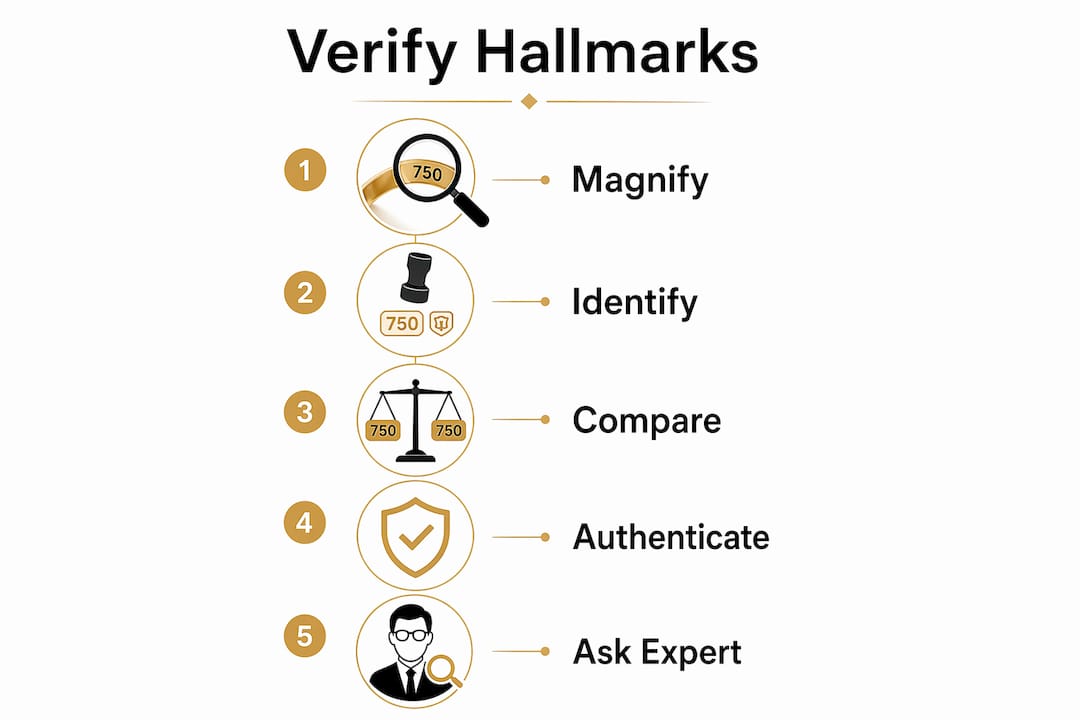
Watch out for marks like “GP” (gold plated) or “GF” (gold filled). These indicate only a surface coating of gold over a base metal. They are not hallmarks. They tell you the piece is not solid gold.
Using digital tools:
India’s BIS CARE mobile app lets you verify HUID codes instantly by entering the six-digit alphanumeric code on the piece. This kind of digital verification is a significant step forward for consumer confidence. You can confirm purity, the assay center, and the jeweler’s registration in seconds.
If you are unsure about a piece, a qualified jeweler or your nearest assay office can authenticate it. For a broader look at testing methods, Bakergoldchains covers gold purity verification methods that work alongside hallmark checks.
Pro Tip: Before buying any gold piece online, ask the seller for a close-up photo of the hallmark area. A legitimate seller will provide it without hesitation. If they cannot or will not, that is a clear red flag.
How do hallmarks affect provenance, history, and resale value?
A hallmark functions as a jewelry birth certificate, recording the maker, the assay office, and in many cases the date of manufacture. That information has real financial and historical value.
For antique and estate jewelry, date letters and assay office marks allow experts to pinpoint when and where a piece was made. A Georgian brooch with a complete London assay mark and date letter is verifiably 200 years old. Without those marks, it is just an old piece of jewelry with no documented history.
For insurance purposes, a hallmark gives appraisers an objective starting point. They can confirm the metal content independently rather than relying solely on the seller’s word. This makes appraisals more accurate and insurance payouts more defensible.
For resale, a complete hallmark increases buyer confidence and, therefore, price. A secondhand gold chain with a clear 585 fineness mark and maker’s stamp sells more easily than one with worn or missing marks. Buyers know what they are getting.
“Hallmarks are not just quality stamps. They are permanent records that connect a piece of jewelry to its origin, its maker, and its moment in time. For collectors and appraisers, that record is often as valuable as the metal itself.”
One practical concern: jewelry repairs that involve shank replacement can destroy the original hallmark area. Always ask your jeweler to preserve the hallmark when significant work is done. If the mark is lost, the piece loses its provenance documentation, which affects both its story and its resale value. You can learn more about protecting your investment at Hermj’s guide on shopping for jewelry safely online.
Key Takeaways
Hallmarking is the single most reliable way to verify precious metal purity in jewelry, and understanding it protects both your money and your long-term investment.
| Point | Details |
|---|---|
| Hallmarks certify purity independently | Official marks come from assay offices after chemical testing, not from the seller. |
| Fineness numbers tell the full story | Marks like 585 (14K) and 750 (18K) confirm exact gold content in every piece. |
| Regulations vary but the principle holds | The UK’s Hallmarking Act 1973 and India’s BIS system both enforce independent certification before sale. |
| Digital tools make verification easy | India’s BIS CARE app lets buyers verify HUID codes instantly on any registered gold item. |
| Hallmarks protect resale and insurance value | A complete hallmark provides documented provenance that appraisers and future buyers rely on. |
Why hallmarking still matters more than most buyers realize
I have spent years watching buyers focus on design and price while treating the hallmark as an afterthought. That is a mistake I see repeatedly, and it costs people real money.
The most common misconception I encounter is that a karat stamp from the jeweler is the same as an official hallmark. It is not. A jeweler’s stamp is a self-declaration. An assay office hallmark is an independent test result. The difference matters the same way a doctor’s diagnosis matters more than a self-diagnosis. You want someone with no financial stake in the outcome to verify the claim.
Digital hallmarking systems like India’s HUID program are genuinely changing the game for consumer protection. The ability to scan a code on your phone and confirm a piece’s purity in seconds removes a layer of trust that buyers previously had to extend on faith. I expect more markets to adopt similar systems over the next decade.
My practical advice: treat any piece without a verifiable hallmark as unproven. That does not mean it is fake. It means you cannot confirm it is real. For everyday purchases, that uncertainty is an unnecessary risk. For significant investments in gold, it is simply unacceptable. Bakergoldchains has a detailed guide on spotting fake gold chains that pairs well with what you now know about hallmarks.
— Blayne
Certified gold jewelry you can trust at Bakergoldchains
Bakergoldchains sources all its gold jewelry from reputable U.S. suppliers, with every piece made from solid 10K, 14K, or 18K gold. The purity is not a claim. It is built into the metal and backed by the karat standards you now know how to read.
The 14K yellow gold graduated bead necklace is a strong example of what certified quality looks like in practice. It is solid 14K gold, crafted for durability and everyday wear. Every piece at Bakergoldchains ships free with insurance on orders over $150 and comes with a lifetime craftsmanship guarantee. When you know what hallmarks mean, you can shop with the confidence that comes from understanding exactly what you are buying.
FAQ
What is jewelry hallmarking?
Jewelry hallmarking is the process of independently testing and certifying the purity of precious metals in a piece, then stamping it with official marks from a government-authorized assay office. It provides buyers with verified proof of metal content.
What does a 585 hallmark mean on gold jewelry?
A 585 hallmark means the piece contains 58.5% pure gold, which corresponds to 14 karat gold. This is one of the most common fineness marks on gold jewelry sold in the United States and Europe.
Is hallmarking required by law?
Hallmarking requirements vary by country. The UK’s Hallmarking Act 1973 requires independent hallmarking on precious metal items over 1 gram, while India mandates hallmarking with HUID codes across 380 districts. The US requires accurate karat stamps but does not mandate third-party hallmarking.
How do I tell a real hallmark from a fake one?
Genuine hallmarks are struck deeply into the metal and survive polishing and wear. Laser-etched or superficial marks fade easily and may disappear during refinishing. If a mark looks flat or faint under magnification, have the piece verified by a qualified jeweler or assay office.
Does a missing hallmark mean jewelry is fake?
A missing hallmark does not automatically mean a piece is fake, but it does mean purity is unverified. Older pieces may have worn marks, and some markets have weaker regulations. For any significant purchase, always seek independent verification of metal content before buying.

