

What is 14k gold: quality and durability guide
If you’ve ever looked at a piece of jewelry and wondered what that small stamp reading “14K” actually means, you’re not alone. Understanding what is 14k gold matters more than most buyers realize, because that number tells you exactly how much real gold you’re wearing, how durable the piece will be, and what you’re paying for. This guide breaks down the 14k gold definition, what the alloy metals do for your jewelry, how to read common markings, and how to shop with confidence so every purchase is one you’ll be happy with for years.
Table of Contents
- What does 14k gold mean? Understanding purity and karats
- Why 14k gold is popular for everyday jewelry: durability and affordability
- Decoding jewelry stamps: what 14K, 585, and other markings tell you
- How alloy metals affect 14k gold color and skin sensitivity
- Smart buying tips for 14k gold jewelry: what to look for and avoid
- A jeweler’s perspective: what 14k gold really means for quality and value
- Find your perfect 14k gold jewelry at Baker Gold Chains
- Frequently asked questions
Key Takeaways
| Point | Details |
|---|---|
| Purity scale defined | 14k means 14 parts gold out of 24, roughly 58.3% pure gold alloyed with other metals. |
| Durability advantage | 14k gold is stronger and more resistant to daily wear than higher-purity gold like 24k. |
| Markings explained | Jewelry stamped 14K, 14KT, or 585 indicate approximately the same gold purity level. |
| Alloy impacts color & skin | Variations in alloy metals determine 14k gold color and influence sensitivity for some wearers. |
| Buying smart | Verify markings, consider alloy composition, and choose reputable sources for quality 14k gold jewelry. |
What does 14k gold mean? Understanding purity and karats
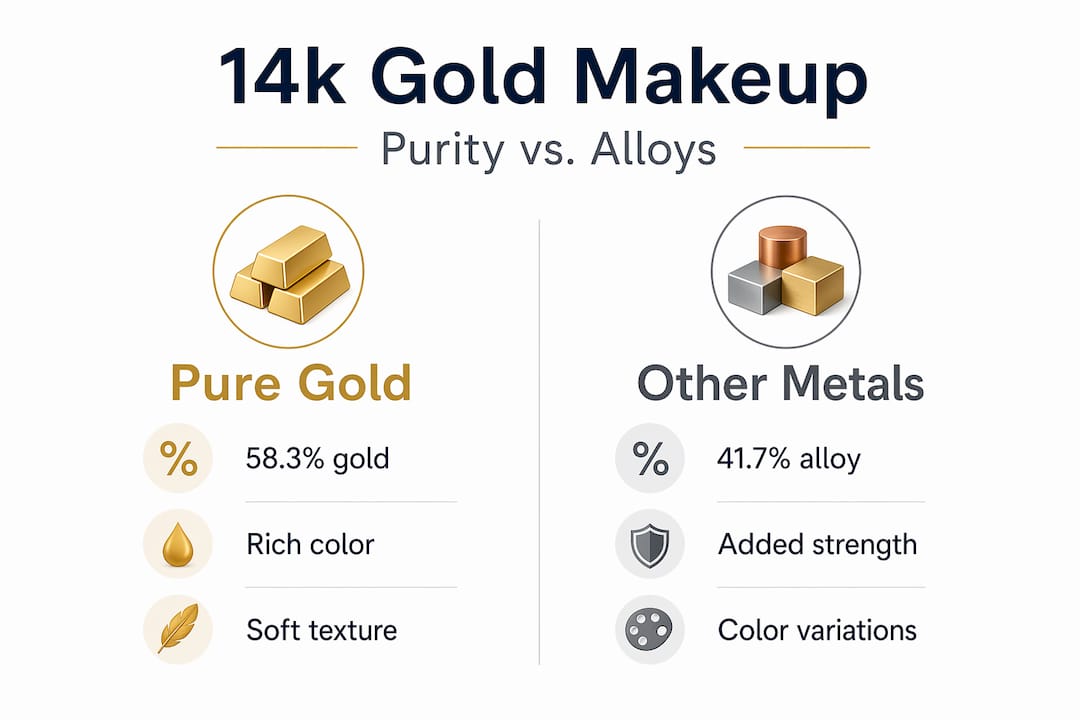
The karat system measures gold purity on a scale of 24 parts. Pure gold is 24 karats, meaning all 24 parts are gold. When you see 14k, that means 14 of those 24 parts are gold and the remaining 10 parts are other metals mixed in, called alloys. In plain terms, 14k gold is approximately 58.3% pure gold, with about 41.7% made up of other metals.
One thing worth clarifying right away: karat and carat are not the same thing. Karat (abbreviated K or KT) refers to gold purity only. Carat is a unit of weight used for gemstones like diamonds and rubies. Mixing these two up is one of the most common points of confusion for new jewelry buyers.
The 14k gold meaning goes beyond just a number. It signals a deliberate choice to create a practical alloy. The metals commonly blended with gold in 14k pieces include:
- Copper: Adds strength and warmth to color, used in yellow and rose gold alloys
- Silver: Lightens color and improves malleability
- Zinc: Improves durability and helps achieve lighter tones
- Palladium or nickel: Used in white gold alloys to achieve that silvery appearance
- Manganese: Sometimes added in small amounts for extra hardness
Each of these alloy metals serves a specific purpose, and their proportions determine everything from how hard the piece feels to what color it turns out to be.
Now that you know the basic meaning of 14k gold, let’s explore how its composition affects jewelry durability and appearance.
Why 14k gold is popular for everyday jewelry: durability and affordability
Pure 24k gold is genuinely beautiful, but it has a major problem: it’s soft. You can scratch it with a fingernail. That softness makes it impractical for rings, bracelets, or chains that go through daily use. 14k gold’s alloying with other metals is precisely what makes it practical for jewelry that experiences daily wear, giving it far greater resistance to scratching and damage than 24k ever could.

That’s why one of the key benefits of 14k gold is its balance between genuine gold content and real-world toughness. You get a piece that holds its shape, resists bending, and survives daily wear much better than higher-purity options. Daily wear gold jewelry specifically benefits from this balance because everyday activities put constant stress on fine jewelry.
The advantages of 14k gold also show up in price. Because it contains less pure gold by weight than 18k or 22k options, it typically costs less, making it accessible without sacrificing the look and value of real gold. That’s a meaningful advantage when you’re shopping for a substantial chain, a bracelet, or a gift piece where budget matters.
Here’s a quick look at why 14k gold suits everyday jewelry so well:
- Scratch resistance: Harder alloy metals make it significantly more durable than higher-karat options
- Shape retention: Holds up better under physical stress like wearing, clasping, and storing
- Lower price per gram: More affordable than 18k or 22k while still being genuine gold
- Wide availability: The most commonly produced karat in the U.S. market
- Color range: Available in yellow, white, and rose gold due to alloy flexibility
Pro Tip: If you wear your jewelry every day, including during activities like cooking, working, or exercising, 14k gold is worth choosing over 18k specifically because its hardness holds up better to friction and impact over time.
Having covered why 14k gold is defined the way it is, let’s look at the markings you’ll find on jewelry and what they mean for buyers.
Decoding jewelry stamps: what 14K, 585, and other markings tell you
When you flip a ring over or look at the clasp of a necklace, you’ll often find a tiny stamp. Knowing how to identify 14k gold starts with understanding what those stamps mean.
The most common marks you’ll see on 14k pieces include:
- 14K or 14KT: The straightforward karat stamp used widely in the U.S.
- 585: An international fineness mark indicating approximately 58.5% gold content
- 14K P: The “P” stands for plumb, meaning the piece meets or exceeds the stated gold content
- 14KGF: Gold-filled, meaning a layer of gold over a base metal — not solid 14k
The “585” fineness mark corresponds to 58.5% pure gold and is commonly treated as equivalent to 14-karat gold internationally. You’ll see this stamp frequently on European-made pieces, and it means the same quality level as 14K stamped jewelry. The small difference between 58.3% and 58.5% comes from rounding in different standardization systems and is not significant for buyers.
Here’s a comparison table to make sense of the most common stamps:
| Stamp | Gold content | Common use region |
|---|---|---|
| 14K or 14KT | ~58.3% gold | United States |
| 585 | ~58.5% gold | Europe and international |
| 14K P | 58.3% minimum guaranteed | United States |
| 14KGF | Thin gold layer only | Costume/fashion jewelry |
| 14K HGE | Heavy gold electroplate | Not solid gold |
The most important takeaway here is that 14K and 585 on jewelry both confirm genuine solid gold at roughly the same purity level. If a piece has no stamp at all, that’s a reason to ask questions before buying.
Understanding these marks helps you verify a piece’s gold purity, but the type of alloy metals also impacts the piece’s qualities.
How alloy metals affect 14k gold color and skin sensitivity
What is 14k gold made of beyond pure gold? The answer to that question directly determines the color of the piece you’re buying and how your skin will respond to wearing it. Different manufacturers use different alloy metals in 14k gold, and those choices determine whether you end up with yellow, white, or rose gold, as well as how the metal interacts with your skin.
Here’s how the main alloy variations break down:
- Yellow gold: A mix of gold, copper, and silver in balanced proportions, giving the classic warm tone
- Rose gold: Higher copper content creates that warm pinkish-red color
- White gold: Mixed with nickel, palladium, or zinc to produce a silver appearance, often plated with rhodium for a brighter finish
Skin sensitivity is a real consideration, especially with white gold. 14k gold is not automatically hypoallergenic just because of its karat level. The 14k purity alone doesn’t tell you whether the piece contains nickel, which is one of the most common causes of metal allergies. If you or the person you’re buying for has sensitive skin, always ask about the specific alloy composition, particularly in white gold pieces.
Yellow gold 14k tends to be the gentler choice for sensitive skin because it typically uses copper and silver rather than nickel. Rose gold is also generally well tolerated. White gold requires a closer look at what’s creating that color. Some white gold alloys use palladium instead of nickel, which is far less likely to trigger reactions. For solid gold jewelry benefits to show up fully, the alloy composition matters just as much as the karat stamp.
Pro Tip: If you’re gifting 14k white gold to someone with sensitive skin, look specifically for nickel-free alloys or pieces that use palladium as the whitening agent. Reputable sellers will be able to tell you what’s in the alloy.
Now that you understand the composition and markings, let’s examine how to use this knowledge when buying 14k gold jewelry.
Smart buying tips for 14k gold jewelry: what to look for and avoid
Knowing the 14k gold definition is only the first step. Using that knowledge to shop well is where it really counts. Here are the most important steps to take before and after you buy:
- Check for a karat stamp. Look for 14K, 14KT, or 585 on the piece. The stamp is usually inside a ring band, on a chain clasp, or on the back of a pendant.
- Ask about alloy metals. Especially for white or rose gold, confirm which metals are in the alloy, particularly if skin sensitivity is a concern.
- Buy from sellers with clear return policies. Authentic 14k gold pieces come with documentation, and reputable sellers stand behind their products.
- Consider getting an appraisal for high-value pieces. A certified jeweler can verify purity and give you peace of mind on significant purchases.
- Match the style to your lifestyle. Heavier, thicker chains and wider bands hold up better to daily use. Delicate styles are better suited for occasional wear.
It’s also worth knowing that the 14k number is a minimum gold content guide. Small variations exist due to manufacturing tolerances, but reputable producers aim to meet or slightly exceed the stamped purity. This is not a reason for concern with established jewelers, but it’s good context for understanding what the stamp actually guarantees.
For care, keeping your 14k gold jewelry clean is straightforward. A soft cloth and warm soapy water handle most everyday buildup. Store pieces separately to avoid scratching, and remove jewelry before swimming in chlorinated water, which can affect alloy metals over time. These small habits go a long way toward long-lasting gold jewelry.
With these tips, you can confidently shop and care for your 14k gold jewelry. Let’s now share a deeper perspective on the meaning and value of 14k gold.
A jeweler’s perspective: what 14k gold really means for quality and value
Here’s something most buyers don’t think about: choosing 14k gold over 18k isn’t a compromise. It’s often the smarter choice, and not just because of price.
When you wear a ring or chain every day, you’re putting it through constant friction, impact, and stress. Higher karat gold like 18k is genuinely beautiful and has more gold by weight, but that also means it’s softer. A 14k piece worn daily often outlasts an 18k piece simply because the alloy structure resists wear more effectively. The benefits of solid gold jewelry only show up fully when the metal is suited to how you actually wear it.
Purity stamps are also not absolute. A 14k stamp is a regulated minimum, not a precise laboratory measurement. The actual gold content in a stamped 14k piece can vary slightly between manufacturers. This doesn’t mean you’re being misled. It means that two 14k pieces from different makers may not be identical in gold content, alloy composition, or final durability. Reputable makers and suppliers consistently hit or exceed their stamp, which is one strong reason why buying from established, transparent retailers matters more than most buyers realize.
The 14k gold meaning, when you look at it from a craftsman’s point of view, is really about designed balance. It’s gold that has been made to perform. The alloy choices affect how the metal moves through a machine, how it holds a clasp, how it takes a polish, and how it feels against skin after years of wear. That level of intention is what separates a well-made 14k piece from a poorly made one, even when both carry the same stamp.
Find your perfect 14k gold jewelry at Baker Gold Chains
Now that you know exactly what makes 14k gold a practical, lasting choice, it’s time to find pieces that fit your style and stand up to daily life.
At Baker Gold Chains, every piece is made from solid 14k gold sourced from reputable U.S. suppliers. Whether you’re looking for a classic everyday necklace, a set of elegant hoops, or a bold chain that makes a statement, the quality is consistent and the purity is guaranteed. Check out the graduated bead necklace in 14k yellow gold for a timeless everyday look, the small wedding hoops in 14k yellow gold for a refined gift option, or the 14k yellow gold curb chain 4.40 mm for a durable, stylish everyday chain. Free insured shipping on orders over $150 and a lifetime craftsmanship guarantee mean you can buy with confidence.
Frequently asked questions
What does 14k mean on a gold ring?
14k indicates the ring contains 14 parts gold and 10 parts other metals, making it about 58.3% pure gold by weight. This is the most common purity level for solid gold rings sold in the United States.
Is 14k gold real gold?
Yes, 14k gold is genuine gold alloyed with other metals. It contains about 58.3% pure gold and 41.7% other metals, making it a durable and valuable choice for fine jewelry.
What is the difference between 14k gold and 585 gold?
Both mean the same purity level. The “585” fineness mark corresponds to about 58.5% pure gold and is the international way of expressing 14-karat gold purity, commonly used on European-made pieces.
Is 14k gold hypoallergenic?
Not automatically. 14k gold may contain nickel, especially in white gold alloys, so people with sensitive skin should confirm the alloy metals used before purchasing.
Can 14k gold jewelry be resized or repaired?
Yes. 585 gold, equivalent to 14k, can be resized and repaired by professional jewelers without losing quality or structural integrity, making it a practical choice for long-term ownership.

