

What Is Ethical Gold Sourcing? A Consumer's Guide
Ethical gold sourcing is the practice of obtaining gold through supply chains that meet verified social and environmental standards, protecting human rights, labor conditions, and ecosystems at every stage. The industry uses the term “responsible gold sourcing” interchangeably, though the two concepts differ slightly: ethical sourcing focuses on social principles like labor rights, while responsible sourcing emphasizes environmental protection. Certifications like Fairtrade, Fairmined, and the Responsible Jewellery Council (RJC) set the benchmarks that separate genuine ethical claims from marketing language. For consumers buying gold jewelry, understanding what is ethical gold sourcing means knowing which certifications matter, how to verify them, and what questions to ask before you buy.
What certification standards define ethical gold sourcing?
Ethical gold sourcing requires supply chains to meet social and environmental standards verified by recognized certification bodies. No single global standard defines “ethical gold.” The industry relies on multiple voluntary frameworks, each varying in scope and rigor. The credibility of any ethical claim depends heavily on which framework and which refinery the supplier discloses.
The three most recognized frameworks are the Responsible Jewellery Council, Fairtrade Gold, and Fairmined.

Responsible Jewellery Council (RJC) operates two certifications. The Code of Practices (CoP) requires companies to adhere to social and environmental standards across their operations. The Chain of Custody (CoC) certification goes further, focusing on full traceability from mine to retailer. A key distinction: CoP certification does not mandate full chain traceability. A jeweler can hold CoP status without being able to tell you exactly where their gold was mined.
Fairtrade Gold and Fairmined both target artisanal and small-scale mining (ASM) communities. These certifications ensure improved conditions for mining communities and provide full chain of custody for ASM gold. Fairtrade focuses on a premium paid to mining cooperatives for community development. Fairmined emphasizes environmental and social standards at the mine site itself.
| Certification | Scope | Traceability | Community Focus |
|---|---|---|---|
| RJC Code of Practices | Company operations | Partial | No direct premium |
| RJC Chain of Custody | Full supply chain | Full | No direct premium |
| Fairtrade Gold | Artisanal miners | Full | Yes, community premium |
| Fairmined | Artisanal miners | Full | Yes, mine-site standards |
Pro Tip: Ask your jeweler which specific certification their gold carries. “We source responsibly” is a brand claim. “Our gold is Fairmined certified” is a verifiable product claim. These are not the same thing.
How do refiners ensure ethical gold sourcing in practice?
Refiners are the critical link between mines and jewelry manufacturers. Major refiners align protocols with OECD Due Diligence Guidance to identify and reduce human rights and conflict risks. Rand Refinery and Sibanye-Stillwater report 100% alignment with these standards through independent assurance. That level of accountability sets the bar for what responsible sourcing looks like at scale.
In practice, refiner due diligence includes several concrete steps:
- Supplier screening: Refiners verify the origin of gold before accepting it, checking against conflict-affected and high-risk area lists.
- Third-party audits: Independent assurance reports confirm that a refiner’s processes meet OECD and London Bullion Market Association (LBMA) standards.
- Origin verification: Refiners document the mine or country of origin for each gold lot, creating a paper trail that supports chain-of-custody claims downstream.
- Tracking technology: Some refiners use isotope analysis and blockchain-based provenance tools to establish where gold physically came from.
The artisanal and small-scale mining sector presents the biggest challenge. ASM operations often lack formal documentation, making origin verification difficult. Ethical sourcing has evolved into a core value proposition, with enhanced due diligence and tracking becoming industry non-negotiables. Refiners that hold LBMA Good Delivery accreditation are required to meet responsible sourcing standards as a condition of that status. For consumers, buying from jewelers who source from LBMA-accredited refiners provides a meaningful baseline of assurance.
Understanding retailer supply chain verification processes helps you ask better questions at the point of purchase.
What should consumers look for when verifying ethical gold claims?
Consumers struggle to independently assess ethical standards, which makes knowing the right questions critical. Studies show only a small fraction of jewelers can identify gold origins, mostly those selling Fairtrade or Fairmined gold. That gap means you cannot rely on a retailer’s general reputation alone.
Ethical gold claims exist on a spectrum, from unsubstantiated marketing statements to full third-party audited chain-of-custody evidence at the item level. Savvy buyers pay premiums only for verified proof. Use this five-step checklist when evaluating any ethical gold jewelry purchase:
- Name the framework. Ask which specific certification the gold carries: RJC CoC, Fairtrade, or Fairmined. A vague answer like “we care about sustainability” is not a certification.
- Request refinery disclosure. Ask which refinery processed the gold and whether that refinery holds LBMA accreditation or RJC CoC status. Reputable retailers can answer this.
- Demand item-level documentation. Brand-level sustainability claims do not prove a specific ring or chain is ethically sourced. Ask for product-level chain-of-custody records.
- Separate recycled gold from ethical mined gold. These are different claims with different impacts (covered in the next section). Do not accept one as proof of the other.
- Compare claim strength. A third-party audited certification outweighs a self-declared policy every time. If the retailer cannot point to an external audit, treat the claim as unverified.
Pro Tip: Check whether the jeweler’s website lists a named refinery partner. Retailers who source from reputable U.S. suppliers and can name them are demonstrating a level of transparency that generic “ethical sourcing” language cannot match.
Understanding jewelry transparency basics gives you the vocabulary to have these conversations confidently.
How do recycled, Fairmined, and Fairtrade gold compare?
The three main types of ethical gold each support different outcomes. Knowing the difference helps you choose based on what you actually value.
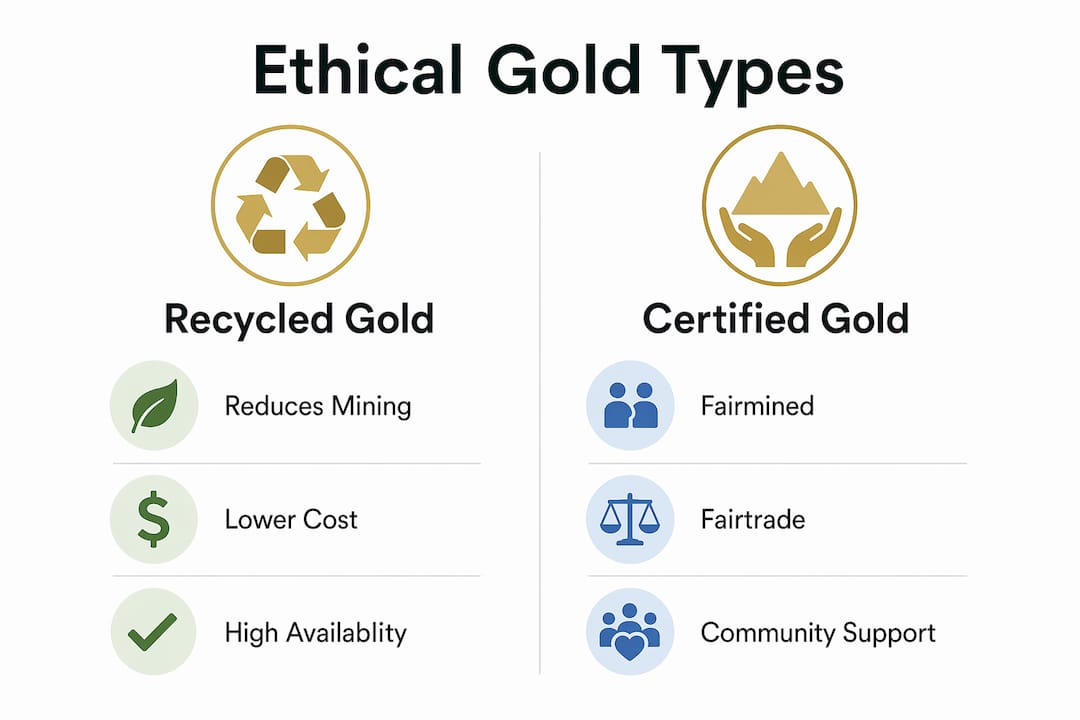
Recycled gold is gold recovered from existing products, electronics, or industrial scrap and refined for reuse. It reduces demand for new mining, which lowers the environmental footprint of new extraction. However, recycled gold does not inherently improve artisanal miner livelihoods or mining environmental standards. If supporting mining communities is your priority, recycled gold does not address that goal.
Fairmined gold comes from certified artisanal and small-scale mining operations that meet strict environmental and social standards at the mine site. The certification includes a premium that goes directly to the mining community for development projects. It also provides full chain of custody from mine to finished product.
Fairtrade gold operates similarly, with a focus on cooperatives and a Fairtrade premium paid to the mining organization. Both Fairtrade and Fairmined ensure full traceability for ASM gold and directly support the communities doing the mining.
| Gold Type | Environmental Benefit | Community Support | Full Traceability |
|---|---|---|---|
| Recycled gold | High (no new mining) | None direct | Varies |
| Fairmined | Moderate (standards at mine) | Yes, direct premium | Yes |
| Fairtrade | Moderate (standards at mine) | Yes, cooperative premium | Yes |
The trade-off is real. Recycled gold is often more available and lower cost. Fairmined and Fairtrade gold carry premiums because they fund community programs. Neither type is universally “better.” Your choice depends on whether you prioritize reducing new extraction or supporting mining communities directly. Understanding handcrafted jewelry traceability can also help you evaluate item-level sourcing claims when shopping for artisan pieces.
Key Takeaways
Ethical gold sourcing requires verified certifications, named refinery disclosure, and item-level chain-of-custody documentation. Generic sustainability claims are not a substitute for any of these.
| Point | Details |
|---|---|
| Certifications vary in rigor | RJC CoC, Fairtrade, and Fairmined each differ in scope and community impact. |
| Refiners set the baseline | LBMA-accredited refiners with OECD-aligned protocols provide the strongest sourcing assurance. |
| Recycled gold is not ethical mined gold | Recycled gold reduces new extraction but does not support artisanal mining communities. |
| Ask specific questions | Name the framework, the refinery, and request item-level documentation before buying. |
| Retailer knowledge gaps are common | Most jewelers cannot identify gold origins unless they sell Fairtrade or Fairmined certified products. |
Why ethical sourcing is the question every gold buyer should ask first
I have spent years watching the jewelry industry treat ethical sourcing as a marketing checkbox. That is changing, but not fast enough.
The uncomfortable truth is that most “ethically sourced” labels on jewelry are brand-level claims, not product-level proof. A company can publish a beautiful sustainability report and still be unable to tell you which refinery processed the gold in a specific chain. That gap is not a technicality. It is the entire problem.
What gives me confidence is the direction of travel. Ethical sourcing is becoming a non-negotiable industry standard, not a differentiator. Refiners with LBMA accreditation and OECD-aligned protocols are raising the floor for everyone in the supply chain. The frameworks exist. The auditing infrastructure exists. The remaining gap is retailer knowledge and consumer demand.
You close that gap by asking specific questions. Not “is this ethically sourced?” but “which certification does this gold carry, and which refinery processed it?” Those two questions separate retailers who know their supply chain from those who do not. The role of gold in fine jewelry is evolving, and sourcing transparency is now part of what defines quality.
My view: ethical sourcing will be the default expectation within a decade. The consumers who ask these questions now are the ones who push the industry to get there faster.
— Blayne
Gold jewelry with sourcing you can ask about
Bakergoldchains sources its gold jewelry from reputable U.S. suppliers and builds transparency into every purchase. That means you can ask about origins, materials, and quality standards and get a real answer.
The collection includes solid 14K gold pieces built for everyday wear and special occasions alike. The graduated bead necklace in 14K yellow gold is a strong example: solid gold construction, clear karat stamping, and sourced through verified U.S. supply channels. Every order over $150 ships free with insurance, and every piece carries a lifetime craftsmanship guarantee. Browse the full collection at Bakergoldchains and shop with the confidence that comes from knowing exactly what you are buying.
FAQ
What is ethical gold sourcing in simple terms?
Ethical gold sourcing means obtaining gold through supply chains that protect human rights, labor conditions, and the environment, verified by recognized certifications like Fairtrade, Fairmined, or the Responsible Jewellery Council.
Is recycled gold the same as ethically sourced gold?
No. Recycled gold reduces demand for new mining but does not support artisanal mining communities or improve mine-site standards, which is what most ethical sourcing programs specifically target.
Which certification provides the strongest ethical gold guarantee?
Fairmined and Fairtrade certifications provide the strongest guarantees for artisanal gold because they include full chain of custody from mine to retailer and a direct community premium. RJC Chain of Custody certification is the strongest option for large-scale mining supply chains.
How can I verify an ethical gold claim before buying jewelry?
Ask the retailer to name the specific certification, the refinery that processed the gold, and to provide item-level chain-of-custody documentation. A retailer who cannot answer these questions is relying on brand-level claims, not verified product-level proof.
What does the LBMA standard mean for gold buyers?
The London Bullion Market Association (LBMA) Good Delivery accreditation requires refiners to meet responsible sourcing standards as a condition of membership. Gold processed by an LBMA-accredited refiner has passed independent scrutiny, giving buyers a meaningful baseline of assurance.

