

What Is Jewelry Financing? Your 2026 Buyer's Guide
Jewelry financing is a payment method that lets you purchase jewelry by spreading the cost over time through installments or credit, rather than paying the full amount upfront. Instead of saving for months before buying an engagement ring, a solid gold chain, or a fine bracelet, you apply for a financing plan and pay in scheduled amounts. Common options include 0% APR credit cards, personal loans, store financing programs, and Buy Now, Pay Later services. Each option carries different terms, costs, and risks. Understanding those differences before you sign anything protects your budget and your credit.
What is jewelry financing and how does it work?
Jewelry financing is the industry term for any credit arrangement that lets you acquire a piece of jewelry today and pay for it over a set period. Stores and third-party providers both offer these programs, and the application process typically involves a credit check, approval decision, and a repayment schedule tied to the purchase amount.
There are six primary financing methods buyers use for jewelry purchases:
- Cash. No interest, no risk, no credit inquiry. The total cost is exactly the price tag.
- 0% APR credit cards. Promotional periods typically run 12–21 months. Pay the full balance before the period ends and you pay zero interest.
- Personal loans. Fixed monthly payments over 2–7 years. Annual percentage rates (APRs) range from 6%–36% depending on your credit profile.
- Jewelry store financing. Often structured as deferred-interest plans, not true 0% APR. More on the difference below.
- Buy Now, Pay Later (BNPL). Short-term installment plans, usually four equal payments spread over six weeks. No interest if paid on time.
- Cash advance apps. Small, short-term advances against your next paycheck. Useful for minor purchases but not practical for fine jewelry.
The table below shows how these options compare at a glance.
| Method | Typical term | Interest rate | Credit check required |
|---|---|---|---|
| Cash | Immediate | None | No |
| 0% APR credit card | 12–21 months | 0% if paid on time | Yes |
| Personal loan | 2–7 years | 6%–36% APR | Yes |
| Store financing | 6–18 months | Deferred (retroactive) | Yes |
| BNPL | 6 weeks typical | 0% if paid on time | Sometimes |
| Cash advance app | Days to weeks | Varies | No |
Choosing the right method depends on your credit score, the purchase price, and how quickly you can realistically pay off the balance.

What are the advantages and risks of each financing method?
Every financing method has a clear upside and a real downside. Knowing both before you commit saves you money and stress.
Cash carries zero financial risk. You pay the price, you own the piece, and no lender can charge you more later. The only downside is that it requires having the full amount available, which rules it out for many buyers looking at higher-value pieces.
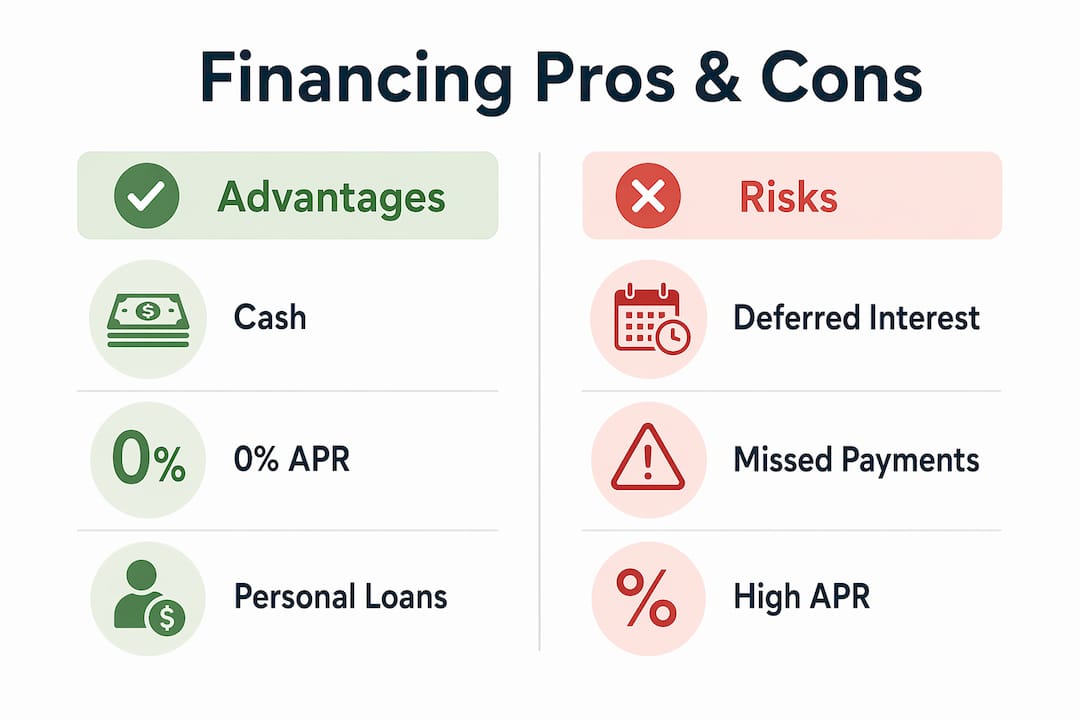
0% APR credit cards are the strongest option when used correctly. If you clear the balance before the promotional period ends, you pay exactly the purchase price and nothing more. The risk is missing that deadline. Once the promotional window closes, standard credit card APRs apply, which are typically well above 20%.
Store financing is where most buyers get surprised. Many store plans use deferred interest, not true 0% APR. The difference is significant. With deferred interest, if you carry any remaining balance when the promotional period ends, the lender charges interest retroactively from the original purchase date. That means months of interest you thought you were avoiding gets added to your bill at once.
Personal loans offer predictability. Fixed APRs between 6% and 36% mean your monthly payment never changes, which makes budgeting straightforward. Buyers with credit scores above 600 often qualify for rates lower than store card rates. The tradeoff is a formal credit inquiry and a longer approval process.
BNPL works well for smaller purchases. Equal installments with no interest make it simple, but a missed payment can trigger fees or higher rates that erase the convenience. Read the terms before you tap “confirm.”
Pro Tip: Ask the retailer directly: “Is this true 0% APR or a deferred-interest plan?” Those are two different things. Get the answer in writing before you sign.
Consumers frequently assume all promotional financing is true 0% interest. That assumption is the single most common and costly mistake in jewelry financing.
How do you evaluate a jewelry financing offer?
Evaluating a financing offer means looking beyond the monthly payment and calculating the total cost of ownership. A $200 monthly payment sounds manageable, but if the loan runs 24 months at 20% APR, you pay far more than the sticker price.
Follow these steps before accepting any financing plan:
- Calculate the total repayment amount. Multiply the monthly payment by the number of months. Compare that number to the cash price.
- Identify the plan type. Confirm whether it is true 0% APR or a deferred-interest plan. Ask for this in writing.
- Note the promotional deadline. Mark the exact date the promotional period ends on your calendar. Set a payment reminder two weeks before.
- Check for fees. Look for origination fees on personal loans, late payment penalties on BNPL, and annual fees on store cards.
- Review the return and exchange policy. Some retailers limit returns on financed purchases. Confirm the policy before you sign.
- Compare your credit options. If your credit score is above 600, a personal loan may offer a lower rate than store financing.
Hidden fees and deferred-interest penalties can increase your total payment well beyond the original price. Clear calculations prevent that outcome.
The table below contrasts two common scenarios for a $1,500 jewelry purchase.
| Scenario | Monthly payment | Term | Total paid |
|---|---|---|---|
| True 0% APR card, paid on time | $125 | 12 months | $1,500 |
| Deferred-interest store plan, balance remaining at end | Varies | 12 months | $1,500 + retroactive interest |
| Personal loan at 10% APR | ~$70 | 24 months | ~$1,680 |
The right choice depends on your ability to pay off the balance within the promotional window. If you are confident you can clear it, a 0% APR card wins. If you need more time, a fixed-rate personal loan gives you certainty.
Pro Tip: Use a free online loan calculator to enter the APR, loan amount, and term before you agree to anything. Seeing the total cost in dollars, not percentages, makes the decision much clearer.
You can also check the jewelry investment guide at Bakergoldchains for additional context on comparing financing options and avoiding misleading terms.
How does jewelry financing affect your budget and buying power?
Financing expands your purchasing power by letting you access higher-value pieces without depleting savings. A $2,000 gold chain that would take six months to save for becomes accessible today through a structured payment plan. That is the core appeal.
The practical effects on your monthly budget are real and require honest planning:
- Lower monthly payments free up cash for other expenses, but they extend the time you carry debt.
- Interest costs add to the total price of the piece, reducing its value as an investment.
- Credit inquiries from financing applications can temporarily lower your credit score by a few points.
- Missed payments on BNPL or store cards can trigger fees and damage your credit history.
Responsible use of jewelry installment payment plans means matching the repayment term to your actual cash flow. If your budget allows $150 per month, do not accept a plan that requires $250. The math has to work before you commit.
A practical budgeting approach is to treat the monthly payment like a fixed bill. Set up automatic payments to avoid missed deadlines. If you are using a 0% APR card, divide the total balance by the number of months in the promotional period and pay that exact amount each month. That method guarantees you clear the balance on time.
Pro Tip: Pair your financing plan with a small savings buffer. If an unexpected expense hits, you still have funds to cover your jewelry payment and protect your credit.
For buyers who prefer the convenience of online purchasing, the benefits of buying jewelry online include access to BNPL platforms and flexible payment options that many physical stores do not offer.
Key Takeaways
Jewelry financing gives you access to fine pieces today, but the total cost depends entirely on which plan you choose and how disciplined you are about repayment.
| Point | Details |
|---|---|
| Six main financing types | Cash, 0% APR cards, personal loans, store financing, BNPL, and cash advance apps each carry different costs. |
| Deferred interest is a trap | Store plans often charge retroactive interest if you carry any balance past the promotional deadline. |
| Personal loans offer predictability | Fixed APRs between 6% and 36% make monthly budgeting straightforward for buyers with credit scores above 600. |
| Total cost beats monthly payment | Always calculate what you pay in full, not just the monthly amount, before signing any financing agreement. |
| Automatic payments protect you | Setting up autopay prevents missed deadlines that trigger fees or retroactive interest charges. |
The financing mistake I see buyers make most often
Most buyers focus on the monthly payment and ignore everything else. That is the wrong lens. A low monthly payment on a deferred-interest plan can cost you significantly more than a slightly higher payment on a true 0% APR card or a fixed personal loan.
I have seen buyers walk into a jewelry purchase excited about a “no interest” offer, only to realize months later that they misread the terms. The plan was deferred interest, not true 0% APR. When they carried a small remaining balance past the promotional deadline, the lender charged interest retroactively from the original purchase date. The surprise bill was hundreds of dollars they did not plan for.
The fix is simple but requires discipline. Before you agree to any plan, write down three numbers: the total purchase price, the total amount you will repay, and the promotional deadline date. If those three numbers make sense together, proceed. If they do not, ask for a different plan or use a personal loan with a fixed rate.
Retailers are often willing to discuss financing terms. Ask questions. Request documentation. A good retailer will give you clear answers. One that deflects or rushes you past the fine print is a signal to slow down.
The best financing plan is the one that fits your real monthly budget, not your optimistic one. Be honest about what you can pay each month, build in a buffer, and choose the plan that gets you to a zero balance before any interest kicks in.
— Blayne
Fine gold jewelry at Bakergoldchains, with flexible payment options
Bakergoldchains carries solid gold pieces in 10K, 14K, and 18K gold, all sourced from reputable U.S. suppliers and backed by a lifetime craftsmanship guarantee. Financing options are available to help you manage the cost of higher-value purchases across the full catalog.
The Graduated Bead Necklace in 14K Yellow Gold is a popular choice for buyers using installment plans, offering timeless design at a price point that works well with a structured payment schedule. The 14k White Gold Trellis Diamond Engagement Ring is another strong option for buyers who want to spread the cost of a meaningful purchase over time. Free insured shipping applies to orders over $150, and every piece ships with full authenticity documentation.
FAQ
What is jewelry financing in simple terms?
Jewelry financing is a credit arrangement that lets you buy a piece of jewelry now and pay for it over time through scheduled installments. Options include credit cards, personal loans, store financing, and BNPL services.
What is the difference between 0% APR and deferred interest?
True 0% APR means no interest is charged during the promotional period. Deferred interest means interest accrues during the period and is charged retroactively if you carry any balance past the deadline.
Does jewelry financing affect your credit score?
Most financing applications require a credit inquiry, which can temporarily lower your score by a few points. Consistent on-time payments over the loan term can improve your credit history over time.
What financing option is best for an engagement ring?
A true 0% APR credit card is the best option if you can pay the full balance within the 12–21 month promotional window. A fixed-rate personal loan is the better choice if you need a longer repayment term and want predictable monthly payments.
How do I avoid unexpected costs with jewelry store financing?
Ask the retailer to confirm in writing whether the plan is true 0% APR or a deferred-interest plan. Set up automatic payments and mark the promotional deadline on your calendar to avoid retroactive interest charges.

