

What Is a Jewelry Guarantee? Your Rights Explained
A jewelry guarantee is a written promise from a seller or manufacturer that your piece meets specific quality standards and is free from manufacturing defects. Most buyers never read the fine print until something goes wrong. Understanding what a jewelry guarantee covers before you buy protects your investment and saves you from costly surprises. This article breaks down legal protections, common coverage terms, key exclusions, and the difference between a guarantee and insurance so you can shop with confidence.
What is a jewelry guarantee and how does it work?
A jewelry guarantee is a seller’s formal commitment to repair or replace a piece if it fails due to defects in materials or craftsmanship. The guarantee can come from the manufacturer, the brand, or the retailer. It typically covers a defined period and requires proof of purchase to activate a claim.

The industry term you will also see is “warranty.” Guarantee and warranty are often used interchangeably in jewelry retail, but they carry the same core meaning: the seller stands behind the quality of what you bought. The key difference is that a guarantee is usually a broader promise of satisfaction, while a warranty is a more specific legal document outlining exact terms and conditions.
A lifetime craftsmanship guarantee is the strongest form of coverage a jewelry retailer can offer. It signals that the seller believes in the durability of their materials and workmanship over the long term. Bakergoldchains offers this type of guarantee on its solid gold pieces, reflecting its commitment to authentic 10K, 14K, and 18K gold construction.
What legal protections apply when you buy jewelry?
Legal guarantees exist independently of any commercial warranty a retailer offers. The guarantee of conformity is a legal protection that automatically applies when you buy new jewelry. It requires that the item matches its description, is free from hidden defects, and meets the quality level a buyer would reasonably expect.
These legal protections are free, mandatory, and cannot be waived or replaced by a commercial warranty. If a retailer’s commercial warranty offers less protection than the law requires, the legal standard wins. That layered framework means you always have a baseline level of protection, even if the seller’s written warranty is limited.
Key legal protections to know:
- Guarantee of conformity: The item must match its advertised description and be free from undisclosed defects.
- Hidden defect coverage: If a flaw existed at the time of purchase but was not visible, you have a legal right to a remedy.
- No extra cost: Legal guarantees are automatic and require no additional payment.
- Proof of purchase: Your invoice is your legal evidence. An invoice as proof must include the date, seller details, buyer details, item description, and price to be valid for a claim.
- Industry standards: Gold jewelry sold in the U.S. must carry a karat stamp indicating purity, such as 10K, 14K, or 18K. That stamp is itself a form of quality guarantee backed by federal law under the National Gold and Silver Stamping Act.
Keeping your original invoice is not optional. It is the document that connects you to every protection you have, both legal and commercial. Store it digitally and in print.
What do typical jewelry warranties cover and exclude?
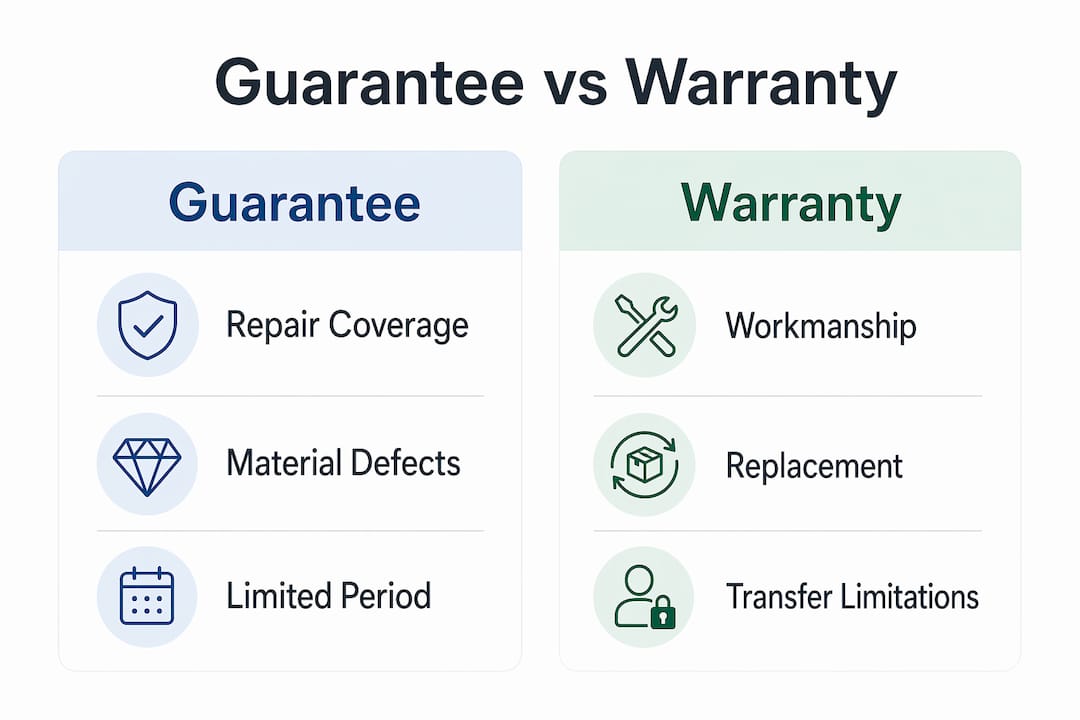
Jewelry warranties cover manufacturing defects and craftsmanship flaws as their primary focus. A stone that falls out because it was set improperly, a clasp that breaks due to a weak solder joint, or a chain link that separates from a structural flaw all fall under standard warranty coverage. Routine maintenance services like polishing and stone tightening are also commonly included.
What warranties do not cover is just as important to understand. Theft, loss, and accidental damage are excluded from virtually every jewelry warranty. Normal wear and tear, such as surface scratches on a gold band worn daily, is also excluded. Damage caused by unauthorized repairs or improper cleaning voids most warranties immediately.
Common warranty exclusions include:
- Theft or loss of the piece
- Accidental damage from drops, impacts, or bending
- Normal wear and tear over time
- Damage from exposure to chemicals, including cleaning products
- Repairs performed by a jeweler not authorized by the original seller
- Resizing or alterations done without seller approval
Pro Tip: Before you buy, ask the retailer for a written list of warranty exclusions. If they cannot provide one, that is a red flag about the quality of their coverage.
The term “limited lifetime warranty” appears frequently in jewelry retail. Under federal guidelines, “limited lifetime” is a federally mandated label applied when a warranty does not meet the full consumer-friendly requirements of the Magnuson-Moss Warranty Act. It signals restricted coverage, not superior protection. Read the exclusions list carefully before assuming broad coverage.
Transferability is another common limitation. Most jewelry warranties apply only to the original buyer. If you sell or gift the piece, the new owner typically has no warranty rights. This matters for pieces purchased as long-term investments or heirlooms.
How do jewelry guarantees differ from jewelry insurance?
A warranty and an insurance policy protect against completely different risks. Warranties protect against defects; insurance protects against external events. Neither one replaces the other, and relying on only one leaves you exposed.
Here is a clear comparison of what each covers:
| Protection type | What it covers | What it does not cover |
|---|---|---|
| Jewelry warranty | Manufacturing defects, craftsmanship flaws, routine maintenance | Theft, loss, accidental damage, normal wear |
| Jewelry insurance | Theft, loss, accidental damage, mysterious disappearance | Manufacturing defects, routine maintenance |
A practical example makes this clear. If a prong on your diamond ring breaks because it was set too thin at the factory, your warranty handles the repair. If that same ring is stolen from your home, your warranty does nothing. Only insurance reimburses you for the loss.
Pro Tip: Contact your homeowner’s or renter’s insurance provider about adding a jewelry rider. Standalone jewelry insurance policies from specialty insurers are also available and often provide broader coverage than a standard home policy.
The role of a lifetime guarantee in jewelry is to give you confidence in the craftsmanship over the long term. It does not replace the need for insurance. The two work together: the guarantee covers what the maker is responsible for, and insurance covers what the world might do to your piece. Buyers who shop for gold jewelry online should set up both protections before the purchase arrives.
What warranty terms and pitfalls should you watch for?
The word “lifetime” in a jewelry warranty rarely means what buyers assume. “Lifetime” typically means the useful life of the product or the period during which the original owner possesses it, not the owner’s entire lifespan. A retailer can define “lifetime” as two years of normal use and remain within legal bounds if that definition appears in the warranty document.
A warranty exclusion review is a best practice that asks buyers to scrutinize warranty language for subjective terms before purchasing. Words like “normal wear” and “accidental damage” are interpreted differently by different retailers. One seller may cover a bent prong as a defect; another may classify it as accidental damage and deny the claim. Confirming the definitions in writing before you buy prevents disputes later.
Watch for these common pitfalls:
- Vague exclusion language: Terms like “misuse” or “improper care” can be applied broadly to deny claims.
- Inspection deadlines: Some warranties require you to bring the piece in for inspection within a set period, such as every 12 months, to keep coverage active.
- Proof requirements: Retailers may require original packaging, the original receipt, and documentation of all prior maintenance.
- Repair authorization: Using any jeweler other than the original seller for repairs can void the warranty entirely.
- Non-transferability clauses: Coverage ends the moment the piece changes ownership.
Confirming exclusions before purchase is the single most effective step you can take to avoid warranty disappointments. Ask the retailer to walk you through the exclusions list verbally, then get it in writing. A seller who is confident in their coverage will have no problem doing this.
Understanding jewelry authenticity standards also matters here. A karat stamp on a gold piece is a quality representation backed by law. If a piece is sold as 14K gold and tests otherwise, that is a legal violation, not just a warranty issue.
Key takeaways
A jewelry guarantee is only as strong as the terms behind it. Reading the exclusions list before you buy is the single most important step to protect your purchase.
| Point | Details |
|---|---|
| Guarantee vs. warranty | Both terms describe a seller’s promise to cover defects; read the specific terms for each. |
| Legal protections are automatic | The guarantee of conformity applies by law and cannot be removed by a commercial warranty. |
| Warranties exclude theft and loss | Insurance is required separately to cover theft, accidental damage, and mysterious disappearance. |
| “Lifetime” has limits | “Lifetime” typically means the product’s useful life or original ownership period, not the buyer’s lifespan. |
| Keep your invoice | A detailed invoice is your legal proof of purchase and activates both legal and commercial protections. |
Why I think most buyers get burned by the word “lifetime”
The biggest mistake I see buyers make is treating a “lifetime guarantee” as a blank check. They hear “lifetime” and stop reading. That word has been stretched so far in retail that it has almost lost its meaning. A warranty that covers the “lifetime of the product” can legally expire the moment a manufacturer decides the product’s useful life is over.
What actually matters is not the label but the exclusions list. I have reviewed warranty documents where “normal wear” was defined so broadly that a scratched clasp would be denied. That is not a guarantee. That is a legal disclaimer dressed up as a benefit.
My honest advice: treat every warranty as a starting point, not a finish line. Combine it with insurance, keep every receipt, and bring your fine jewelry in for inspection at least once a year. Proactive maintenance is the best way to keep a warranty valid and your jewelry in top condition. A seller who makes that process easy is one worth trusting.
Bakergoldchains’ lifetime craftsmanship guarantee is transparent about what it covers. That kind of clarity is what you should demand from any retailer before handing over your money.
— Blayne
Bakergoldchains’ guarantee-backed gold jewelry
Bakergoldchains backs every piece with a lifetime craftsmanship guarantee, covering defects in materials and workmanship on authentic 10K, 14K, and 18K gold jewelry. That commitment is built into every product, from solid gold chains to fine earrings and pendants.
The 14K yellow gold bead necklace is a strong example of that standard in practice: solid gold construction, clear karat stamping, and coverage you can verify before you buy. Bakergoldchains also offers free insured shipping on orders over $150 and flexible financing, so your purchase is protected from the moment it ships. Browse the full collection at Bakergoldchains and buy with the confidence that your coverage is spelled out clearly.
FAQ
What does a jewelry guarantee cover?
A jewelry guarantee covers manufacturing defects and craftsmanship flaws, such as broken clasps, loose stone settings, and structural failures. Routine maintenance like polishing and stone tightening is also commonly included.
Is a jewelry warranty the same as jewelry insurance?
No. A warranty covers defects in materials and workmanship, while insurance covers theft, loss, and accidental damage. You need both for complete protection.
What does “limited lifetime warranty” mean for jewelry?
“Limited lifetime” is a federally regulated term indicating that the warranty has restricted coverage and exclusions. It does not mean the warranty lasts your entire life or covers all damage.
Do I need to keep my receipt to use a jewelry guarantee?
Yes. Your invoice is legal proof of purchase and is required to activate both commercial and legal warranty protections. A valid invoice must include the purchase date, seller details, item description, and price.
Can I transfer a jewelry warranty to someone else?
Most jewelry warranties are non-transferable and apply only to the original buyer. Confirm transferability in writing before purchasing a piece you plan to gift or pass on as an heirloom.

