

Why Choose Authentic Jewelry: Benefits That Last
Counterfeit jewelry has become convincingly realistic. The plating is smoother, the clasps feel sturdier, and the price tags are designed to make you feel like you found a deal. But understanding why choose authentic jewelry goes far beyond spotting a fake. It is about knowing what you are actually buying, how it will perform on your skin and in your life, and whether the piece holds any real value five years from now. This article covers the foundations of authenticity, the practical benefits of genuine jewelry, and how to verify what you are buying before you spend a dollar.
Table of Contents
- Key takeaways
- Why choose authentic jewelry
- Real benefits of genuine jewelry
- Ethical sourcing and sustainability
- How to verify authenticity when buying
- My perspective on buying authentic
- Shop authentic gold jewelry at Bakergoldchains
- FAQ
Key takeaways
| Point | Details |
|---|---|
| Hallmarks confirm material integrity | Look for stamps like 14K, 750, or .925 to verify genuine metal content before purchasing. |
| Authentic jewelry lasts and stays safe | Real precious metals resist tarnish and avoid skin reactions caused by cheap nickel alloys. |
| Provenance adds measurable value | Documentation including certificates and appraisals directly increases resale and insurance value. |
| Ethical sourcing is part of authenticity | Traceable supply chains and conflict-free materials are markers of genuinely authentic pieces. |
| Verification protects your investment | Professional appraisals and certification checks are the most reliable tools a buyer has. |
Why choose authentic jewelry
The word “authentic” gets used loosely in retail, but in jewelry it has a specific meaning. An authentic piece is made from the materials it claims to use, assembled with genuine craftsmanship, and supported by documentation that traces its origin. That is a higher bar than most fast-fashion accessories ever clear.
Material integrity is the starting point. Authentic sterling silver is 92.5% silver and 7.5% copper, which gives it durability and makes it safe for sensitive skin when it is nickel-free. Gold-plated pieces, by contrast, use a base metal coated in a thin layer of gold that wears off within months. The difference between wearing solid 14K gold and wearing brass with a gold coat is not just cosmetic. It affects how the piece ages, how it feels, and whether it causes a reaction on your skin.
Hallmark stamps are the fastest verification tool you have access to. Common hallmarks include 916 for 22K gold, 750 for 18K, 585 for 14K, and 999 for 24K pure gold. Stamps like these are regulated in most countries and represent a maker’s legal declaration of metal content. If a piece has no stamp, that absence is a red flag.
Craftsmanship indicators tell another part of the story. Artisan pieces show subtle tool marks and surface variations that machines cannot replicate. Collectors specifically look for those slight irregularities as proof that a human hand was involved in making the piece. Mass-produced jewelry, by contrast, is perfectly uniform in a way that signals factory output rather than skilled work.
Provenance ties everything together. Reliable sellers provide paperwork linking pieces to specific mines, batches, or studios. That paper trail transforms a beautiful object into a verifiable asset.
Pro Tip: When buying gold, always ask for the karat stamp location before you look at it yourself. A seller who knows their product will point you there immediately. Hesitation is informative.
Real benefits of genuine jewelry
The advantages of authentic jewelry become clearest when you think about long-term wear. A genuine gold chain you buy this year should still look sharp in ten years. A plated alternative will likely be showing its base metal within twelve months of regular wear.
Here is what genuine materials actually deliver:
- No tarnish from genuine metals. Solid gold does not oxidize the way plated or base-metal jewelry does. You will not find green marks on your skin or a dull gray patina forming on a piece of real 14K gold.
- Skin safety. Many counterfeit and fashion jewelry pieces use nickel as a base metal. Nickel is a common cause of contact dermatitis, particularly with prolonged wear. Authentic precious metals do not carry that risk.
- Resale and investment value. Original grading, appraisals, and service documents are critical when you decide to sell. Without documentation, a buyer has no way to verify what they are purchasing, and your asking price drops accordingly.
- Timeless styling over trend-chasing. Fine chains, discreet motifs, and smaller stones create a refined aesthetic that holds up across decades, while oversized or flashy styles tied to a specific trend feel dated quickly.
“Authentic jewelry is not just about what it looks like today. It is about what it still looks like in twenty years, and what it is still worth.”
The emotional dimension matters too. A handcrafted piece carries the story of its maker in a way that a factory-stamped accessory never can. Collectors value subtle engraving variations and hand-shaped settings as signs of authenticity. That individuality is part of why real jewelry matters to people who wear it daily.
Ethical sourcing and sustainability

Authenticity is not only about the metal. Increasingly, buyers want to know where materials came from and who made them. That information is now a meaningful part of a piece’s identity and value.
Here is how to think about the ethical side of an authentic purchase:
- Ask about conflict-free sourcing. Reputable jewelers will disclose whether their diamonds and colored stones come from certified conflict-free sources. If a seller cannot answer that question, that tells you something.
- Look for recycled precious metals. Recycled gold and silver carry the same quality as newly mined materials with a significantly lower environmental footprint. Many authentic jewelers now specify this on their product pages.
- Verify traceability claims. Traceability, supply-chain audits, and fair-trade relationships are markers that distinguish genuine ethical sourcing from vague marketing language. Ask for specifics.
- Consider vintage and estate jewelry. Buying pre-owned authentic pieces is one of the most sustainable choices you can make in the jewelry category. No new mining required, and the piece already has a documented history.
Pro Tip: Be skeptical of terms like “eco-friendly” or “sustainably sourced” without any supporting documentation. These phrases cost nothing to print on a website. Certificates and audit trails cost something, which is why legitimate sellers actually provide them.
Supporting independent artisans sustains craft culture and delivers authenticity beyond the product itself. When you buy from an artisan jeweler, you are funding a skill set that takes years to develop. That investment in human craft is worth recognizing. Handmade jewelry costs 30-50% more on average but is valued for exclusivity, ethical sourcing, and superior craftsmanship that wears better over time.
How to verify authenticity when buying
Knowing why real jewelry matters is one thing. Knowing how to confirm you are actually buying it is what protects your purchase. These checkpoints apply whether you are shopping at a local jeweler, browsing online, or picking through an estate sale.
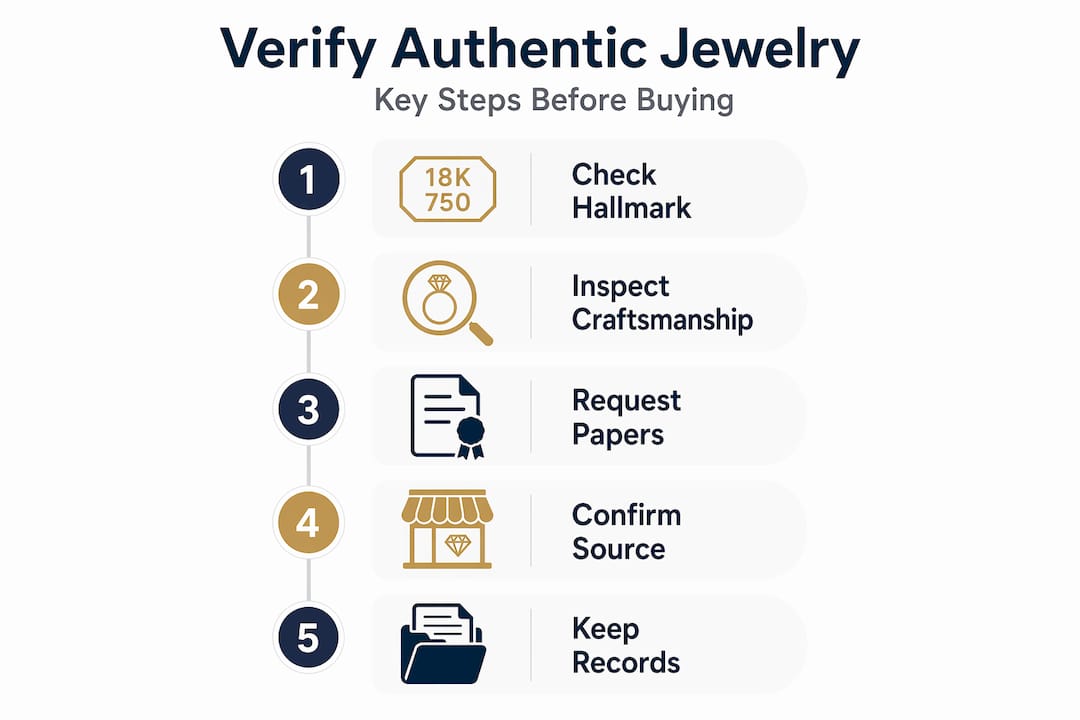
What to check before you buy
| Verification Step | What to Look For | Red Flag |
|---|---|---|
| Hallmark stamp | 585, 750, 916, .925, or 999 on the piece | No stamp, or stamp looks engraved after the fact |
| Certification | GIA, IGI, or AGS certificate for gemstones | Seller-issued certificates with no third party |
| Provenance documents | Receipt, appraisal, origin paperwork | No documentation available |
| Seller reputation | Established track record, transparent policies | Pressure tactics, no return policy |
| Physical inspection | Weight, texture, finish consistency | Unusually light piece, flaking or discoloration |
The hallmark check is your first move. Learn to recognize what the stamp locations look like on different jewelry types. Rings are typically stamped inside the band. Chains are often stamped on the clasp. Earrings carry stamps on the post or the back finding.
Requesting certification is non-negotiable for gemstones. A GIA report, for example, is issued by an independent lab and describes a stone’s cut, color, clarity, and carat weight. That report cannot be faked without detection.
Professional appraisals every 3-5 years help you stay current on market value and serve your insurance policy. An appraisal done independently of the seller carries far more weight than one the seller provides at the point of sale.
After the purchase, keep every document. The box, the certificate, the receipt, and any appraisal paperwork should be stored together. That file is what separates a piece with verifiable resale value from one that has only sentimental worth to you personally.
My perspective on buying authentic
I have spent years watching buyers make the same mistake. They find a piece that looks great, the price feels reasonable, and they skip the verification step because asking feels awkward. Then six months later, the piece starts turning colors or causes a skin reaction, and they realize they bought something hollow.
What I have learned is that authenticity is not about spending more money for the sake of it. It is about spending money once and knowing what you got. A solid 14K gold chain from a verified seller is something you wear for decades. A plated alternative is something you replace repeatedly, and each replacement costs you both money and time.
The misconception I see most often is that premium craftsmanship is only relevant to collectors or people buying engagement rings. That is not accurate. The same principles apply to a simple chain you wear every day. The quality of the alloy, the finish on the links, the strength of the clasp. Those details determine whether a piece lasts or fails.
My honest advice is to buy fewer pieces and buy them correctly. One authentic gold chain that you can verify, document, and wear for twenty years is worth more in every sense than a drawer full of fashion jewelry that you replace seasonally.
— Blayne
Shop authentic gold jewelry at Bakergoldchains
If this guide has given you clarity on what to look for, Bakergoldchains makes the next step straightforward.
Every piece in the Bakergoldchains catalog is made from solid 10K, 14K, or 18K gold sourced from reputable U.S. suppliers. Each item carries the karat stamp you need to verify authenticity on the spot. The 14K yellow gold bead necklace is a strong example of what genuine craftsmanship looks like in an everyday piece. For earrings, the 14K small wedding hoops offer the kind of clean, timeless design that holds its look and value over time. All orders over $150 ship free with insurance included, and every piece comes backed by a lifetime craftsmanship guarantee. If you want to go deeper before buying, the gold chain buying guide on the Bakergoldchains blog covers everything from karat selection to chain style comparisons.
FAQ
What makes jewelry authentically genuine?
Authentic jewelry is made from the materials it claims, carries verifiable hallmark stamps, and comes with documentation tracing its origin or certification from a recognized lab.
How do I identify a hallmark on gold jewelry?
Look inside the band on rings, on the clasp of chains, or on the post of earrings. Common gold hallmarks include 585 for 14K, 750 for 18K, and 916 for 22K gold.
Is authentic jewelry always worth more than fashion jewelry?
Over time, yes. Genuine precious metals hold or grow in value, resist tarnish, and do not cause skin reactions. Fashion jewelry depreciates quickly and typically cannot be resold at any meaningful price.
Why does provenance documentation matter?
Provenance paperwork, including receipts, certificates, and appraisals, is what allows you to prove what a piece is worth to an insurer, a buyer, or an appraiser. Without it, a piece’s value is unverifiable.
Can I verify authenticity without a professional?
You can do a first-pass check using hallmark stamps and a basic magnet test. However, a professional appraisal from an independent appraiser is the most reliable way to confirm both material content and market value.

