

Understanding Jewelry Metal Stamps: U.S. Buyer's Guide
A stamp like “14K” or “585” on a gold piece is a manufacturer’s purity claim, not an independent guarantee. In the United States, no government assay office verifies that claim before the piece reaches you. That means understanding jewelry metal stamps starts with one check: confirm the karat or fineness mark is paired with a maker’s mark or seller guarantee. Without both, you have a claim with no one accountable for it.
Before you buy or accept a piece, run through this quick checklist:
- Karat or fineness mark present? Look for 10K, 14K, 18K, or numeric equivalents like 417, 585, or 750.
- Maker’s mark visible? A registered trademark or manufacturer’s name should appear near the purity stamp, per FTC guidance.
- Seller documentation available? Ask for a written guarantee, assay report, or return policy.
- Visual inspection done? Use magnification to check font clarity, stamp depth, and placement.
Pro Tip: Bring a 10x jeweler’s loupe to the store. Shallow stamps on chains and clasps can be nearly invisible to the naked eye under normal lighting.
Table of Contents
- Purity stamps vs. hallmarks: what the difference means for U.S. buyers
- Common marks you’ll see on fine gold jewelry
- How to verify a metal stamp on a gold piece, step by step
- Red flags that suggest a stamp may not be trustworthy
- What to do if a piece appears mis-stamped
- Key Takeaways
- The stamp is only as good as the seller behind it
- Bakergoldchains makes stamp verification straightforward
- Useful sources and where to learn more
Purity stamps vs. hallmarks: what the difference means for U.S. buyers
Most people use “hallmark” and “stamp” interchangeably, but they describe two different things with different levels of accountability.
A purity stamp is applied by the manufacturer. It states the metal’s karat or fineness (for example, 14K or 585) and is essentially a self-reported claim. A maker’s mark is the manufacturer’s registered trademark or name, placed alongside the purity stamp to identify who made the claim. Together, these two marks are what the FTC’s Jewelry Guides (16 C.F.R. Part 23) expect to see on a piece sold as gold in the U.S.
A hallmark, in the strict sense, is something different: a mark applied by an independent assay office after third-party testing. This system is standard in the UK, France, and Italy, where government-authorized offices test and certify metal content before a piece can be sold. In the U.S., that system does not exist. American pieces carry manufacturer stamps, and accountability depends on the maker’s mark and the seller’s guarantee.
The FTC is clear on one point: calling a piece “gold” without a karat designation is prohibited. An FTC staff letter from August 2012 confirmed that using “gold” for products below 10K fineness, or without a karat qualifier, risks violating the Jewelry Guides.
The FTC’s Jewelry Guides require that any karat quality mark be accompanied by the manufacturer’s name or U.S. registered trademark. A purity claim without a maker’s mark leaves the buyer with no clear party to hold accountable.
- Purity stamp: manufacturer’s self-reported metal content (karat or fineness number)
- Maker’s mark: registered trademark identifying who stands behind the claim
- Hallmark: third-party assay office mark (common in UK/EU; rare in the U.S.)
- “Gold” alone, with no karat: prohibited under FTC guidelines
Pro Tip: When buying imported pieces, ask whether the piece carries an assay office mark from its country of origin. A UK piece with a lion passant mark has been independently tested; a U.S. piece has not.
Common marks you’ll see on fine gold jewelry
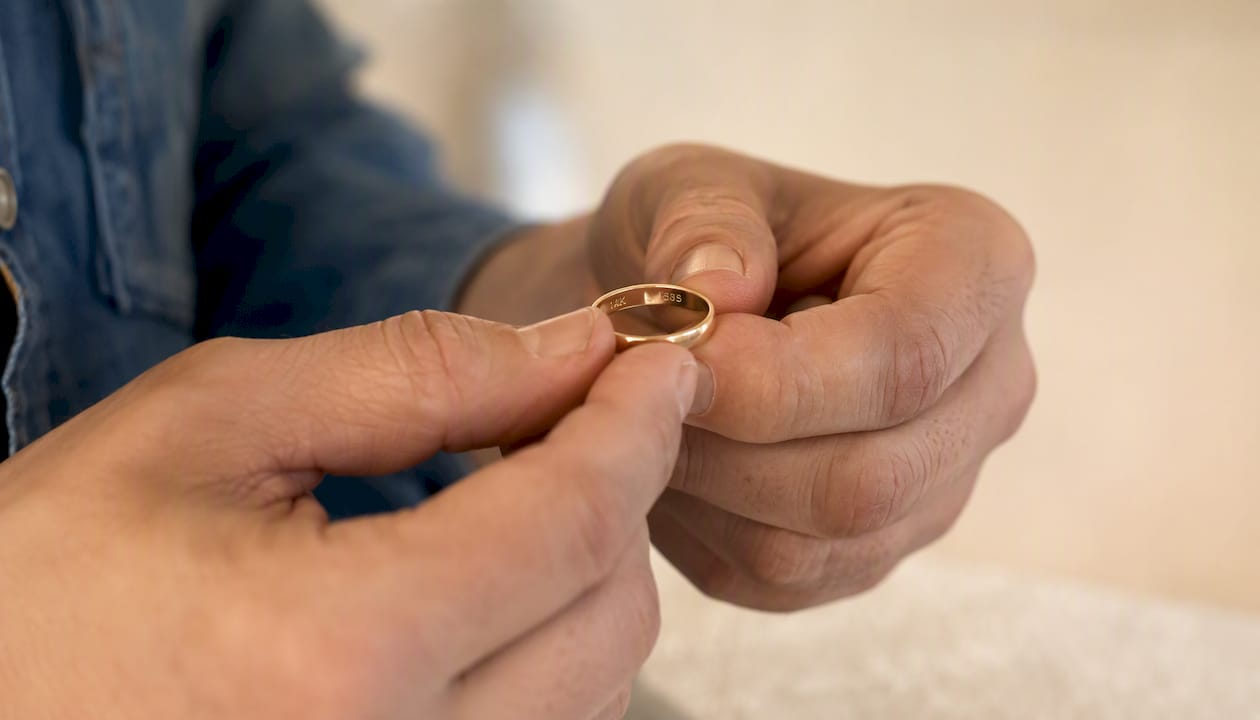
Knowing what each abbreviation actually means lets you read a stamp in seconds.
| Stamp | Karat | Gold Content | What It Means for You |
|---|---|---|---|
| 24K | 24K | pure gold | Pure gold; soft and rarely used for everyday jewelry |
| 750 or 18K | 18K | 75% gold | High purity; durable for fine jewelry |
| 585 or 14K | 14K | 58.5% gold | Most common in U.S. fine jewelry; good durability |
| 417 or 10K | 10K | 41.7% gold | Minimum karat to be sold as gold in the U.S. |
| GP or GEP | N/A | Gold plated | Thin gold layer over base metal; not solid gold |
| GF or 1/20 14K GF | N/A | Gold filled | Thicker gold layer bonded to base metal; more durable than plating |
| RGP | N/A | Rolled gold plate | Similar to gold filled; thinner layer than GF |
Plated and filled stamps matter because they signal construction, not composition. A piece stamped “GP” or “GEP” has a thin gold coating over a base metal core. “GF” pieces, often stamped with a fraction like 1/20 14K GF, have a thicker gold layer mechanically bonded to the base, making them more durable than plating but still not solid gold. Neither carries the same long-term value as a solid 14K or 18K piece.
Maker’s marks typically appear in the least visible spot on a piece: inside a ring band, on a clasp, or on a jump ring. That placement is intentional and standard. If you cannot find a maker’s mark at all, that absence is worth noting.
- On rings: inside the band, near the sizing area
- On necklaces and chains: on the clasp or a small jump ring near the clasp
- On bracelets: on the clasp or a link near the clasp
- On earrings: on the post or the back finding
How to verify a metal stamp on a gold piece, step by step
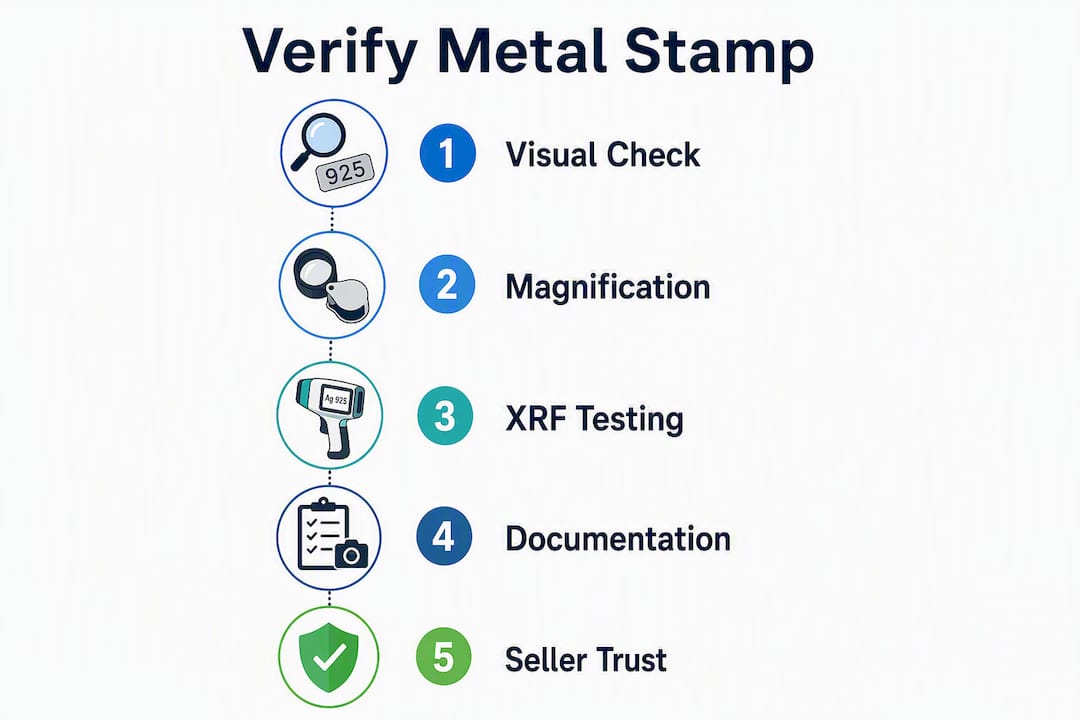
Verification does not require a lab. Start simple and escalate only if something looks off.
- Visual inspection first. Use a jeweler’s loupe under good lighting to check that the stamp font is clean and uniform, the impression depth is consistent, and the mark placement matches where you would expect it on that type of piece. Mismatched fonts or shallow, uneven impressions are a common red flag.
- Check weight and feel. Solid gold is dense. A 14K chain should feel noticeably heavier than a plated piece of the same size. If a piece feels light or hollow in a way that does not match the stamp, that is worth investigating further. See the gold jewelry weight guide for density expectations by karat.
- Magnet test. Gold is not magnetic. Hold a strong magnet near the piece. Any attraction suggests a ferrous base metal, which rules out solid gold regardless of the stamp.
- Ask for documentation. Before purchasing, request a written guarantee, return policy, and any assay or certification paperwork the seller holds.
- Jeweler acid test or XRF. If you want confirmation before a significant purchase, take the piece to a local jeweler. An acid spot test or XRF (X-ray fluorescence) scan typically involves a modest fee and gives you a reliable read on metal content without damaging the piece.
- Certified lab assay. For high-value pieces or when a dispute is involved, a certified assay provides documented proof of metal content. This takes longer and costs more than a jeweler test, but the written report is the strongest evidence you can hold.
| Verification Method | Typical Cost | Timeline | Best For |
|---|---|---|---|
| Visual inspection (loupe) | Free | Immediate | First check at point of sale |
| Magnet test | Free | Immediate | Ruling out ferrous base metals |
| Jeweler acid test or XRF | $20 | Same day | Confirming purity before purchase |
| Certified lab assay | Higher; varies by lab | Days to weeks | High-value pieces or disputes |
Pro Tip: Ask the seller to arrange or accompany you for an in-store XRF test. A seller who refuses to allow testing on a piece they claim is solid gold is telling you something important.
Red flags that suggest a stamp may not be trustworthy
Most mis-stamped pieces are caught by a combination of visual and physical checks. Watch for these warning signs.
- “Gold” with no karat designation — This is prohibited under FTC guidelines. Any piece labeled simply “gold” without a karat number should be treated with skepticism.
Pro Tip: If you spot a red flag at the point of sale, ask the seller directly for documentation before you pay. A legitimate seller will have answers. If they cannot provide a written guarantee or allow testing, walk away.
What to do if a piece appears mis-stamped
If you already own the piece or have just received it, here is how to escalate.
- Contact the seller immediately. Ask for the assay documentation, written guarantee, and return or refund policy. Put the request in writing (email is fine) and keep a copy.
- Document everything. Photograph the stamp under magnification, keep your receipt, and note the date and details of every conversation with the seller.
- Arrange an independent test. Take the piece to a jeweler for an XRF or acid test. For high-value pieces, a certified lab assay gives you a written report you can use as evidence. Maintain a clear chain of custody: do not leave the piece unattended during testing.
- Use the test results. If the results contradict the stamp, present them to the seller and request a refund. Most reputable sellers will resolve the issue at this stage.
- File a complaint if the seller refuses. You can report deceptive marking to the FTC online or to your state’s consumer protection office. Include photos of the stamp, your receipt, and the lab report.
- Keep all receipts and written communications
- Photograph stamps before and after any testing
- File complaints with both the FTC and your state attorney general’s office if fraud is suspected
- Check whether your credit card issuer offers purchase protection for disputed transactions
Key Takeaways
A jewelry metal stamp is a manufacturer’s purity claim, not a guarantee; pairing it with a maker’s mark and seller documentation is the most reliable protection for U.S. buyers.
| Point | Details |
|---|---|
| Stamp vs. hallmark | U.S. pieces carry manufacturer stamps; true third-party hallmarks are rare here. |
| FTC requirements | Every karat mark must be paired with a maker’s mark; “gold” alone without a karat is prohibited. |
| Common purity marks | 10K (417), 14K (585), 18K (750); GP/GF stamps indicate plated or filled construction, not solid gold. |
| Verification costs | Visual and magnet checks are free; jeweler XRF or acid tests typically cost $20. |
| Bakergoldchains approach | Bakergoldchains provides transparent karat labeling, maker’s marks, and a lifetime craftsmanship guarantee on all solid gold pieces. |
The stamp is only as good as the seller behind it
The most overlooked truth about jewelry metal stamps is that the mark itself proves nothing in isolation. A stamp can be applied to any surface. What actually protects you is the combination of the mark, the maker’s accountability, and the seller’s willingness to stand behind both.
Most buyers focus entirely on reading the stamp correctly, which matters, but they skip the second question: who is responsible if the stamp is wrong? In the U.S., without a mandatory assay system, the answer is the maker’s mark and the seller’s guarantee. That is why a reputable seller who offers written documentation, a clear return policy, and access to testing is a stronger protection than any stamp alone.
There is also a practical point that gets lost in most stamp guides: the condition of the stamp tells you as much as its content. A clean, deeply impressed, precisely placed mark on a well-finished piece is consistent with professional manufacturing. A shallow, slightly off-center mark on a piece with rough finishing is not. You are reading the whole piece, not just the number.
Bakergoldchains makes stamp verification straightforward
Solid gold jewelry should come with clear answers, not guesswork. Bakergoldchains carries 14K and 18K certified pieces with transparent karat labeling, maker’s marks, and product pages that detail metal content so you know exactly what you are buying before checkout.
Every piece comes backed by a lifetime craftsmanship guarantee, and the team can walk you through stamp verification or connect you with testing resources if you have questions after purchase. Free insured shipping applies to qualifying orders, and financing options are available. Browse the 14K yellow gold ring collection or reach out to customer service directly to request documentation on any piece before you buy.
Useful sources and where to learn more
- FTC Jewelry Guides — Summary of Basis and Purpose (August 2018): the primary regulatory document explaining how the FTC evaluates precious metal claims.
- 16 C.F.R. Part 23 — Guides for the Jewelry, Precious Metals, and Pewter Industries: the full federal regulation covering quality marks, karat designations, and plated/filled labeling requirements.
- FTC Consumer Advice: Buying Platinum, Gold, and Silver Jewelry: plain-language buyer guidance from the FTC, including what marks to look for and what questions to ask a seller.
- What Is Authentic Gold? Purity, Hallmarks, and Smart Buying — Bakergoldchains: Bakergoldchains’ own educational resource covering karat marks, hallmark differences, and practical buying steps.
- How to Verify Gold Purity: Methods That Actually Work — Bakergoldchains: detailed breakdown of XRF, acid testing, and lab assays with pros, cons, and cost context.
- The Role of Hallmarking in Jewelry: A Buyer’s Guide — Bakergoldchains: U.S.-focused explanation of the difference between manufacturer stamps and third-party hallmarks.
The FTC’s Jewelry Guides are the governing standard for gold labeling in the United States. When in doubt about a stamp’s legitimacy, the Guides and your state consumer protection office are your two most reliable starting points.

