

Gold Jewelry Weight Measurement Guide for Buyers
Gold jewelry weight measurement is the process of accurately determining how much a piece weighs and calculating its actual gold content using karat purity marks and standard unit conversions. Getting this right matters whether you are buying, selling, or appraising a piece. A 10-gram ring stamped 14K contains only 5.85 grams of pure gold. That gap between total weight and actual gold content is where buyers lose money. This guide covers the tools, steps, units, and calculations you need to measure gold jewelry weight with confidence.
1. Essential tools for accurate gold jewelry weight measurement
The right scale is the foundation of any gold jewelry weight measurement guide. A digital jewelry scale with at least 0.01g accuracy is the minimum standard for reliable results. Kitchen scales typically read to 1g or 0.1g, which is far too coarse for gold valuation work.
Key tools to have on hand:
- Digital jewelry scale: Look for models with 0.01g resolution and a tare/zero function. Brands like American Weigh Scales and Fuzion offer reliable options in the $15–$50 range.
- Calibration weights: A certified test weight set (typically 10g or 20g) lets you verify your scale reads correctly before each session.
- Small weighing container or tray: Use this with the tare function to hold small or unstable pieces without touching the scale platform directly.
- Jeweler’s loupe or magnifier: Helps you read faint karat stamps on clasps, inner bands, or chain links.
- Notepad or spreadsheet: Record each piece’s weight and karat separately to avoid mix-ups.
The tare function zeroes out the container weight so you measure only the jewelry. This is especially useful for small earrings or thin chains that shift on an open platform.
Pro Tip: Never use a postal scale or a kitchen scale for gold. The resolution is too low, and even a 0.5g error on a 5-gram piece creates a significant valuation mistake.
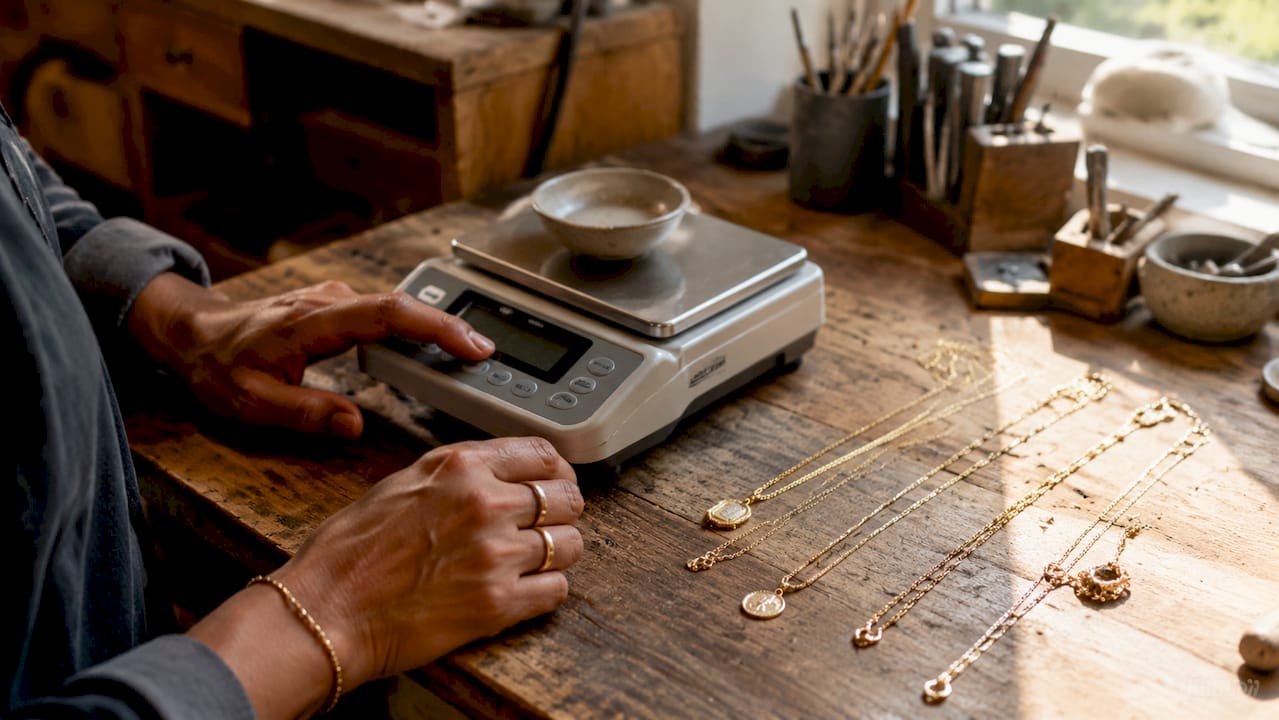
2. How to weigh gold jewelry correctly at home
Follow these steps in order. Skipping any one of them introduces error.
- Choose a stable surface. Place your scale on a flat, hard table away from fans, air vents, and open windows. Airflow causes fluctuations in sensitive scales, even at the 0.01g level.
- Power on and let the scale settle. Give it 30–60 seconds to stabilize before calibrating.
- Calibrate with a test weight. Place your certified calibration weight on the platform. If the reading does not match the known weight, adjust using the scale’s calibration mode.
- Tare the container. Place your small tray or container on the platform and press the tare button. The display should read 0.00g.
- Place the jewelry carefully. Set one piece at a time into the container. Wait for the reading to stop moving before recording the number.
- Record in grams. Grams are the standard unit for jewelry weight. Convert to troy ounces only when a buyer or appraiser requests it.
- Weigh each piece separately. Weighing multiple pieces together makes it impossible to account for different karat values.
- Apply the purity formula. Multiply the total weight by the purity percentage from the karat stamp to find actual gold content.
Pro Tip: Weigh each piece three times and average the results. If readings vary by more than 0.02g, recalibrate your scale before proceeding.
3. Understanding gold weight units and conversions
Gold is traded and valued using units that differ from everyday measurements. Mixing them up is a costly mistake.
| Unit | Abbreviation | Weight in Grams | Common Use |
|---|---|---|---|
| Gram | g | 1.000 g | Jewelry retail, most common |
| Troy ounce | ozt | 31.1035 g | Precious metals trading |
| Avoirdupois ounce | oz | 28.35 g | Everyday items, not gold |
| Pennyweight | dwt | 1.555 g | Antique jewelry, some appraisers |
| Carat (gemstone) | ct | 0.200 g | Gemstone weight only |
The troy ounce equals 31.1035 grams, which is the global standard for precious metal pricing. A troy ounce is about 10% heavier than a regular avoirdupois ounce at 28.35 grams. That difference sounds small, but it creates real valuation errors when buyers and sellers use different units without clarifying which one they mean.
Key conversion formulas to keep handy:
- Grams to troy ounces: divide by 31.1035
- Troy ounces to grams: multiply by 31.1035
- Grams to pennyweights: multiply by 0.6430
- Pennyweights to grams: multiply by 1.5552
Note that carat (ct) measures gemstone weight, not gold weight. Do not confuse it with karat (K), which measures gold purity. They are entirely different scales.
4. Calculating pure gold weight from total jewelry weight
Knowing the total weight of a piece is only half the picture. You also need to know how much of that weight is actually gold. That is where karat purity comes in.
The formula is straightforward: pure gold weight = total weight × purity percentage.
Common karat purity values:
- 24K: 99.9% pure gold (0.999)
- 18K: 75.0% pure gold (0.750)
- 14K: 58.5% pure gold (0.585)
- 10K: 41.7% pure gold (0.417)
A practical example: a 10-gram 14K gold ring contains 10 × 0.585 = 5.85 grams of pure gold. The remaining 4.15 grams is alloy metal such as copper, silver, or zinc. That pure gold weight calculation is what determines the melt value of the piece.
Gemstones and heavy clasps affect this calculation. A ring with a 1-carat diamond (0.2 grams) adds minimal error, but a large gemstone cluster can add several grams to the gross weight. Remove stones where possible, or ask an appraiser to estimate the stone weight separately. You can learn more about evaluating gold purity to verify that karat stamps are accurate before you run any calculation.
5. Common pitfalls to avoid when measuring gold jewelry weight
Improper scale calibration is the leading cause of inaccurate gold weight measurements at home. Calibrating once a week is not enough if you move the scale or change environments between sessions.
Watch out for these frequent errors:
- Weighing jewelry with gemstones attached. Non-gold parts like clasps and stones inflate gross weight and skew your pure gold calculation.
- Confusing karat with weight. Karat measures purity, not mass. Two rings of identical size but different karat ratings weigh differently because alloy metals have different densities.
- Skipping calibration before each session. Temperature changes and vibration shift scale readings. Always calibrate fresh.
- Measuring near air vents or open windows. Even gentle airflow causes the reading to fluctuate on a 0.01g scale.
- Trusting missing or worn purity stamps. A faded or absent karat stamp means you cannot calculate gold content reliably. Get the piece tested by a professional before valuing it.
- Disagreeing on units with buyers or sellers. Mutual agreement on grams versus troy ounces and gross versus net weight prevents disputes and ensures fair transactions.
For advanced validation, professional appraisers use density determination by weighing a piece in both air and water to confirm purity. This method requires specialized scale setups and is not practical at home, but it is worth knowing exists if you ever need a professional second opinion.
“Verifying purity marks is just as important as measuring weight. A perfectly weighed piece with an unverified stamp is still an unknown quantity.”
Key takeaways
Accurate gold jewelry weight measurement requires a calibrated 0.01g digital scale, correct unit conversions, and a purity-based calculation to determine true gold content.
| Point | Details |
|---|---|
| Use a 0.01g digital scale | Kitchen scales lack the resolution needed for reliable gold jewelry weight readings. |
| Calibrate before every session | Temperature and movement shift scale accuracy; always verify with a certified test weight. |
| Apply the purity formula | Multiply total weight by the karat purity percentage to find actual gold content. |
| Know your units | A troy ounce equals 31.1035 grams, not 28.35 grams; mixing them up causes valuation errors. |
| Account for non-gold parts | Gemstones and clasps inflate gross weight; remove or estimate them separately for accuracy. |
Why I trust the scale more than the stamp
The most common mistake I see buyers make is trusting the karat stamp and skipping the scale entirely. They assume the stamp tells the whole story. It does not. The stamp tells you the purity ratio. The scale tells you the mass. You need both numbers to know what you are actually paying for.
I have handled 14K pieces that weighed 30% less than expected because the design was hollow. The stamp was accurate. The weight was not what the buyer assumed. That gap cost them real money when they tried to resell.
My recommendation is to always weigh before you buy, not after. A calibrated American Weigh Scales pocket scale costs less than $20 and fits in a jacket pocket. Carry one. Use it. Cross-check the reading against the listed weight on any reputable retailer’s product page. If the numbers do not match within a reasonable margin, ask questions.
Purity stamp verification matters just as much. Learn to spot authentic karat marks and understand what the numbers mean before committing to a purchase. Small errors in weight or purity add up fast, especially on heavier pieces like chains and bracelets.
— Blayne
Bakergoldchains makes weight and purity easy to verify
At Bakergoldchains, every piece in the collection comes with clearly listed gold weight and karat information so you never have to guess what you are buying.

The Graduated Bead Necklace in 14K Yellow Gold is a strong example of this transparency in practice. Weight, karat, and dimensions are listed directly on the product page. Bakergoldchains sources all jewelry from reputable U.S. suppliers and backs every piece with a lifetime craftsmanship guarantee. Orders over $150 ship free with insurance included. If you want gold jewelry where the numbers are already done for you, the Bakergoldchains collection is the right place to start.
FAQ
What scale accuracy do I need to weigh gold jewelry?
A digital scale with at least 0.01g accuracy is the minimum for reliable gold jewelry weight readings. Scales with lower resolution cannot detect small weight differences that matter in valuation.
How do I calculate pure gold content from a karat stamp?
Multiply the total weight of the piece by the purity percentage for that karat. For 14K gold, multiply by 0.585; for 18K, multiply by 0.750.
What is the difference between a troy ounce and a regular ounce?
A troy ounce equals 31.1035 grams, while a regular avoirdupois ounce equals 28.35 grams. Always confirm which unit a buyer or seller is using before agreeing on a price.
Do gemstones affect gold weight calculations?
Yes. Gemstones add to the gross weight of a piece but contain no gold. Remove them when possible or estimate their weight separately to get an accurate pure gold figure.
How often should I calibrate my jewelry scale?
Calibrate your scale before every measurement session, especially if you have moved it or if the room temperature has changed since the last use.

