

Solid Gold Jewelry: What U.S. Buyers Need to Know
Solid gold means the piece is a gold alloy all the way through, not a surface coating over a base metal. For most U.S. buyers, that single fact changes everything about how long a piece lasts, whether it holds resale value, and whether it’s worth the price tag.
Quick decision guide:
- Buy solid gold (10K, 14K, or 18K) for daily wear, heirloom pieces, chains you’ll wear for years, and anything you want to resell or pass down.
- Buy gold-plated for trend pieces you’ll rotate out in a season or two.
- Check the karat stamp (10K, 14K, 18K) before you buy. No stamp, no deal.
- Bakergoldchains sources all pieces from U.S. suppliers and provides metal certification with every order, which is the kind of transparency the FTC expects from reputable sellers.
Table of Contents
- What does “solid gold” actually mean?
- How solid gold compares to gold-plated, gold-filled, and vermeil
- Which karat should you choose: 10K, 14K, or 18K?
- How to verify a piece is truly solid gold
- Your pre-purchase checklist for buying solid gold
- How U.S. pricing works and what resale value to expect
- How to care for solid gold so it lasts for decades
- Key Takeaways
- Why solid gold is the only choice for pieces that matter
- Bakergoldchains: solid gold chains and fine jewelry you can trust
- Useful sources and further reading
What does “solid gold” actually mean?
Solid gold means every part of the piece, from the surface to the core, is made from a gold alloy. There is no base metal underneath with a thin gold layer on top. The karat number tells you how much of that alloy is pure gold: 14K means 14 parts gold out of 24; 18K has a higher proportion of gold; 10K has the lowest gold content among these standards.
Pure 24K gold is too soft for everyday jewelry. Alloying it with metals like copper, silver, and zinc adds the hardness that lets a chain survive daily wear without bending or scratching. That’s why you’ll almost never see 24K in a chain or bracelet meant for regular use.
Common U.S. karat stamps and their gold content:
- 10K — 41.7% gold; marked “10K” or “417”
- 14K — 58.3% gold; marked “14K” or “585”
- 18K — 75% gold; marked “18K” or “750”
How solid gold compares to gold-plated, gold-filled, and vermeil
These are different products built for different jobs. Solid gold is for investment-quality, lifetime wear. Plated pieces are for affordable, trend-led style you plan to rotate.

| Type | Construction | Typical Lifespan | Resale Value |
|---|---|---|---|
| Solid gold | Gold alloy throughout | Decades with care | Yes, scrap/resale value |
| Gold-filled | Thick bonded layer | Intermediate lifespan | Minimal |
| Vermeil | Sterling silver base, gold layer | Moderate lifespan | Minimal |
| Gold-plated | Thin layer over base metal | Short lifespan | Essentially none |
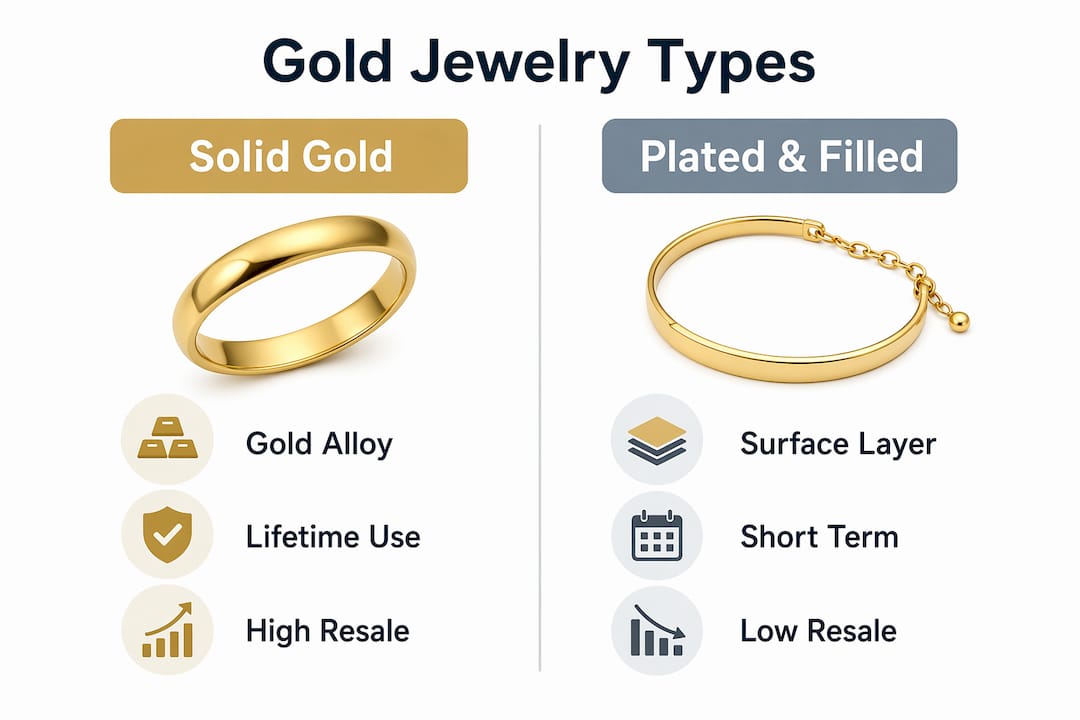
Gold-filled and vermeil sit in the middle: gold-filled has a thicker bonded layer and outlasts simple plating, while vermeil requires a sterling silver base, which resists skin reactions better than brass. If you want plated, choose a sterling silver base over brass or generic alloys. It tarnishes more slowly and is far less likely to cause irritation.
Pro Tip: Plated jewelry makes sense for fashion pieces you’ll wear for one season. For a chain, ring, or bracelet you plan to wear daily or gift to someone, solid gold is the only option that holds up and holds value.
Which karat should you choose: 10K, 14K, or 18K?
For most buyers, 14K is the sweet spot. It balances durability, color, and intrinsic gold content better than any other option for everyday pieces. That said, your use-case matters.
- 10K — 41.7% gold, most durable, most affordable, slightly paler yellow. Best for rings and bracelets that take daily abuse or for buyers on a tighter budget.
- 14K — 58.3% gold, strong alloy mix, warm yellow color. The recommended choice for daily-wear chains and staple pieces. Carries real resale value.
- 18K — 75% gold, richer color, softer feel, higher price. Best for heirloom rings or pieces worn occasionally rather than every day.
Higher karat means more pure gold and a deeper yellow tone, but also less hardness. A 24K chain would bend with minimal force. For a Cuban link or Franco chain you wear daily, 10K or 14K will outlast 18K in terms of scratch resistance.
Pro Tip: If you’re buying a chain for daily wear, 14K hits the right balance. If you’re buying a ring that takes more impact, 10K’s extra hardness is worth the trade-off in color.
How to verify a piece is truly solid gold
The three fastest checks are the hallmark, the weight in your hand, and the paperwork. Start there, then go deeper if the value is high.
Step-by-step verification:
- Read the hallmark. Use a loupe or magnifying glass to find the karat stamp (10K, 14K, 18K). Stamps like “GP” or “GEP” mean gold-plated, not solid.
- Check the weight. Gold is dense. A solid gold chain feels noticeably heavier than a plated one of the same size.
- Try the magnet test. Gold is not magnetic. If a piece pulls toward a strong magnet, there’s a base metal inside. This test rules out fakes but doesn’t confirm solid gold on its own.
- Request documentation. Ask for an invoice that lists karat and weight, or a metal certification. Reputable sellers provide this without hesitation.
- Get professional testing for high-value pieces. Acid testing or XRF analysis by a trusted jeweler gives you certainty no at-home check can match.
If a seller refuses to share documentation or can’t tell you the exact karat and weight, that’s a clear red flag. Learn more about spotting fake gold chains before you buy.
Your pre-purchase checklist for buying solid gold
If a listing or seller fails any of these checks, pause the purchase.
What to confirm before you buy:
- Karat and weight are clearly listed (not just “gold-tone” or “gold-colored”)
- Photos show the hallmark stamp clearly
- Seller provides metal certification or an invoice with karat and weight
- Return policy is stated and reasonable
- Lifetime craftsmanship guarantee is offered
- Shipping is insured (especially for orders over $150)
- Financing options are available if needed
- Product photos show actual measurements and chain width
Seller behaviors that build confidence:
- Third-party assay or grading documentation on request
- Transparent SKU details with metal specs
- Customer reviews that include photos of the actual piece
- U.S.-based supplier sourcing with clear provenance
How U.S. pricing works and what resale value to expect
Solid gold pricing tracks the spot price of gold by weight, but what you pay at retail also includes labor, design, and the seller’s markup. A 14K chain priced at $300 is not unusual for a lighter everyday piece; heavier or more intricate designs can reach $3,000 or more depending on karat and weight.
How the math works:
- Find the piece’s weight in grams.
- Multiply by the gold content percentage (e.g., 58.3% for 14K).
- Multiply by the current spot price per gram to get the raw metal value.
- The retail price will be higher than that raw value due to labor and design costs.
Gold-plated jewelry has essentially no melt or scrap value because the gold layer is too thin to recover. Solid gold, by contrast, can be sold to a refiner or resold as jewelry. That intrinsic value is one of the clearest reasons to choose solid gold for pieces you plan to keep long-term.
Spot gold prices shift with market conditions, so the raw metal value of your piece fluctuates. The craftsmanship and design premium you pay at retail does not recover at scrap, but the metal value does.
How to care for solid gold so it lasts for decades
Simple, consistent care keeps solid gold wearable for generations. You don’t need special products.
- Clean with mild soap and warm water, then dry with a soft cloth.
- Remove pieces before swimming in chlorinated pools or using bleach-based cleaners.
- Store chains flat or hung to prevent kinking and tangling.
- Polish occasionally with a jewelry polishing cloth to restore shine.
- Have prongs and solder joints checked by a jeweler every year or two, especially for rings and pendants.
Pro Tip: For chain links, run a soft toothbrush gently along the links to clear buildup in the joints. Thin chains are more vulnerable to kinking, so store them separately. If a link feels stiff or a clasp catches, take it to a jeweler before it breaks.
For a full step-by-step routine, the gold jewelry care guide at Bakergoldchains covers cleaning, storage, and when to seek professional maintenance.
Key Takeaways
Solid gold is the only jewelry material that combines lifetime wearability, authentic karat value, and real resale potential, making it the right choice for any piece you plan to wear daily or keep long-term.
| Point | Details |
|---|---|
| Solid gold is an alloy throughout | Every part of the piece contains gold, unlike plated items with only a surface layer. |
| 14K is the everyday standard | 14K balances durability, color, and intrinsic value for daily-wear chains and staples. |
| Verify before you buy | Check the hallmark, request metal certification, and get XRF testing for high-value pieces. |
| Plated jewelry has no scrap value | The gold layer is too thin to recover at melt; solid gold retains real metal value. |
| Bakergoldchains provides transparency | Every piece comes with metal certification, insured shipping, and a lifetime craftsmanship guarantee. |
Why solid gold is the only choice for pieces that matter
Most buyers come to this question thinking about price. That’s the wrong frame. The real question is: how long do you plan to wear this piece, and what happens to it after you?
A plated chain at $40 is a perfectly reasonable purchase for a trend you’ll move on from in six months. But if you’re buying a chain you’ll wear every day, a ring you’ll give as a gift, or a bracelet you want to pass down, plated jewelry will let you down. The gold wears through. The base metal shows. There’s no recovery at resale.
Solid gold doesn’t work that way. The metal value is real and present in every gram of the piece. The craftsmanship holds up to daily wear when you choose the right karat. And the piece can be resized, repaired, and handed on.
What most buyers underestimate is how much the seller matters alongside the metal. Transparent karat and weight listings, metal certification, a real return policy, and insured shipping are not extras. They are the minimum standard for a legitimate solid gold purchase. Any seller who hedges on those details is worth avoiding, regardless of how good the price looks.
Bakergoldchains: solid gold chains and fine jewelry you can trust
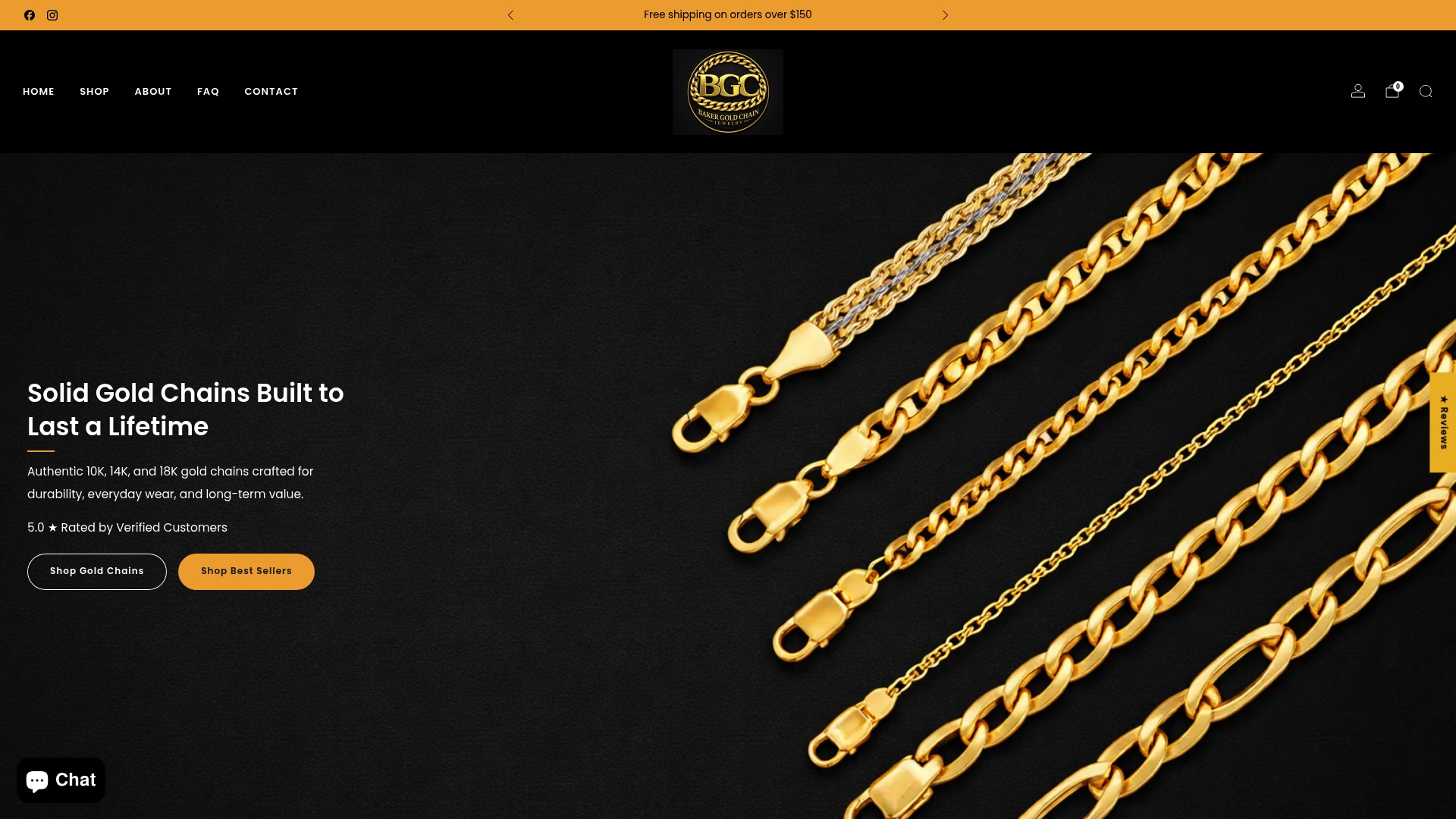
Bakergoldchains offers a focused selection of authentic 10K, 14K, and 18K solid gold chains, rings, bracelets, and pendants sourced from U.S. suppliers. Every piece comes with transparent metal certification, clear karat and weight listings, and a lifetime craftsmanship guarantee. Free insured shipping is included on qualifying orders, and financing options are available at checkout.
The Graduated Bead Necklace in 14K Yellow Gold is a strong example of what everyday solid gold looks like: clear karat documentation, a classic design that wears well daily, and the kind of craftsmanship that holds up over years. When your order arrives, verify the hallmark stamp and confirm the paperwork matches the listed karat and weight. That’s the final step every confident buyer takes.
Browse the full collection at Bakergoldchains and buy with the confidence that comes from knowing exactly what you’re getting.
Useful sources and further reading
- AJLuxe: Gold Plated vs Solid Gold — Covers construction differences, plating thickness, lifespan, and resale value comparisons.
- The Strategist / NYMag: Gold Plated vs. Vermeil vs. Solid Gold — Explains gold-filled and vermeil as intermediate options, with FTC context.
- Swashaa: Gold Plated vs Solid Gold — Expert perspective on karat durability and matching product type to buyer use-case.
- GLDN: 14K Solid Gold Jewelry — Retailer context for why 14K is the everyday standard for chains and staples.
- Bakergoldchains blog — In-depth guides on how to tell if a gold chain is real, choosing between solid and plated chains, and the gold chain buying guide.
For high-value purchases, always request assay documentation from the seller and confirm karat and weight against the invoice before finalizing the transaction.

